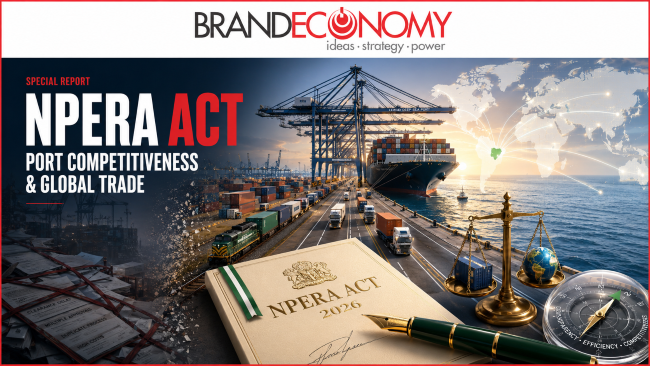
 President Bola Tinubu’s assent to the Nigerian Ports Economic Regulatory Agency Act, 2026, has resolved a long-standing legal question within Nigeria’s maritime industry. The Nigerian Shippers’ Council, which has operated for more than a decade as an interim port economic regulator, now has substantive statutory backing.
A considerably larger economic question, however, has only just opened: can the new regulatory framework make Nigerian ports competitive enough to attract shipping services, recover diverted cargo, accelerate non-oil exports and deepen the country’s participation in global trade?




That—not the creation of another federal agency—will be the true measure of the NPERA Act.
Dr Pius Akutah, Executive Secretary of the Nigerian Shippers’ Council, announced the presidential assent on his verified Facebook page on Thursday, thanking Tinubu for bringing the legislation into force.
Details of the commencement, transition and implementation framework remained sketchy at press time. The gazetted text and subsidiary regulations will be important in establishing the precise extent of the agency’s powers and the obligations facing port service providers.
The legislation nevertheless represents a potentially defining reform. It moves port economic regulation from the vulnerability of administrative policy into the stronger territory of primary law.
Closing a 20-year regulatory gap
Nigeria’s port concession programme of 2006 transferred cargo handling, terminal management and related investments to private operators under the landlord-port model.
The reform was intended to attract capital, modernise equipment, increase efficiency and reduce the financial burden on government. The Nigerian Ports Authority retained ownership and administration of port land and waters, responsibility for harbour and nautical services, infrastructure planning and oversight of concession agreements.
Private participation improved aspects of terminal operations, but the post-concession market lacked a fully empowered independent economic regulator.
The Nigerian Shippers’ Council, established in 1978 to protect the interests of importers and exporters, was designated interim port economic regulator in 2014. That position was reinforced by a presidential order and ministerial regulations issued in 2015.
The Council subsequently monitored tariffs, reviewed charges, mediated disputes and attempted to curb anti-competitive conduct. But it performed those functions with a statute designed for its older shipper-protection mandate rather than the complex commercial realities of concessioned ports.
Maritime expert Dr Eugene Nweke said the new Act should empower the regulator to supervise tariffs, rates, charges, competition, service-provider licensing and commercial dispute resolution, while imposing sanctions where necessary.
The legislative journey was not without difficulty. After passage by both chambers of the National Assembly, the Bill was returned by the President because some provisions conflicted with the Nigeria Tax Administration Act, 2025. The issues were corrected, and a harmonised version was passed in April 2026.
That legal review was useful. Regulatory legislation must not only express good intentions; it must fit coherently within Nigeria’s wider tax, competition, investment and commercial-law architecture.
What makes a port globally competitive?
Port competitiveness is often discussed as though it were simply a matter of tariffs. It is considerably broader.
Shipping lines and cargo owners evaluate the total performance of a trade corridor: channel depth, berth availability, crane productivity, vessel turnaround, cargo dwell time, Customs processes, documentation, security, road and rail connectivity, digital visibility and the predictability of charges.
A port may publish relatively low tariffs yet remain expensive because cargo spends too long in storage, trucks wait for days or importers must navigate multiple agencies. Conversely, a more expensive port may be commercially attractive if it provides speed, certainty and dependable vessel schedules.
Global port competition is consequently built on five connected assets: cost, time, reliability, connectivity and regulatory certainty.
NPERA can directly influence pricing transparency, service standards, market conduct and dispute resolution. It can create incentives for operators to improve. It cannot, acting alone, deepen channels, repair access roads, install Customs scanners or build rail connections.
Its success will therefore depend on whether it becomes an organiser of economic discipline across the port value chain rather than an institution that claims responsibility for functions it cannot deliver.
Nigeria’s scale advantage—and complacency risk
Nigeria possesses an enormous natural advantage: the largest domestic market in Africa and substantial demand for imported raw materials, consumer goods, machinery and energy-related cargo.
Nigerian Ports Authority figures indicate that total cargo throughput increased by 24.8 per cent to more than 129 million metric tonnes in 2025. In 2024, the country’s ports handled approximately 1.74 million twenty-foot-equivalent container units and recorded more than 4,000 ship calls.
These volumes should provide a foundation for a powerful regional maritime hub.
Market size, however, can also create complacency. A port serving captive domestic demand may continue receiving cargo despite poor service because businesses have limited alternatives. The commercial punishment for inefficiency then appears through higher consumer prices, reduced manufacturing competitiveness and cargo diversion rather than an immediate collapse in throughput.
Regional competitors such as Lomé, Tema and Cotonou are not waiting for Nigeria to complete its reforms. They compete for transshipment cargo, shipping-line calls and landlocked-country traffic through deeper channels, faster processing, stable operating rules and increasingly integrated logistics systems.
Nigeria must therefore move beyond assuming that its population automatically guarantees maritime leadership. Global shipping capital follows efficiency, not demographics.
The global-trade opportunity
The NPERA Act arrives at an important moment.
Nigeria launched the National Single Window in March 2026 to create a unified electronic platform for processing import and export documentation. The government’s objective is to reduce average cargo-clearance time from about 21 days to fewer than seven days.
That digital reform can simplify documentation, reduce repeated submissions and support risk-based clearance. NPERA can complement it by enforcing transparent tariffs, measurable service standards and fair commercial conduct.
Together, both reforms could reduce the cost of moving goods through Nigeria. That would have implications far beyond the waterfront.
Manufacturers would carry less emergency inventory. Importers would face lower exposure to demurrage and storage charges. Exporters could deliver agricultural and manufactured goods to vessels with greater certainty. Logistics businesses could plan capacity around more reliable cargo flows.
Efficient ports would also strengthen Nigeria’s position under the African Continental Free Trade Area. The country cannot become a continental manufacturing and distribution centre if its goods reach regional markets at uncompetitive logistics costs.
Ports are the physical gateways through which trade agreements become commercial reality. Tariff preferences mean little when delays, opaque charges and inefficient transport corridors erase the advantage.
Regulation must promote competition—not punish profit
The new agency’s most sensitive responsibility will be tariff regulation.
Port users understandably want lower charges. Operators, however, require sufficient revenue to maintain equipment, train personnel, expand capacity and recover substantial capital investments.
NPERA must avoid two extremes.
The first is regulatory weakness, under which service providers can introduce charges without adequate justification or exercise dominant positions against captive customers.
The second is populist price suppression, where tariffs are held below sustainable levels without considering inflation, exchange-rate movements, equipment costs, financing expenses and capital-recovery obligations.
Both outcomes damage competitiveness.
Effective economic regulation should distinguish between genuinely competitive services and areas where monopoly or dominant-market power exists. Strong intervention is most necessary where customers cannot reasonably switch providers. Where competition is effective, monitoring and disclosure may be more productive than direct price control.
Tariff approvals should be connected to performance. Operators requesting higher charges should demonstrate improvements in equipment availability, crane productivity, cargo dwell time, vessel turnaround and customer service.
Regulation should make poor performance expensive and excellent performance profitable.
One national system, different port markets
Nigeria’s port system is not a single homogeneous market.
Apapa and Tin Can Island serve dense commercial and industrial corridors but remain exposed to access and congestion pressures. Lekki Deep Sea Port offers modern infrastructure, greater depth and growing transshipment potential. Onne plays a strategic role in oil, gas and regional logistics. Warri, Calabar and Rivers ports have distinct geographic, industrial and hinterland opportunities.
NPERA should not impose a simplistic, uniform regulatory model across these different operating environments.
Tariff and service benchmarks must reflect cargo type, infrastructure, market concentration, capital investment and the degree of competition available at each port. Regulation should encourage competition between ports as well as among operators within them.
This creates an opportunity to develop a genuine national port network in which cargo is distributed according to commercial efficiency and geographic logic—not forced through Lagos because alternative corridors remain underdeveloped.
Preventing a collision of regulators
A major concern is the possibility of overlapping mandates.
The Nigerian Ports Authority remains responsible for port land, infrastructure, concessions, harbour operations and common-user facilities. The Nigerian Maritime Administration and Safety Agency regulates maritime safety, security, seafarers, labour and environmental compliance. The Nigeria Customs Service manages cargo clearance, duties and border enforcement.
The Federal Competition and Consumer Protection Commission also retains economy-wide competition responsibilities, while the Council for the Regulation of Freight Forwarding in Nigeria regulates freight-forwarding practice.
Hajia Bola Muse and other stakeholders have demanded clearer delineation to prevent regulatory conflict. That concern is justified.
If NPERA converts its economic-licensing powers into another layer of technical permits, fees and inspections, it could increase the very costs it was established to reduce.
The Federal Ministry of Marine and Blue Economy should publish an inter-agency mandate charter identifying the lead institution for every major function. Information submitted to one agency should, where lawful, be accessible to others through interoperable platforms.
Port users need one coordinated government interface—not multiple agencies asserting superiority over the same transaction.
Market and investor implications
For shipping lines, terminal operators, inland dry ports, freight forwarders, warehouse businesses and logistics-technology companies, NPERA could create a more disciplined market.
Transparent tariff rules and enforceable service standards should protect efficient operators from competitors that profit through opacity or regulatory connections. Faster dispute resolution could prevent commercial disagreements from trapping cargo and accumulating punitive charges.
For investors, the most valuable outcome would be predictability.
Several concessions created during the 2006 reform era have reached renewal or review stages. Investors need clarity on tariff adjustment, concession obligations, foreign-exchange indexation, capital recovery, licence renewal and appeal rights.
A competent regulator can reduce sovereign and regulatory risk, encouraging investment in terminals, cargo-handling equipment, rail links, barges, warehousing, cold chains and digital logistics.
A discretionary regulator can achieve the opposite. Retrospective decisions, unexplained tariff restrictions and institutional conflicts would raise the cost of capital and discourage long-term investment.
NPERA’s independence must consequently be demonstrated through transparent appointments, professional staffing, reasoned decisions, published procedures and an accessible appeal mechanism.
Brand implications
The Act presents an opportunity to rebuild the Nigerian port brand.
That brand will not be transformed by advertising slogans. It will be shaped by the experience of a manufacturer waiting for equipment, an exporter racing to meet a vessel, a shipping line calculating port-call costs and an investor assessing regulatory risk.
Nigeria’s ports must come to signify speed, transparency and certainty.
For NPERA, stakeholders’ description of a “new sheriff in town” communicates expectation but also creates a risk. A regulator should not build its identity around confrontation. Its strongest brand position is that of a competent, independent referee trusted by shippers, operators, investors and government.
For port operators, transparent pricing and dependable service will become competitive brand assets. Companies that meet performance standards, communicate clearly and resolve complaints quickly should enjoy stronger customer confidence and investor appeal.
BRANDECONOMY Insight
Nigeria should define NPERA’s mission as port competitiveness—not simply tariff control.
Its flagship product should be a quarterly Nigerian Port Competitiveness Index ranking individual ports and major service providers across cost, speed, reliability, transparency and connectivity.
Within its first 12 months, NPERA should publish a national port-cost baseline, an authorised digital tariff registry, measurable service standards, complaint-resolution timelines and a complete inter-agency mandate map.
The regulator should also track vessel turnaround, cargo dwell time, truck-processing time, export-laden containers, transshipment volumes, cancelled vessel calls, cargo diversion and operator capital expenditure.
These indicators would reveal whether Nigeria is gaining or losing ground in regional and global trade.
The Act will have succeeded if Nigerian manufacturers can import machinery more predictably, exporters can reach vessels faster, shipping lines can deploy larger services with confidence and investors can finance infrastructure under stable rules.
It will have failed if NPERA becomes another office issuing permits, collecting fees and duplicating inspections.
President Tinubu’s signature has created a legal regulator. The larger national task is to build a competitive trade gateway.
Nigeria does not need ports that are busy merely because its population generates cargo. It needs ports that global commerce actively chooses.