

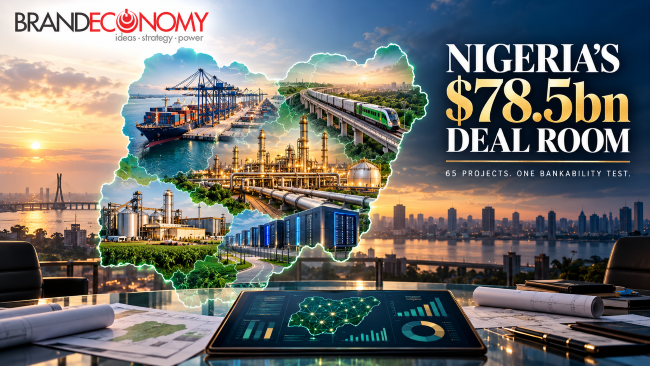
 Nigeria has taken 65 investment opportunities worth a combined $78.5 billion to the global capital market. Yet the real test is not how many projects appear in the catalogue, but how many can survive lender scrutiny, attract committed equity and reach financial close.
Nigeria arrived at the 2026 IMF–World Bank Annual Meetings in Bangkok carrying a proposition of appropriate scale: 65 projects requiring $78.5 billion across energy, transport, maritime infrastructure, manufacturing, mining, agriculture, technology, healthcare and urban services.



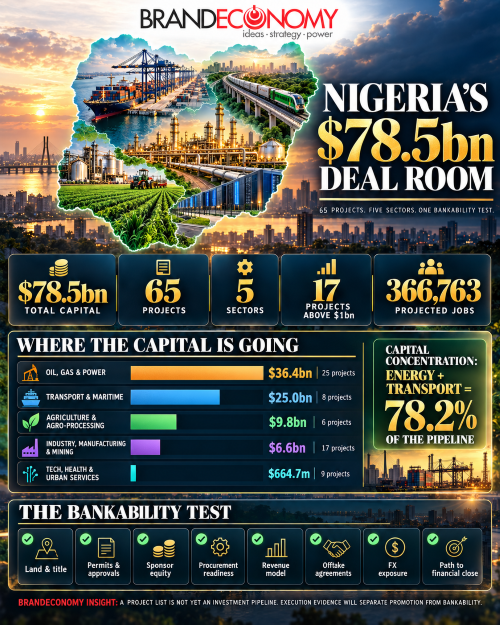
The portfolio is projected to generate 366,763 jobs. It includes 17 projects requiring more than $1 billion apiece and combines federal, institutional, private-sector and state-sponsored opportunities. The Federal Government presents it as a pipeline ready for global partnership. Special Edition
That is an important improvement in investment marketing. Nigeria is no longer asking investors merely to believe in its population, mineral wealth or market potential. It is attempting to place specific projects, sponsors, capital requirements and transaction structures before them.
But a catalogue is not a deal room. A capital requirement is not committed financing. A memorandum of understanding is not financial close. And a projected internal rate of return is not bankability until the assumptions supporting it have survived independent technical, legal and financial due diligence.
The critical question, therefore, is not whether Nigeria has 65 attractive ideas. It is how many of them are sufficiently prepared to receive money.
 A portfolio dominated by energy and transport
 A portfolio dominated by energy and transport
Oil, gas and power account for 25 projects requiring $36.4 billion. Transport and maritime infrastructure add eight projects valued at $25 billion. Together, these two sectors represent approximately 78% of the entire financing requirement.
Manufacturing, industry and mining account for 17 projects worth $6.6 billion; agriculture and agro-processing contribute six projects requiring $9.8 billion; while nine technology, health and urban-service projects collectively require $664.7 million. Bangkok 2026
The concentration is even more striking at project level.
The proposed Ondo Modular Refinery carries a stated cost of $15 billion. Strategic deep-sea ports across Badagry, Ibom, Ondo, Agge and Bakassi are grouped into an $11.5 billion programme. The National Inland Waterways programme requires $10 billion, the One Million Hectare Tree Crops initiative $6.14 billion, and the Ace Floating LNG project $5.5 billion.
Together, these five opportunities account for about $48.1 billion—or more than 61% of the entire pipeline.
This means the credibility of the $78.5 billion proposition rests heavily on a small number of mega-projects. If their cost estimates, approvals, commercial assumptions or financing structures prove weak, the value of the wider portfolio could shrink substantially.
Bankability is more than economic importance
Many projects in the portfolio address genuine national constraints. Nigeria requires ports, railways, gas infrastructure, domestic refining, industrial parks, broadband, affordable housing and agricultural processing.
Economic necessity, however, does not automatically produce an investable transaction.
A bankable project must demonstrate secure land and rights of way, completed feasibility studies, environmental and regulatory approvals, credible sponsors, committed equity, enforceable revenue arrangements, appropriate risk allocation and a realistic route for lenders and investors to recover their capital.
Projects earning naira while servicing dollar-denominated debt face an additional currency mismatch. Where tariffs are politically sensitive—as they are in transport, power, waste management and housing—the investor must also understand who bears the risk when prices cannot be adjusted.
Nigeria’s Infrastructure Concession Regulatory Commission has itself stressed that national importance does not eliminate the need to test feasibility, affordability, risk allocation, sustainability and value for money. Infrastructure Concession Regulatory Commission
The projects closest to serious due diligence
Based solely on the information published by the Federal Ministry of Finance, several projects appear better prepared than the rest. This is not a final investment rating; it is an assessment of disclosed readiness.
Lagos Greenline Railway
The $1.29 billion Lagos Greenline has several features lenders will recognise. An independent demand study projects 56,300 passengers daily in its first year. The financing plan includes $144 million in federal equity, alongside export-credit, development-finance and commercial debt. A full Federal Government sovereign guarantee is also proposed.
The published model projects an internal rate of return of 9%, a debt-service coverage ratio of 2.69 times and a 15-year investment horizon. Special Edition
Its principal vulnerability is currency. Fares will be earned in naira while much of the financing may be foreign-currency debt. The sovereign guarantee improves credit quality but transfers part of the risk to the public balance sheet. Investors will need clarity on fare adjustment, ridership risk, land acquisition and the fiscal treatment of the guarantee.
MIPL Ammonia and Phosphate Complex
The proposed $2.69 billion fertiliser complex at Ikot Abasi benefits from heavyweight sponsorship by the Nigeria Sovereign Investment Authority and OCP Africa. Its published structure envisages 70% debt and 30% equity, while approximately 70% of output is described as guaranteed through an offtake and distribution arrangement.
Dollar-linked revenues, an identified export market and a projected debt-service coverage ratio of 1.82 times strengthen its proposition. Special Edition
The project’s challenge is execution scale. Gas availability, port infrastructure, construction risk and the durability of fertiliser prices must still be stress-tested.
Global Gas Cawthorne Channel Plant
This $300 million brownfield opportunity appears stronger than many greenfield concepts because its site, licences and rights of way are reportedly already in place. The proposed financing mix is 30% equity and 70% senior debt, with dollar-linked revenue from processed gas, LPG and condensate.
Its published model indicates a 22.6% internal rate of return and minimum debt-service coverage of 1.87 times. However, no credit support is identified, leaving lenders exposed to feedstock, buyer and execution risks. Special Edition
Premium Steel’s integrated upgrade
The $1.255 billion Premium Steel and Mines upgrade in Delta State offers an existing industrial site, power, gas, water, rail and captive-port infrastructure. The sponsor says $150 million in equity has already been invested, with another $226.5 million required to complete the equity contribution.
This brownfield character makes it more tangible than a new industrial-zone proposal. But the absence of disclosed credit support or firm offtake means lenders must still test domestic steel demand, energy costs, import competition and management capacity. Special Edition
Promakar’s sorghum expansion
At $7.5 million, the Promakar Flour Mills expansion is one of the portfolio’s smallest opportunities—and potentially one of its most straightforward. It is an operating business seeking growth equity to expand into a 200-tonne-per-day production line.
Its projected 49.8% return and 8.8-times multiple should be treated cautiously until independently verified. Nevertheless, its manageable ticket size, existing operations and clear import-substitution proposition could make it more executable than several billion-dollar concepts. Special Edition
That contrast carries an important lesson: smaller operating businesses with customers and cash flow may attract capital faster than nationally celebrated megaprojects.
Where the gaps become visible
The official portfolio also contains unusually candid disclosures.
The $3 billion IESL LNG project names potential gas suppliers and offtakers and cites a $3 billion investment memorandum. Yet its detailed financing structure, use of funds, investment instrument and exit route were still listed as information to be provided by the sponsor.
The proposed $19.8 million Amari CNG project carries attractive return projections, but the document acknowledges that a PwC review found insufficient evidence concerning the sponsor’s financial capacity, gas supply and supporting documentation.
The $10 billion National Inland Waterways programme is still at pre-feasibility stage, has no stated credit support and projects a return of just 3.8%. The $3 billion Fish City seafood programme is classified as a concept and also lacks credit support. Special Edition
Such disclosure is welcome. It allows investors to distinguish an opportunity requiring project-preparation capital from one ready for construction finance.
The challenge is that these distinctions are not applied consistently across the entire portfolio.
The state-project problem
Thirty-three of the 65 projects were submitted through the Nigeria Governors’ Forum and have a combined stated value of $24.8 billion.
BRANDECONOMY’s review of their published stage classifications found 12 described as being in “planning” and seven at “initiation”. In other words, 19 of the 33 state projects—about 58%—remain at relatively early stages by the government’s own descriptions.
Several state entries disclose little beyond capital requirement, location, stage and a generic PPP structure. Many do not provide independently validated demand forecasts, revenue models, debt-equity ratios, permits, credit enhancements, returns or confirmed offtake arrangements.
The $15 billion Ondo Modular Refinery illustrates the information gap. It is described as being in implementation and designed to process 500,000 barrels daily. Yet the public profile does not disclose a detailed financing plan, committed sponsor equity, feedstock agreement, product-offtake arrangement or lender mandate. Special Edition
That does not prove the project is unviable. It means the published evidence is insufficient to describe it as bankable.
What a Nigeria Project Bankability Index should measure
To convert the Bangkok pitch into investable transactions, the Federal Government should rank the projects through a transparent, independently reviewed index:
| Test | Suggested weighting |
| Sponsor equity and financial capacity | 15% |
| Binding offtake and revenue security | 15% |
| Technical studies, FEED and EPC readiness | 10% |
| Land, permits and environmental approvals | 10% |
| Financial model and stress-tested returns | 10% |
| Procurement and PPP approvals | 10% |
| Currency and refinancing risk | 10% |
| Guarantees and credit enhancement | 10% |
| Community, security and ESG readiness | 5% |
| Exit route and operating track record | 5% |
Projects scoring above 80 could be classified as finance-ready. Those between 60 and 79 could enter full investor due diligence. Projects below that level should remain in preparation rather than being marketed as though construction capital were immediately required.
This would also help pension funds, banks and development-finance institutions identify the appropriate financing instrument. Not every project needs a sovereign guarantee. Some require viability-gap funding; others need local-currency bonds, first-loss capital, political-risk insurance or carefully structured concessions.
Guarantees must be selective and transparently recorded because they create contingent liabilities for government. A project can appear privately financed while transferring substantial downside risk to taxpayers.
The market and investor implications
Nigeria’s improved macroeconomic position provides a more credible background for the investment drive. The World Bank says growth, public finances and the external position strengthened in 2026, but stresses that the next phase must turn stability into private investment, productivity and jobs. worldbank.org
The World Bank Group is separately supporting efforts to mobilise as much as $5.79 billion in private financing through policy reform, investment platforms, guarantees and commercial capital. That demonstrates what investability requires: institutions working in sequence to develop projects, reduce risk and crowd in investors. worldbank.org
Nigeria’s banks will be interested in advisory mandates, syndication, trade finance and naira tranches, but their balance sheets cannot carry decades-long infrastructure risk unaided. Pension funds need rated and properly secured instruments. Foreign investors will demand contractual protection against currency instability, arbitrary tariff decisions and political transitions.
The 366,763-job projection must also be disaggregated. Investors and citizens need to know how many are temporary construction jobs, permanent operating roles, indirect supply-chain positions or estimates based on multipliers. Jobs are a development benefit, not a substitute for commercial viability.
Brand and reputation implications
The Projects Nigeria initiative is also a test of the country’s investment brand.
Nigeria has often generated ambitious project announcements that fail to progress beyond ceremonies, memoranda and political transitions. Every poorly prepared opportunity marketed as “investment ready” increases investor fatigue and weakens confidence in subsequent offerings.
Consistency matters. The government’s project website and accompanying investor publication should use the same tax rates, project definitions, stage classifications and financial assumptions. Investors should not have to reconcile contradictory official guidance before entering the data room.
The most powerful signal would be a public, version-controlled dashboard showing feasibility completion, permits, sponsor equity, procurement stage, financial commitments, construction progress and jobs actually created. Successful transactions should move visibly from “pipeline” to “financial close” and then to “operational”.
BRANDECONOMY Insight
Nigeria’s problem is not a shortage of projects. It is a shortage of projects prepared deeply enough for capital to move with confidence.
The $78.5 billion portfolio is valuable because it gives investors something more concrete than a national aspiration. But its credibility will depend on disciplined prioritisation. Government should identify perhaps 10 to 15 transactions with the strongest sponsors, clearest revenues and most advanced approvals, then concentrate project-preparation resources on taking them to financial close.
The rest should be honestly classified as concepts, pre-feasibility opportunities or projects requiring development capital.
Nigeria’s investment brand will not be strengthened by describing every project as ready. It will be strengthened by telling investors precisely what remains undone—and then proving that institutions can finish the work.
The enduring measure of the Bangkok initiative will not be the number of meetings held, expressions of interest received or memoranda signed. It will be the value of equity committed, debt agreements executed, construction sites mobilised and sustainable jobs placed on payroll.
That is the distance between a project pipeline and an investable economy.