FG Proposes ₦85m Mortgage Cap, 40% Informal-Sector Window
Affordability Is the Real Test

 The Federal Government wants to enlarge Nigeria’s mortgage market, increase National Housing Fund disbursements and reserve a substantial share for informal workers. The ambition is welcome, but higher loan limits will not produce affordable homes unless interest rates, incomes, land administration and housing supply move in the same direction.
Nigeria’s housing-finance reform is moving towards a potentially significant reset, with the Federal Government proposing to raise the maximum mortgage loan available under its intervention framework from ₦50 million to ₦85 million.



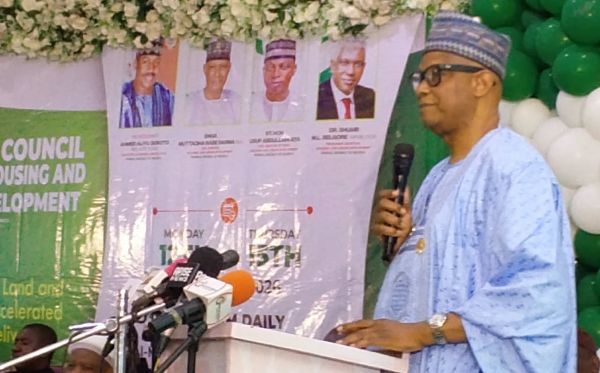
Minister of Housing and Urban Development, Dr Muttaqha Rabe Darma, announced the plan at the 15th National Council on Lands, Housing and Urban Development in Sokoto. The government is also targeting 2,000 mortgage transactions in 2026, rising to 5,000 by 2028.
Perhaps more consequentially, between 30% and 40% of mortgage bookings would be allocated to informal-sector workers—a category that includes traders, artisans, transport operators, farmers and self-employed professionals whose irregular or poorly documented earnings frequently exclude them from conventional housing finance.
The package signals recognition of a longstanding structural problem: millions of Nigerians contribute economically without possessing the payslips, employment letters and predictable monthly cash flows on which traditional mortgage underwriting depends.
But the announcements remain policy intentions. The applicable interest rate, equity requirement, commencement date, eligibility rules and legal framework for the higher mortgage ceiling have not yet been fully published. Those details will determine whether the plan becomes a genuine homeownership bridge or merely a larger loan that most households still cannot afford.
The difference between a bigger loan and an affordable home
Raising the ceiling responds to the sharp increase in property and construction costs. A ₦50 million limit no longer buys what it did before the naira’s depreciation and the escalation in cement, steel, imported fittings, transport, labour and land prices.
Yet affordability is determined less by the headline loan amount than by the monthly repayment.
Under the existing National Housing Fund mortgage structure, eligible contributors can access financing at 6% annually for up to 30 years. If the proposed ₦85 million facility retained those terms, a fully amortising loan would require an indicative monthly repayment of approximately ₦510,000.
Because FMBN generally restricts mortgage servicing to about one-third of an applicant’s income, such a repayment could require monthly net earnings of roughly ₦1.53 million. That calculation excludes equity contributions, insurance, transaction costs and property-registration expenses.
The implication is clear: an ₦85 million mortgage may assist upper-middle-income professionals and households combining two stable incomes, but it would remain beyond the reach of most low-income workers.
The government must therefore avoid presenting a higher ceiling as synonymous with mass affordability. For poorer households, incremental construction loans, serviced plots, rent-to-own programmes, housing cooperatives and smaller units may deliver greater value than a large conventional mortgage.
Informal-sector inclusion needs a new underwriting model
The proposed 30% to 40% allocation for informal workers could be the reform’s most socially important element. If applied to the 5,000-mortgage target, it would represent between 1,500 and 2,000 facilities.
However, reserving slots is not the same as approving loans.
Informal-sector applicants will require an underwriting framework capable of assessing bank transactions, digital-payment histories, cooperative savings, business turnover, seasonal income and other evidence of repayment capacity. Rigid salary-based assessment would defeat the inclusion objective before it begins.
FMBN and participating mortgage banks must also clarify whether the target refers to applications, approvals or completed disbursements. A quota measured at the application stage could create the appearance of inclusion while concealing high rejection or abandonment rates.
Credit guarantees, mortgage insurance and cooperative risk-sharing arrangements may be necessary to widen access without compromising loan quality. The challenge is to recognise unconventional income, not to suspend responsible lending.
FMBN faces a tougher disbursement test
Darma said the government would direct the Federal Mortgage Bank of Nigeria to disburse through mortgages at least 70% of the preceding year’s National Housing Fund contributions annually.
This attempts to answer a persistent contributor complaint: deductions are made regularly, but access to mortgages remains slow, opaque and limited.
The proposed ratio should be accompanied by public disclosure of total contributions, approved applications, actual disbursements, processing times, geographic distribution, income categories and loan performance. Without these figures, a percentage target could disguise a weak absolute outcome or merely shift money towards a small pool of easily bankable applicants.
With the government targeting only 5,000 mortgages by 2028, scale is another concern. The World Bank has estimated Nigeria’s housing deficit at about 17 million units, while tens of millions of residents occupy inadequate housing. Against that challenge, 5,000 mortgages would represent only a fraction of one-tenth of 1%.
The target may be achievable as an institutional rebuilding benchmark, but it cannot credibly be described as a national solution.
A proposed regulator must reduce—not multiply—bureaucracy
The government also intends to establish a National Housing Finance Authority to coordinate regulation, strengthen accountability and improve the mortgage market’s performance.
A dedicated authority could standardise documentation, facilitate mortgage refinancing, improve sector data and coordinate the multiple institutions involved in housing finance. But its mandate must be carefully designed to avoid overlap with the Central Bank of Nigeria, FMBN, primary mortgage banks, the Nigeria Mortgage Refinance Company and state land authorities.
Nigeria’s housing problem is already burdened by institutional fragmentation. Creating another agency without consolidating responsibilities could add approval layers and administrative costs.
The authority should be judged by whether it shortens title verification, reduces transaction costs, expands long-term funding and protects buyers—not by the size of its bureaucracy.
Housing supply must rise with mortgage demand
The government says it is working towards constructing 100 housing units in each of Nigeria’s 774 local government areas. If fully delivered, that would amount to 77,400 homes.
This is substantially larger than the announced mortgage target, raising an important coordination question: who will buy the units, through what financing mechanism and at what income-adjusted price?
Expanding mortgage purchasing power while housing supply remains constrained can push property prices higher. Demand-side financing must therefore be matched by serviced land, functioning infrastructure, faster approvals and a construction strategy that lowers costs.
At the Sokoto meeting, House Committee on Urban Development and Regional Planning Chairman Awaji-Inombek Abiante called for single-digit mortgage rates, more transparent land registration, better development control, realistic housing prices and increased use of locally sourced building materials. He also proposed a National Housing Identification Number.
A credible property-identification system could improve title verification, valuation, taxation, mortgage security and investment due diligence. Its success, however, would require interoperability with state land registries and safeguards for data integrity and privacy.
Diaspora capital requires institutional trust
The government’s recently launched Diaspora Mortgage Programme is intended to give Nigerians abroad a more structured route to homeownership at home.
Diaspora demand can unlock foreign exchange, construction finance and long-term investment. But this segment has also been exposed to failed developments, disputed titles, unauthorised sales and weak project supervision.
The strongest brand promise the government can offer Nigerians abroad is therefore not sentiment but enforceable trust: verified titles, licensed developers, protected payments, independent construction certification and transparent dispute resolution.
Sokoto positions housing as social infrastructure
Sokoto State Governor Ahmad Aliyu described housing as a foundation for dignity, security, family stability and confidence in the future.
He cited the 500-unit Sokoto New City Housing Project and shelters for internally displaced people being developed with international support as part of the state’s response to the needs of lower-income and vulnerable residents.
The Sultan of Sokoto, Alhaji Sa’ad Abubakar, similarly urged policymakers to give greater priority to low-income earners and pledged the support of traditional institutions.
Those interventions reinforce the wider development argument: housing is not simply a real-estate product. It affects health, household wealth, urban productivity, social stability and the ability of workers to live within reasonable distance of employment.
Market, investor and brand implications
A functioning mortgage market would have multiplier effects across cement, steel, paints, roofing, furniture, insurance, property technology, construction services and professional advisory businesses. It could also create investible long-term assets for pension funds and institutional capital.
Investors will nevertheless require predictable foreclosure rules, credible property titles, transparent housing data and a dependable refinancing market. Mortgage growth cannot be sustained solely through public contributions and administrative directives.
For the government and FMBN, the programme is also a test of brand credibility. “Affordable housing” has become one of Nigeria’s most repeatedly announced but weakly measured policy promises.
Publishing a live performance dashboard—showing applications, approvals, disbursements, completed homes, informal-sector participation, repayment performance and processing times—would do more for public confidence than another ceremonial allocation exercise.
BRANDECONOMY Insight
The Federal Government has correctly identified the central weakness in Nigeria’s housing market: building houses without financing buyers produces empty estates, while financing buyers without expanding supply produces more expensive houses.
The proposed ₦85 million ceiling is therefore useful but incomplete. Its real value will depend on four foundations: affordable long-term funding, reliable income assessment, clean land titles and housing supply at prices connected to Nigerian earnings.
The most important number is not the maximum amount a contributor may borrow. It is the number of households that can complete an application, receive a disbursement, enter a habitable home and maintain repayment without sacrificing food, education, healthcare or productive investment.
Until those outcomes are measured publicly, Nigeria has a larger mortgage ambition—not yet a more inclusive housing-finance system.