
Dangote Refinery IPO: Why Nigerians Must Treat Shares as Investment, Not Charity

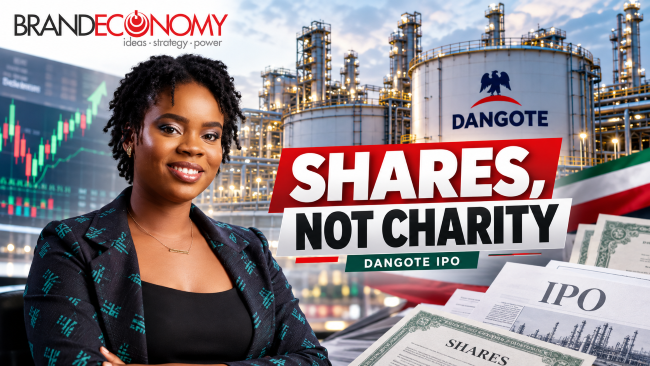 Financial analyst Hesed Sign warns that prospective investors must look beyond founder mystique and interrogate valuation, debt, profitability, cash flow and risk.
The Investor Question Behind the Publicity


Nigerians eyeing the proposed Dangote Refinery Initial Public Offering have been urged to approach the opportunity as investors, not beneficiaries of billionaire generosity.
Financial analyst, Ms Hesed Sign, made the point in an interview with the News Agency of Nigeria in Lagos, warning that prospective shareholders must look beyond publicity, national pride and the reputation of Aliko Dangote to examine the fundamentals of the transaction.
Her argument is simple but important: when a multi-billion-dollar industrial company opens its ownership to the public, the central question should not be whether the founder is being charitable. It should be what investors are buying, what price they are paying, what risks they are assuming and what the company intends to do with the capital raised.
That distinction matters because Dangote Refinery naturally carries national emotion. It speaks to energy security, industrial ambition, jobs, local refining capacity and Africa’s ability to build major private-sector infrastructure. But an IPO is still a capital-market transaction. It is not a social intervention programme.
Shares Are Ownership, Not Handouts
Sign pushed back against suggestions that opening the refinery to public ownership should be seen mainly as an effort to “help the poor.” According to her, an IPO is not charity; it is a process through which a company raises money by selling ownership stakes to investors.
In capital-market terms, anyone who commits personal savings to buy shares becomes an investor. That investor is not receiving a cash grant. He or she is purchasing a claim on the future performance of the business, while accepting the possibility of gain or loss.
This is why the language around retail participation matters. If ordinary Nigerians are encouraged to see the offer as benevolence, they may underprice the risk. If they are addressed as investors, they are more likely to ask the right questions: What is the valuation? How much debt does the company carry? What are the projected earnings? How reliable are the cash flows? How liquid will the shares be after listing?
Debt, Equity and the Cost of Capital
Sign explained that companies generally raise capital through debt or equity. Debt involves borrowing, with repayment obligations and interest costs. Equity involves selling part of the company to investors in exchange for capital.
Dangote Refinery, she noted, has used both approaches. Its construction required substantial funding, including borrowing obligations that must be serviced irrespective of market conditions. Every dollar spent on interest payment is a dollar that cannot be simultaneously deployed into feedstock procurement, operational efficiency, expansion, maintenance, technology or logistics.
Equity financing can therefore help strengthen a company’s balance sheet, support expansion and reduce dependence on additional borrowing. But equity is not free. It dilutes ownership and transfers part of the business risk and reward to new shareholders. That is why valuation, pricing and use of proceeds matter in getting a piece of the Dangote Refinery IPO.
Profitability and Sustainability
Sign also urged prospective investors to examine the refinery’s financial history. She noted that the business recorded substantial losses during its first two years of commercial operations before reporting a significant profit in the first half of 2026.
For investors, that history should not be ignored. A move from losses to profit can be encouraging, but it must be analysed carefully. Was the turnaround driven by higher volumes, better margins, pricing advantages, improved operations, currency effects, policy shifts or one-off factors? Is the profit sustainable?
A serious investor does not stop at the headline profit figure. The stronger test is cash generation. A business may report accounting profit while still facing pressure from debt service, working capital, inventory financing or delayed receivables. Refining is capital-intensive, margin-sensitive and exposed to global commodity swings. Scale does not remove risk.
Dangote Refinery IPO: Market, Brand and Investor Implications
The market implication is clear: a Dangote Refinery IPO could deepen Nigeria’s capital market, widen public ownership of a strategic industrial asset and give retail investors exposure to one of Africa’s most ambitious private-sector infrastructure projects. But it could also test the quality of investor education, disclosure culture and market liquidity.
If the offer is framed responsibly, it can strengthen trust in the capital market. If it is sold as a sentimental national opportunity without enough emphasis on valuation and risk, it could expose inexperienced investors to disappointment.
The brand implication is equally important. Dangote is one of Africa’s most powerful corporate names. That brand equity can attract investors, but it must not substitute for due diligence. Strong brands still need transparent numbers, credible governance, disciplined communication and fair treatment of minority shareholders.
For the refinery, public ownership would expand reputational responsibility. Once ordinary Nigerians become shareholders, the company’s communication must evolve from founder-centred admiration to investor-grade accountability.
BRANDECONOMY Insight
The deeper issue is not whether Nigerians should buy Dangote Refinery shares. The real issue is whether they will be invited into the transaction as informed investors or emotionally mobilised fans.
Dangote Refinery is a landmark industrial asset, but shares are not souvenirs. They are financial instruments tied to ownership, valuation, earnings, cash flow, leverage, governance, liquidity and risk. Nigerians who commit their savings deserve more than slogans. They deserve a clear prospectus, honest risk disclosure, understandable numbers and respect for their role as providers of capital.
The best outcome would be an IPO that strengthens the refinery, deepens Nigeria’s capital market and gives citizens a fair opportunity to participate in industrial value creation. But that outcome depends on discipline. Retail investors must read, compare, question and assess before buying.
As Sign rightly argues, Nigerians who buy into the company are not beneficiaries of charity. They are shareholders. They are investors. And investors deserve to be spoken to with the seriousness, transparency and respect that capital demands.