Insurance Recapitalisation, How Can Nigeria’s Insurers Convert Capital into Growth and Profitability?

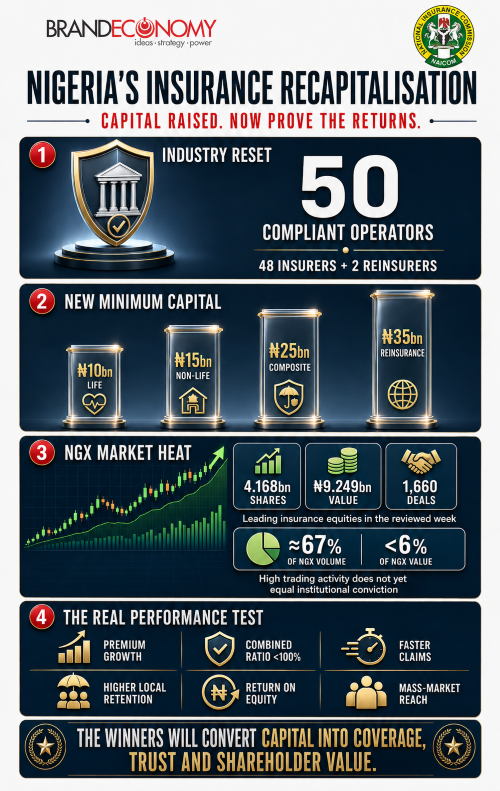
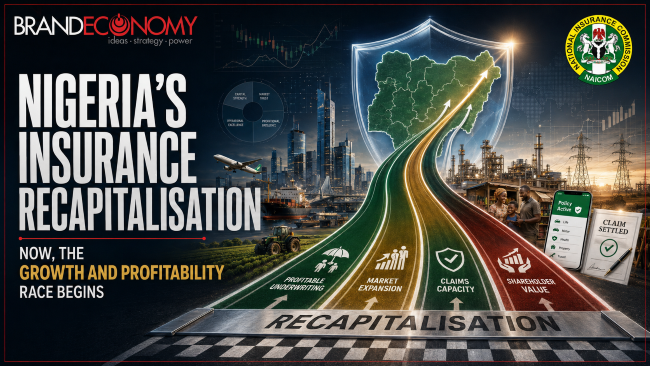 With 48 insurers and two reinsurers clearing Nigeria’s new capital thresholds after scaling the recapitalisation test, the industry’s defining contest is shifting from regulatory survival to profitable growth, claims performance, market expansion and investor returns.
Nigeria’s insurance recapitalisation exercise may have produced bigger balance sheets, new regulatory licences and a smaller field of compliant operators. But the capital race was only the qualifying round.




The more consequential competition begins now.
For the 48 insurance companies and two reinsurers confirmed as meeting the new minimum capital requirements, the challenge is to transform fresh equity into premium growth, stronger underwriting capacity, faster claims settlement, wider distribution and sustainable profitability.
That test arrives as three developments reshape the market simultaneously.
Shareholder groups are seeking regulatory relief for companies that missed the capital threshold. The National Insurance Commission is positioning Takaful as a new engine of insurance inclusion. On the Nigerian Exchange, insurance equities are commanding extraordinary trading volumes, suggesting that investors are already attempting to identify potential winners and casualties in the emerging order.
Together, the developments signal a decisive transition. Nigeria’s insurance sector is moving from a compliance cycle into a commercial-performance cycle.
 The new capital starting line
 The new capital starting line
The Nigerian Insurance Industry Reform Act 2025 raised minimum capital requirements to ₦10 billion for life insurers, ₦15 billion for non-life companies, ₦25 billion for composite insurers and ₦35 billion for reinsurers.
The objective was not simply to force companies to raise money. It was to strengthen their capacity to absorb losses, meet policyholder obligations, retain more domestic risks and support larger economic transactions.
Yet capital in itself is neither growth nor profitability.
For many operators, the recapitalisation process involved new share issuance, strategic placements, rights issues and changes in ownership. Those transactions may have strengthened solvency, but they have also enlarged the equity base against which future returns will be measured.
New investors will expect earnings. Existing shareholders will want dividends and recovery from dilution. Regulators will demand stronger claims-paying capacity. Customers will expect better products and service.
Management teams of insurers must therefore make the additional capital work.
An insurer that raises billions of naira only to continue with weak distribution, underpriced policies, poor claims administration and high operating costs may become better capitalised without becoming better managed.
Capital must become commercial capacity
The strongest opportunity lies in risks that Nigerian insurers have historically lacked sufficient capacity to retain.
Oil and gas, aviation, marine, infrastructure, power, manufacturing, construction, telecommunications and emerging climate risks represent significant premium pools. Larger capital bases should allow insurers to retain a greater share of these risks locally, strengthen reinsurance negotiations and reduce the volume of premiums transferred offshore.
But taking on bigger risks requires more than money.
Insurers will need specialist underwriters, actuaries, engineers, loss adjusters, risk surveyors, data analysts and sophisticated reinsurance arrangements. A poorly priced infrastructure or energy portfolio can consume newly raised capital faster than a conservative retail book.
Growth must consequently be risk-adjusted.
The commercial winners will not necessarily be the companies recording the fastest increase in gross written premiums. They will be those able to grow premiums while controlling claims, acquisition costs, operating expenses and exposure concentrations.
For non-life insurers, the combined ratio—the relationship between claims, expenses and earned premiums—will become especially important. A ratio below 100 per cent generally indicates an underwriting profit; a persistent ratio above that level suggests that investment income may be masking weaknesses in the core insurance business.
Life insurers face a different test. They must improve policy persistency, manage actuarial liabilities, match long-term assets with obligations and prevent inflation from destroying the perceived value of savings-linked products.
The mass market cannot remain an afterthought
Nigeria’s insurance industry cannot build its future entirely around corporate accounts and government business.
Millions of farmers, traders, artisans, transport operators, informal-sector workers and small businesses remain underinsured. The scale of this underserved market represents the industry’s largest growth opportunity—but also its most difficult distribution challenge.
Traditional branch-led models cannot economically reach enough consumers. Growth will increasingly depend on digital channels, mobile platforms, embedded insurance, cooperatives, fintech partnerships, agent networks and appropriately structured bancassurance arrangements.
Products must also be redesigned around how Nigerians earn and spend.
A market dominated by irregular incomes requires flexible premiums, simple policy language, immediate digital confirmation and claims processes that do not force customers through excessive documentation.
The companies capable of converting small, frequent contributions into scalable risk pools could create an entirely new insurance economy. But mass-market expansion will succeed only if claims are settled visibly and promptly. One badly handled retail claim can damage confidence across an entire community.
Takaful moves towards the centre
NAICOM’s engagement with the Islamic Financial Services Board adds another important growth channel.
Commissioner for Insurance and NAICOM Chief Executive, Mr Olusegun Omosehin, reaffirmed the regulator’s determination to develop Takaful as a vehicle for financial inclusion and sustainable economic development following an IFSB diagnostic assessment mission in Abuja.
Omosehin has argued that Takaful should be understood as an alternative insurance model rather than a minor extension of conventional underwriting.
That distinction matters commercially.
Takaful is built around risk sharing, participant funds, ethical investment and defined surplus-management arrangements. Although governed by Shariah principles, it should not be branded solely as a product for Muslim consumers.
Its ideas of mutual responsibility, transparency and community protection can appeal to cooperatives, agricultural groups, small businesses and consumers who remain sceptical of conventional insurance.
The IFSB assessment identified opportunities to strengthen the legal, regulatory and supervisory structure supporting the segment. NAICOM has highlighted risk-based capital, data transparency, participant protection and prudent surplus management as important priorities.
The growth opportunity is substantial, but credibility will depend on clear separation between policyholders’ funds and shareholders’ resources, independent Shariah oversight and transparent treatment of surpluses and deficits.
Takaful must compete on product quality, accessibility, service and claims performance—not religious identity alone.
The unresolved recapitalisation overhang
Not every operator crossed the capital threshold, and shareholder groups continue to press for regulatory accommodation.
Mr Boniface Okezie, Chairman of the Progressive Shareholders Association of Nigeria, has urged NAICOM to grant an additional five to seven months to companies that demonstrated serious capital-raising efforts.
Speaking in Lagos, he argued that firms which had already raised between ₦3 billion and ₦7 billion, or secured willing investors, should be allowed to complete their transactions.
Okezie warned that withdrawing licences from potentially viable companies could trap shareholder funds and weaken local investor confidence. He also noted that insurance stocks do not attract the same investor appetite as banking equities, partly because of inconsistent dividends and difficult shareholder experiences dating back to 2007 and 2008.
Mr Moses Igbrude, National Coordinator of the Independent Shareholders Association of Nigeria, similarly proposed an additional six months for viable firms to secure investors. He suggested that NAICOM could replace weak management teams or directors and give selected companies a defined rescue period.
Mrs Adetutu Shiyanbola, Chairperson of the Highly Favoured Shareholders Association of Nigeria, described the situation as painful for affected investors.
Their concerns deserve attention, but any intervention must preserve regulatory credibility.
Companies that complied within the stipulated period incurred real financial costs. A blanket extension could penalise discipline and encourage future operators to regard statutory deadlines as negotiable.
A better solution would be a transparent resolution framework. Potentially viable operators could be directed towards mergers, acquisitions, portfolio transfers or controlled run-off. Companies without credible rescue plans should exit, with policyholders receiving priority protection.
The objective should be to preserve sound insurance portfolios—not indefinitely protect failed ownership structures.
Insurance equities attract the market
Investor interest in insurance stocks has intensified.
Fortis Global Insurance, Lasaco Assurance and Consolidated Hallmark Holdings accounted for 4.168 billion shares valued at ₦9.249 billion in 1,660 deals during the reviewed week.
In the preceding week, Fortis Global Insurance, Cornerstone Insurance and Consolidated Hallmark Holdings generated 9.488 billion shares worth ₦36.219 billion.
The current week’s leading insurance equities contributed roughly two-thirds of total NGX trading volume but less than six per cent of turnover value. This is an important distinction.
The figures demonstrate liquidity and speculative interest, but not necessarily institutional confidence or improving profitability. Large quantities of low-priced shares can dominate market volume without representing a proportionate share of invested value.
Overall NGX turnover declined to 6.242 billion shares worth ₦157.764 billion, compared with 12.153 billion shares valued at ₦176.058 billion in the preceding week. The All-Share Index lost 1.35 per cent to close at 239,351.16 points, while market capitalisation fell by 1.33 per cent to ₦154.534 trillion.
The Financial Services Industry accounted for 89.62 per cent of traded volume and 35.77 per cent of value.
The listing of an additional 15 billion Veritas Kapital Assurance shares may improve capital and liquidity, but it also enlarges the share base over which future earnings must be distributed.
Meanwhile, the suspension of Universal Insurance following the revocation of its operating licence demonstrates that regulatory compliance can immediately become an investment issue.
The market may be trading the recapitalisation story, but it has not yet established which companies can deliver superior returns.
Market implications
The post-recapitalisation phase will accelerate consolidation, partnerships and competition for distribution.
Larger insurers may pursue acquisitions to gain customers, licences, specialist teams or regional reach. Fintech companies, telecommunications operators, banks, retailers and digital platforms will become increasingly valuable distribution partners.
Competition may initially encourage aggressive premium growth. That creates a danger: insurers could underprice risks simply to gain market share and satisfy investor expectations.
Such growth would be self-defeating. Premium without adequate pricing is merely future claims liability disguised as revenue.
The strongest companies will combine scale with actuarial discipline, efficient reinsurance, automation and lower customer-acquisition costs.
Brand implications
Recapitalisation has reset the industry’s financial architecture, but it has not automatically repaired its reputation.
For consumers, an insurer’s most important brand message remains simple: will it pay a valid claim promptly?
New capital must therefore become visible through faster claims, clearer policy language, better digital service and greater transparency.
The companies that communicate only their recapitalisation success will quickly lose attention. Those that demonstrate what the new capital enables—larger risks underwritten, claims settled, new communities reached and innovative products launched—will build stronger brands.
NAICOM’s brand must also evolve from capital enforcer to market-development regulator. Its next responsibility is to demonstrate that recapitalisation has improved policyholder protection, industry conduct and economic relevance.
Investor relevance
The post-recapitalisation investor should look beyond share volume, new licences and headline premium growth.
Critical indicators include:
- Gross and net premium growth
- Premium-retention ratio
- Claims and combined ratios
- Solvency margin and risk-based capital position
- Reinsurance quality and concentration
- Operating and acquisition costs
- Return on equity
- Earnings per share after dilution
- Policy persistency in life insurance
- Claims-settlement record
- Digital customer growth
- Corporate-governance quality
- Dividend capacity
A recapitalised insurer may be safer without becoming more profitable. The investable companies will be those that deploy capital efficiently and generate sustainable returns without compromising claims obligations.
BRANDECONOMY Insight
The recapitalisation scorecard has counted how many companies raised sufficient capital. Nigeria now needs a Post-Recapitalisation Growth and Profitability Dashboard.
Such a dashboard should monitor premium growth, underwriting profitability, claims-settlement speed, return on equity, solvency, domestic retention of major risks, new distribution partnerships, mass-market policies, Takaful expansion and customer complaints.
It should also reveal how much additional Nigerian underwriting capacity is being deployed into oil and gas, infrastructure, manufacturing, agriculture, aviation, marine and other economically strategic sectors.
The industry’s next winners will not be determined by the size of their recapitalisation announcements. They will be determined by how productively they convert capital into coverage, customer trust and shareholder value.
Nigeria’s insurers have secured the financial permission to compete.
Now, the growth and profitability race begins.