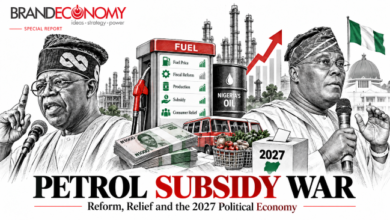
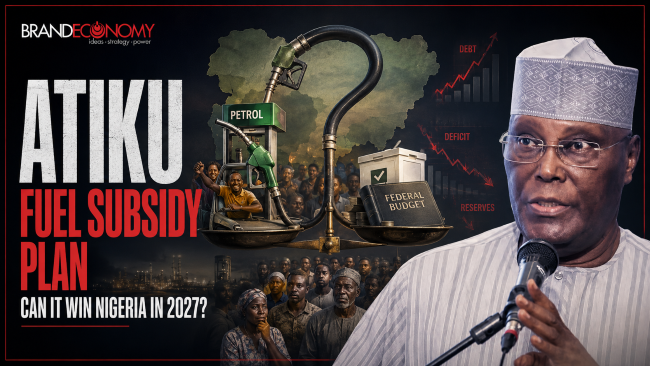
 The ADC presidential candidate, Atiku Abubakar, has turned Nigeria’s most combustible economic policy -fuel subsidy- into a campaign weapon. His plan is more sophisticated than the slogan—but is it protected against capture and broken promises?
Atiku Abubakar has reopened the most politically explosive economic argument in Nigeria: whether the Federal Government should again intervene to make petrol cheaper.


The African Democratic Congress presidential candidate promised during a Hausa-language interview that, if elected in 2027, he would restore fuel subsidy and recover money allegedly stolen under the old system. He said he had not initially opposed subsidy removal, but asked why the policy had failed to produce sufficiently visible improvements in healthcare, education, security, youth opportunity and household welfare.
It was a devastatingly simple message. Nigerians remember the pump price before President Bola Tinubu declared at his May 2023 inauguration that “subsidy is gone.” They also know today’s cost of transport, food, electricity and business survival.
Yet the economics behind Atiku’s promise is more nuanced than the headline.
Not the Old Subsidy—At Least on Paper
Under his subsequently published Atiku Economic Recovery Plan, Atiku says he will not resurrect the old import-based subsidy characterised by under-recovery claims, opaque deductions and retrospective bills. Instead, support would move “from importation to production,” with the “subsidy following the barrel.”
Qualifying public and private Nigerian refineries would receive domestic crude at a preferential price, subject to independently verified capacity, efficiency, transparency and domestic-supply obligations. The intervention would have a predetermined annual ceiling approved through the federal budget. Crude allocation, refinery intake, production yields, inventories and local deliveries would be reconciled. Refiners that diverted supported crude, manipulated records or failed to pass the benefit to consumers would lose eligibility, refund the advantage and face sanctions.
Atiku also proposes periodic reviews, declining support benchmarks and a statutory sunset. The plan is therefore closer to a temporary producer subsidy than the freewheeling import regime Nigeria operated before 2023.
The distinction matters. A verified barrel is easier to audit than an importer’s later claim. Domestic refining can reduce freight, port charges and some foreign-exchange demand while improving refinery utilisation.
But “restore subsidy” may make voters expect dramatically cheaper petrol, while a capped crude discount may deliver only modest relief. Unless Atiku reconciles those expectations, pre-election applause could become post-election disappointment.
 Tinubu’s Counterattack
 Tinubu’s Counterattack
The Tinubu administration describes the pledge as a fiscally reckless reversal. Presidential spokesman Bayo Onanuga argues that subsidy is not money waiting in a treasury account. It is the difference between the economic cost of petrol and the controlled price paid by consumers. If motorists do not pay that difference, it appears elsewhere—as reduced public revenue, NNPC losses, supplier arrears, borrowing, debt or lower spending on services.
The Presidency also says Nigeria’s market has changed. The Petroleum Industry Act created a market-oriented downstream framework, while Dangote Refinery and smaller plants have reduced import dependence. Reviving the old arrangement, it argues, could undermine investment and recreate costly distortions.
Its strongest questions are unavoidable: What pump price is Atiku promising? What would the intervention cost annually? Who pays when crude prices rise or the naira falls? What happens when the budget ceiling is exhausted? How will discounted crude translate into lower retail prices? What legal or regulatory changes are required?
These are not partisan distractions. They are the minimum tests of a credible subsidy proposal.
However, the government’s initial rebuttal largely attacked the old subsidy, whereas Atiku’s detailed model expressly rejects imported-product claims, unlimited liabilities and off-budget under-recovery. The administration is strongest when demanding arithmetic and weakest when portraying every intervention as a return to yesterday’s system.
Government nevertheless faces a social-legitimacy problem. Higher allocations, reserves and investor confidence mean little to a family whose transport and food bills have outrun income. Atiku’s question—“Where is the money?”—is technically imprecise because savings are not stored in one vault, but politically potent. It asks where the public value is.
The Cost Nigeria Cannot Dance Around
Atiku’s proposal may be economically defensible, but it is not free. If Nigeria supplies crude to a refinery below its export-equivalent value, the Federation surrenders revenue that could have accrued to the federal, state and local governments. A discount delivered in barrels rather than cash is still a public cost.
The programme must therefore publish the eligible number of barrels, discount per barrel, annual fiscal exposure and implied support per litre. It must also show the pump-price reduction actually delivered.
Crucially, a crude discount does not automatically become a retail discount. Refinery margins, depot charges, financing, transport costs or scarcity premiums can absorb the benefit. Nigeria could subsidise production while consumers still pay near-market prices.
The system must track crude beyond the refinery gate, publishing ex-refinery and depot prices, transport allowance, retail margin and regional pump-price bands. Failure to deliver the prescribed benefit should trigger refunds and suspension.
Competition presents another danger. A policy centred on a dominant refinery could transfer public value to private market power. Yet inefficient government refineries must not be rewarded for chronic underperformance. Eligibility should be automatic and open, based on certified output, uptime, yields, tax compliance, product quality, beneficial-ownership disclosure and acceptance of real-time audit.
For businesses, the policy’s value will be judged through predictable energy costs, not campaign arithmetic. Manufacturers, farmers, transporters and small enterprises could gain from lower logistics bills and stronger demand. They could equally lose if foregone public revenue weakens infrastructure spending, the naira or confidence in fiscal discipline over time.
What the World Teaches Nigeria
Comparable economies show that neither permanent subsidy nor shock deregulation is a magic formula.
Saudi Arabia has partly phased out explicit energy subsidies while using fiscal capacity and citizen-support programmes to cushion costs. Its administrative strength and buffers are difficult for Nigeria to replicate.
Indonesia removed its gasoline subsidy, temporarily retained targeted diesel support and redirected savings into cash transfers, healthcare, education and infrastructure. Abrupt reforms provoked unrest; later changes gained acceptance when compensation became visible.
Angola’s phased removal, accompanied by the Kwenda cash-transfer programme, still triggered protests when fuel and transport costs rose faster than citizens felt protected. Iran paired major energy-price reform with broad cash payments, but inflation and financing weaknesses eventually eroded their value.
The lesson is straightforward: reform works better when government communicates the arithmetic, phases adjustment, protects vulnerable people before the shock, strengthens social registries, improves state enterprises and depoliticises pricing through automatic rules.
Nigeria’s real failure was not merely subsidising for too long or removing too quickly. It was attempting a reform larger than the country’s public trust and compensatory capacity.
Will the Promise Move Votes?
Almost certainly. Whether it can win the presidency is another matter.
Afrobarometer found overwhelming public disapproval of subsidy removal, with a majority supporting reinstatement even if it reduced spending elsewhere. Petrol is more than a commodity in Nigeria; it is a price-setting signal for transport, food distribution, self-generated power and household confidence. It gives Atiku a simple contrast: Tinubu represents painful reform; Atiku promises immediate relief.
The message travels across class and geography. Commuters, farmers, traders, manufacturers, transporters and generator-dependent households understand fuel costs without an economics lecture.
But the pledge carries five liabilities. Atiku supported subsidy removal during the 2023 election cycle, creating a credibility problem. Voters may expect a return to old pump prices. Subsidy remains associated with corruption and smuggling. Wealthier households consume more petrol and capture more direct benefit. Most importantly, fuel is not the only determinant of voting behaviour.
Atiku must still overcome opposition fragmentation, APC’s governor network, incumbency, turnout, regional arithmetic and doubts about his reversal. A popular promise cannot replace coalition-building, polling-unit organisation, candidate trust or credible answers on insecurity and jobs.
The pledge therefore has a high probability of strengthening Atiku’s campaign, a moderate chance of becoming the election’s decisive economic wedge, and a much lower probability of being implemented cleanly without binding safeguards.
The Nigerian Factor
The greatest threat is political practice. Preferential crude is valuable. Interests will compete over refinery qualification, allocations, price benchmarks, transport contracts and auditors. Weak metering can enable diversion, manipulated yields and fabricated delivery records. Large regional price gaps can revive smuggling.
The best version of Atiku’s idea would be a temporary Domestic Energy Stability Contract: a modest published discount; a hard annual ceiling; competitive refinery eligibility; digital tracking from crude nomination to retail sale; weekly public data; automatic refunds; independent audit; targeted support for mass transit and vulnerable households; and a two-year sunset renewable only after a published cost-benefit review.
No agency should borrow, deduct unappropriated revenue or manufacture retrospective claims when the ceiling is reached. The price formula should adjust transparently instead.
BRANDECONOMY Verdict
Atiku has discovered the most emotionally resonant economic promise of the 2027 campaign. His detailed model deserves more serious consideration than the phrase “bring back subsidy” suggests. A capped, transparent production intervention is superior to open-ended import claims and could temporarily moderate transport and production costs.
But it remains a subsidy with a real fiscal bill. Its benefits can disappear between refinery and pump. It can strengthen private monopoly, reduce Federation revenue and become another permanent political entitlement.
Tinubu is right about the arithmetic but wrong to believe arithmetic alone settles the argument. Atiku is right about household pain but wrong if he suggests Nigerian crude can be discounted without public sacrifice.
The policy is conditionally credible, but not yet bankable. The campaign promise is powerful, but not sufficient. Its success will depend on whether the safeguards are stronger than the Nigerian incentives designed to defeat them.
Ultimately, the 2027 subsidy battle is not simply about cheaper petrol. It is about whether Nigeria can convert its barrels into cheaper movement, stronger businesses, transparent public accounts and a fairer household bargain.