

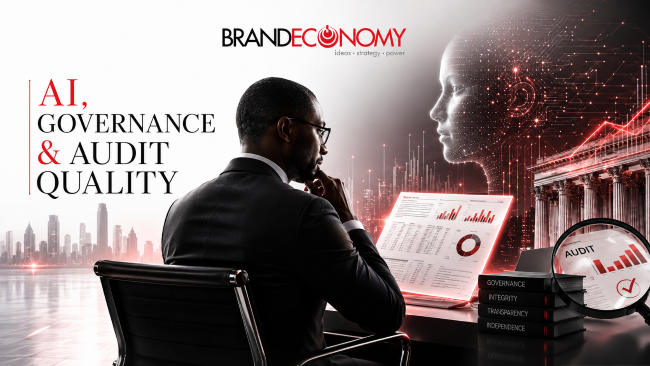
 At the 2026 Audit Committee Institute Conference in Lagos, leading audit and governance professionals delivered a timely message to corporate Nigeria: artificial intelligence may transform the speed and reach of assurance work, but the integrity of financial reporting will still depend on human judgement, strong controls and boards willing to ask difficult questions.
Artificial intelligence is arriving in the audit profession with enormous promise.




It can scan vast transaction populations in minutes, identify unusual patterns, flag inconsistencies, strengthen risk assessment and help auditors focus attention where the likelihood of error, manipulation or control failure appears highest.
For companies navigating increasingly complex operations, digital payments, cross-border transactions, fast-moving supply chains and data-heavy reporting systems, these capabilities can be transformational.
But technology does not eliminate the responsibility to think.
That was the central message from Christian Ekeigwe, Chairman of the Audit Committee Institute, and Dr Goodluck Obi, Partner and Head of Audit at KPMG West Africa, at the 2026 Audit Committee Institute Conference in Lagos.
Ekeigwe, in a keynote address titled “Guardians of Truth: Informed, Vigilant and Attending,” urged accountants, auditors and audit committee members to embrace AI while refusing to surrender professional judgement to machines.
“The greatest risk is not that AI will replace auditors,” he said. “It is that auditors will stop thinking and defer to the machine in their place.”
It is a warning with implications far beyond the audit profession.
As Nigerian companies adopt AI across finance, customer service, risk management, procurement, human resources and operations, the real governance question is becoming clearer: who remains accountable when an automated system gets it wrong?
The New Audit Equation
Audit has always involved evidence, independence, professional scepticism and judgement.
AI changes the scale at which evidence can be examined.
Traditional audit methods often rely on sampling: selecting a portion of transactions and using that sample to assess broader financial-reporting risk. AI tools can help auditors review much larger populations of data, identify hidden relationships, detect outliers and spot patterns that may not be visible through manual testing.
That is a major advance.
A system can compare thousands or millions of entries, flag duplicate payments, detect unusual supplier activity, analyse payment timing, identify inconsistent journal entries and draw attention to transactions that require deeper investigation.
For businesses, this can improve efficiency. For boards, it can offer faster visibility into emerging risks. For investors, it can potentially strengthen confidence that material issues are being identified earlier.
But AI is only as reliable as the data it receives, the models it uses and the humans who interpret its findings.
An algorithm may identify an anomaly. It cannot always determine whether the anomaly is an innocent operational exception, a legitimate commercial decision, a data-quality problem or an indication of fraud.
That is where professional judgement remains essential.
Ekeigwe noted that while AI can examine full populations of transactions and identify unusual behaviour, it cannot replicate contextual reasoning, ethical awareness or the scepticism required to understand financial reality.
In other words, machines can point to the smoke. Humans must determine whether there is a fire.
Why Governance Matters More in the AI Era
The rise of AI does not reduce the need for corporate governance. It increases it.
Boards and audit committees are now expected to understand not only financial statements, internal controls and regulatory obligations, but also the systems shaping the information placed before them.
That includes questions such as:
Who designed or selected the AI tool? What data is it using? How reliable is that data?
Can the system explain its conclusions? Who reviews the output before management acts on it?
What happens when the tool produces an error, bias or misleading recommendation?
How are confidential financial and customer data protected?
Ekeigwe urged audit committees to build enough AI literacy to challenge management meaningfully on how artificial intelligence is being used in reporting, internal controls and governance.
That does not mean every director must become a data scientist.
It means boards must understand enough to ask the right questions, demand clear accountability and recognise when technology is being used as a shield against scrutiny.
The capital market, Ekeigwe argued, does not merely need faster algorithms. It needs “thinking guardians” who are informed, vigilant and attentive.
That is the correct framing.
AI may make information faster. Governance determines whether that information is trustworthy.
Audit Failure Begins Before the Audit Report
Dr Goodluck Obi took the conversation deeper, arguing that audit failure is often misunderstood.
Many people assume that auditors are responsible for detecting every instance of fraud or misconduct within an organisation. But audit, by professional design, is not a substitute for management responsibility, functioning controls or ethical leadership.
Auditors are expected to issue an independent opinion on whether financial statements present a true and fair view in line with applicable standards. They do not replace the board, management team, compliance function or internal-control system.
“The auditor is not a watchdog expected to sniff out every fraud,” Obi said. “Strong governance, effective internal controls and responsible management are the first lines of defence.”
This distinction is crucial for investors and the public.
When companies collapse, misstate results or face governance crises, attention often turns immediately to external auditors. That scrutiny is understandable. Auditors play a vital role in protecting shareholder confidence.
But quality financial reporting is a collective responsibility.
Management must prepare accurate accounts. Boards must oversee strategy, risk and integrity. Audit committees must interrogate key assumptions and disclosures. Internal auditors must test controls. Shareholders must demand accountability. Regulators must enforce standards. External auditors must remain competent, independent and sceptical.
When any one of these lines of defence fails, the risk of financial-reporting failure rises.
AI’s Greatest Risk May Be False Confidence
AI can be persuasive even when it is wrong.
That is one of the most difficult governance problems facing businesses today.
An automated system can produce a polished report, a concise explanation, a risk score or a financial summary that appears highly credible. But clarity of presentation is not proof of accuracy.
Obi cautioned that AI can generate inaccurate or misleading information and should never displace professional review.
“The fact that AI produces a report does not remove your responsibility,” he said. “Professionals must review and stand behind whatever AI generates.”
This is particularly important in financial reporting.
A misleading automated narrative could result from poor source data, outdated information, biased assumptions, weak prompts, flawed integrations or a system that simply produces a confident but incorrect result.
The danger is not only technical. It is behavioural.
When busy professionals trust automated outputs too easily, they may stop challenging assumptions. When boards receive polished dashboards, they may fail to ask how the conclusions were reached. When companies prioritise speed over verification, weak information can move rapidly through decision-making channels.
The result can be a new form of governance failure: not deliberate deception, but uncritical dependence.
What Responsible AI in Audit Should Look Like
Responsible AI adoption in audit should be built around augmentation, not abdication.
The strongest use of AI is to help professionals work better: review more data, detect patterns earlier, prioritise risk areas, improve documentation and free experienced teams to focus on complex judgement calls.
It should not become an excuse to reduce scrutiny.
For corporate Nigeria, a responsible AI audit framework should include clear human oversight, documented governance responsibilities, model validation, data-quality checks, access controls, audit trails and escalation procedures when unusual findings emerge.
Audit committees should insist on transparency around the systems used in financial reporting and assurance processes. They should understand where AI is deployed, what decisions it influences and what safeguards exist against error or misuse.
Management, meanwhile, must avoid presenting AI-generated analysis as unquestionably objective.
AI is a tool. It is not a director, auditor, compliance officer or accountable executive.
Market Implications: Trust Is Becoming a Competitive Asset
The implications for Nigeria’s capital market are significant.
Investors increasingly assess not only revenue growth and profitability, but also governance quality, reporting credibility, risk controls and board effectiveness.
Companies that use AI responsibly may gain an advantage. They can improve the speed and depth of risk monitoring, reduce repetitive manual work and create stronger reporting processes.
But companies that deploy AI without governance may create new vulnerabilities.
A major data breach, misleading automated disclosure, weak model controls or an overreliance on machine-generated analysis can damage investor confidence quickly. In a market where trust is already a premium asset, governance failures can become expensive.
For listed companies, banks, insurers, pension managers, fintechs and large private enterprises, the lesson is clear: AI strategy must sit alongside governance strategy.
The two cannot be separated.
Brand Implications: Technology Without Trust Is a Liability
For corporate brands, responsible AI is becoming part of reputation management.
Customers, investors, regulators and employees increasingly want to know whether companies are using technology fairly, securely and transparently.
A business can gain attention for adopting AI. But it earns durable trust only when it can show that its systems are governed responsibly.
That is especially true for financial institutions and public-interest companies.
Banks, audit firms, fintechs and investment platforms operate on confidence. Their customers must believe that decisions are accurate, information is protected and systems are not being used carelessly.
The brand advantage will belong to organisations that communicate a simple but powerful principle: technology may enhance our work, but accountability remains human.
Investor Relevance
Investors should view AI adoption as a governance variable, not merely a productivity story.
Questions worth asking include:
- Does the company have a clear AI governance policy?
- Is board-level oversight in place?
- Are controls strong enough to validate AI-generated analysis?
- Does management understand the risks of poor data or inaccurate outputs?
- Are internal audit teams equipped to review AI-related controls?
- Are financial disclosures transparent about material technology risks?
- Companies that can answer these questions well may be better positioned to use AI productively without weakening trust.
The companies most exposed will be those that embrace automation faster than they build governance around it.
BRANDECONOMY Insight
The future of audit will be faster, more data-rich and more technologically enabled.
But the future of trust will remain deeply human.
AI can search every transaction. It can detect patterns invisible to the eye. It can improve audit efficiency and sharpen risk assessment.
It cannot replace independence. It cannot substitute ethical judgement. It cannot take responsibility for a misleading report. And it cannot stand before shareholders, regulators or the public when things go wrong.
That responsibility remains with people.
For Nigerian businesses entering the AI era, the winning formula is not artificial intelligence alone.
It is responsible intelligence: capable technology, disciplined governance, strong controls and professionals who remain willing to question what the machine says.