
Negative Narratives Are Raising Africa’s Cost of Capital, Afreximbank President Warns

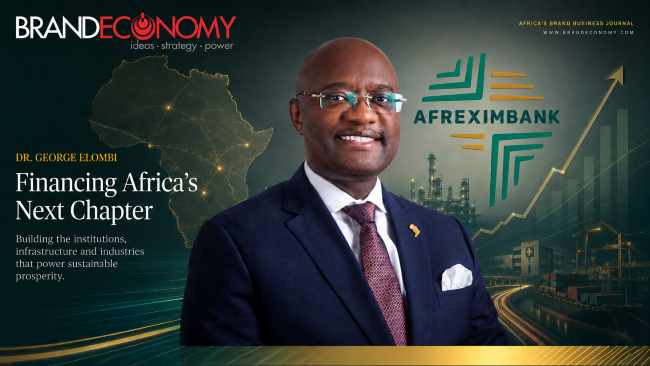 Afreximbank President and Chairman of the Board of Directors, Dr George Elombi, has challenged African journalists, policymakers and business leaders to confront the narratives that shape how the continent is priced, financed and perceived by the world.
Africa’s investment challenge is not only about capital. It is also about confidence.




It is about the stories repeated often enough to become assumptions: that Africa is inherently risky; that African institutions are fragile; that infrastructure projects are exceptions rather than evidence of capability; and that the continent’s future must always be validated elsewhere before it can be believed at home.
For Dr George Elombi, President and Chairman of the Board of Directors of the African Export-Import Bank, Afreximbank, that narrative is not merely unfair. It is expensive.
Speaking during a media roundtable in Abuja, Elombi urged African journalists to give greater prominence to the continent’s industrial, financial, scientific and infrastructure achievements, arguing that the global lens through which Africa is often viewed can influence investment flows, borrowing costs, access to expertise and the willingness of businesses to take long-term positions on the continent.
His message was direct: Africa cannot build a stronger economic future while allowing its most visible story to remain one of crisis.
Beyond the Headlines of Crisis
Elombi argued that international coverage of Africa frequently gives disproportionate attention to conflict, disasters, hunger, political instability, strikes and coups, while underreporting the factories, airports, refineries, hospitals, trade platforms, digital-payment systems and industrial projects reshaping African economies.
That imbalance, he suggested, has consequences.
Investors do not arrive in a vacuum. They make decisions based on data, risk models, local partnerships and market potential. But they are also influenced by perception. When an economy is repeatedly framed as unstable, dangerous or incapable, even credible investment opportunities may carry a higher perceived risk premium.
“We must change that narrative by highlighting African successes and demonstrating that excellence is an everyday reality across the continent,” Elombi said.
The call is not for public relations disguised as journalism. It is for fuller journalism.
Africa must report its challenges honestly. Conflict, governance failures, poverty and institutional weakness are real and deserve rigorous scrutiny. But a continent of more than 1.4 billion people cannot be accurately represented through its moments of crisis alone.
The fuller African story includes the entrepreneur building a cross-border logistics business, the manufacturer replacing imports, the hospital delivering complex care, the refinery processing local crude, the fintech lowering payment costs and the young engineer building solutions for markets that global companies often overlook.
That story is not a sentimental one. It is an investment case.
The Cost of the “Africa Risk” Label
Elombi also took aim at the way African risk is assessed by global credit-rating institutions.
He argued that African banks and corporations are often evaluated through a broad regional risk lens, even where their individual repayment histories, governance structures and loan performance suggest stronger underlying resilience.
“Don’t make those presumptions,” he said. “They say we are operating in a risky environment, but year after year we demonstrate that the loans we provide are safe.”
His remarks come against the backdrop of a wider dispute over how African institutions are rated and how those ratings influence borrowing costs.
Afreximbank has publicly challenged aspects of external ratings methodologies, while the African Union and African Peer Review Mechanism have also raised concerns that conventional frameworks may overstate African risk or fail to account adequately for the continent’s institutional realities. Credit-rating agencies, however, have maintained that their methodologies are applied consistently across markets and are based on their assessment of creditworthiness, debt exposure and repayment risk.
That tension is important.
A lower rating can mean higher borrowing costs. Higher borrowing costs can make infrastructure less viable. Less viable infrastructure means fewer factories, fewer jobs, weaker trade links and slower development.
In that sense, rating methodology is not an abstract financial debate. It can influence whether a road is financed, whether a power project reaches financial close, whether a hospital is built, or whether a manufacturer can access long-term capital.
Elombi’s argument is that Africa must not only challenge inaccurate risk assumptions; it must build stronger institutions capable of producing credible, transparent and locally informed evidence.
The Case for an African Credit Rating Agency
The Afreximbank President expressed support for the African Union’s plan to establish a professionally managed African credit-rating agency.
The proposed Africa Credit Rating Agency, AfCRA, is intended to provide independent, African-owned assessments of sovereigns, sub-sovereigns and corporates, while reflecting the continent’s economic realities and development priorities.
The idea is not that Africa should create an agency that gives favourable ratings simply because an issuer is African. That would undermine credibility before it begins.
The real value of an African rating institution would lie in deeper local intelligence.
It could better understand regional trade corridors, domestic-currency markets, informal-sector dynamics, development-finance structures, public-private partnerships, local legal frameworks and the commercial realities behind African businesses.
For African corporates seeking finance, the goal should be fairer pricing—not softer scrutiny.
A credible African rating agency must therefore be independent, technically rigorous, transparent and globally respected. It must challenge bias without creating a new form of bias in the opposite direction.
Afreximbank’s Bigger Argument: Finance What Africa Can Build
Elombi used some of Afreximbank’s flagship interventions to illustrate the continent’s capacity to finance and execute transformational projects.
One example is the African Medical Centre of Excellence, AMCE, in Abuja.
The facility was developed to reduce dependence on overseas medical treatment and to build advanced specialist capacity in oncology, haematology, cardiovascular care and other high-complexity medical services.
For Nigeria and Africa, AMCE represents more than a hospital.
It is a statement about health sovereignty.
For decades, African patients with the means to do so have travelled abroad for specialist treatment, taking scarce foreign exchange, medical spending and human confidence with them. A world-class treatment and research centre in Abuja changes that equation. It creates a domestic platform for care, research, training, employment and medical innovation.
Elombi said Afreximbank had established a $75 million endowment fund to support research at the centre, including work around sickle-cell disorder and other diseases with disproportionate impact on people of African descent.
The development message is clear: Africa cannot always import solutions to problems it is uniquely positioned to understand.
Dangote Refinery and the Industrialisation Question
Elombi also pointed to Afreximbank’s financing support for the Dangote Petroleum Refinery as an example of the kind of industrial ambition Africa needs to scale.
The refinery is not simply a Nigerian industrial project. It is a test of Africa’s ability to process more of its own resources, reduce dependence on imported petroleum products and build regional supply resilience.
Afreximbank’s role in the refinery’s financing structure reflects a larger philosophy: Africa must finance value addition, not merely the export of raw materials.
For too long, the continent’s economic model has been defined by extraction at one end and import dependence at the other. Raw materials leave Africa. Finished products return at a higher price. Jobs, technology, industrial learning and tax value are often captured elsewhere.
That structure is difficult to sustain.
The refinery’s significance lies in its potential to reduce import dependence, improve regional fuel supply and demonstrate that African capital can support large-scale industrial assets.
The success of such projects will not be determined only by their size. It will depend on governance, feedstock security, operating efficiency, commercial discipline, environmental standards and the ability to compete across African markets.
But the principle is powerful: Africa must become more deliberate about financing the industries that allow it to produce, process and trade on stronger terms.
PAPSS and the Financial Architecture of Trade
Elombi also highlighted the Pan-African Payment and Settlement System, PAPSS, as a strategic tool for reducing Africa’s dependence on third-party currencies in intra-African trade.
The system is designed to allow participating banks and payment providers to settle cross-border transactions in African currencies, reducing the cost, delay and foreign-exchange pressure associated with routing trade payments through external correspondent-banking systems.
The potential economic effect is significant.
A Nigerian importer purchasing goods from Kenya should not necessarily have to convert naira into dollars before the Kenyan exporter receives shillings. A more efficient African payment architecture can lower transaction friction, improve trade speed and strengthen the practical foundations of the African Continental Free Trade Area.
The wider ambition is financial sovereignty.
Africa cannot fully integrate commercially while its cross-border payments remain dependent on systems designed largely outside the continent.
PAPSS will need deeper adoption, stronger liquidity arrangements, greater central-bank participation and more commercial-bank integration to realise its full promise. But its direction is strategically important.
Market Implications: Narrative Has a Cost of Capital
For investors, Elombi’s message should be taken seriously.
Narrative does not replace fundamentals. A country with weak institutions, unsustainable debt or policy uncertainty cannot solve its investment problems through messaging alone.
But the opposite is also true: an economy with promising assets, disciplined reforms and credible institutions should not be permanently discounted because of outdated or overly broad assumptions.
Africa’s investment story must be built on evidence.
That means stronger company disclosures, better project preparation, credible data, transparent governance, clear regulatory frameworks and consistent policy implementation.
Media has a role. So do governments, companies, banks and development institutions.
The countries and businesses that communicate their strengths with facts—not slogans—will be better placed to attract patient capital.
Brand Implications: Africa Must Own Its Economic Reputation
For African brands, the lesson is equally clear.
A continent does not become globally competitive by copying external perceptions of itself. It becomes competitive by building confidence around what it can make, finance, export and sustain.
Africa’s strongest national and corporate brands will be those that combine ambition with proof.
They will show that African businesses can build globally competitive products, meet standards, honour obligations, manage risk and create value at scale.
The narrative must shift from Africa as a continent of potential to Africa as a continent of performance.
Potential attracts curiosity.
Performance attracts capital.
Investor Relevance
Investors should watch the practical evidence behind the continent’s changing narrative.
Key indicators include the growth of local-currency trade settlement, the expansion of industrial value chains, the quality of governance around major projects, progress on regional infrastructure, the credibility of credit-assessment systems and the ability of African institutions to maintain strong asset quality.
Afreximbank’s emphasis on industrialisation, health infrastructure and cross-border payments points toward an important investment thesis: Africa’s next growth phase will be driven not only by commodities, but by the systems that help the continent process, finance, trade and retain more value from them.
The opportunity is substantial.
The execution challenge is even greater.
BRANDECONOMY Insight
Dr George Elombi’s intervention is ultimately a call for Africa to become more intentional about how it is seen—and more rigorous about what it builds.
The continent does not need a fictional success story.
It needs a complete one.
Africa must report its crises, but it must also document its capabilities. It must challenge unfair risk assumptions, but it must also strengthen governance and transparency. It must call for more capital, but it must also demonstrate that capital can be deployed productively.
The future of African investment will be shaped by finance, institutions, projects and policy.
But it will also be shaped by confidence.
And confidence grows when Africa tells its own story with facts, ambition and evidence of results.