NGX 30 Rebalance Redraws Blue-Chip Map as NASCON, Unilever Enter; Oando, Transcorp Exit

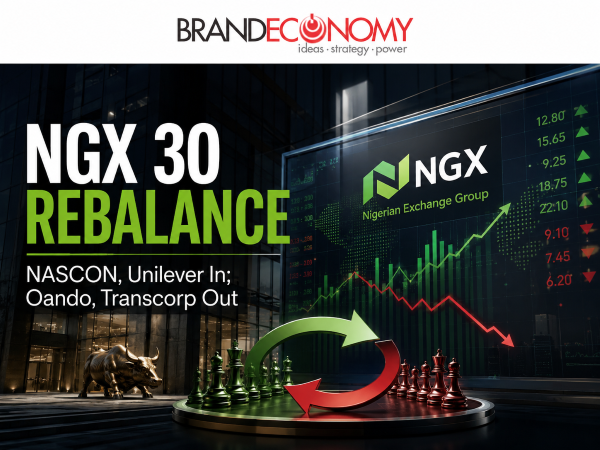 The Nigerian Exchange’s mid-year index review has reshaped the composition of its flagship NGX 30 Index, admitting NASCON Allied Industries and Unilever Nigeria while Oando and Transnational Corporation exit the benchmark. The changes reflect market capitalisation and liquidity dynamics—not a final verdict on the affected companies.
Nigeria’s stock market has refreshed one of its most closely watched scorecards.




In its Half-Year 2025 review of market indices, Nigerian Exchange Limited, NGX, admitted NASCON Allied Industries Plc and Unilever Nigeria Plc into the NGX 30 Index, while Oando Plc and Transnational Corporation Plc, widely known as Transcorp, exited the benchmark.
The changes took effect at the opening of trading on Tuesday, July 1, 2025, following NGX’s prescribed semi-annual rebalancing process.
At face value, it is an index adjustment. In market terms, it is a meaningful signal.
The NGX 30 is the Exchange’s flagship blue-chip benchmark. It tracks companies with strong adjusted market capitalisation and liquidity, providing a reference point for investors, fund managers, exchange-traded products and market analysts seeking to understand the changing shape of Nigeria’s listed corporate economy.
The latest review therefore places NASCON and Unilever Nigeria in a more prominent position within the country’s investable equity landscape, while reminding investors that index membership is dynamic. It is shaped by market value, trading activity and methodology—not sentiment, reputation or corporate history alone.
A Rebalance, Not a Corporate Verdict
The entry of NASCON and Unilever Nigeria should be seen as recognition of their improved fit within the NGX 30’s selection framework during the review period.
For NASCON, the development reinforces the strategic relevance of food, seasoning and consumer staples businesses in an inflation-sensitive economy. As households adjust spending patterns, companies operating in essential consumer categories often attract greater attention from investors looking for businesses with resilient demand profiles, broad distribution networks and the ability to defend volume or pricing.
For Unilever Nigeria, admission into the NGX 30 carries a different but equally important message. The company remains one of Nigeria’s most recognisable consumer-goods brands, with deep heritage across household, personal-care and food-related categories. Its return to the flagship benchmark strengthens its visibility among investors focused on liquid, large-cap and widely followed equities.
But inclusion should not be confused with a guarantee of future returns.
An index is not an award ceremony. It is a rules-based measure of market relevance at a particular point in time. A company can enter because its adjusted market capitalisation and trading activity have improved; it can exit later if market conditions, corporate actions, liquidity or valuation change.
That is precisely why index rebalancing matters: it keeps investment benchmarks aligned with the reality of the market rather than the memory of it.
What the Oando and Transcorp Exits Mean
The exit of Oando and Transcorp from the NGX 30 should also be read with discipline.
Neither development automatically suggests deterioration in the businesses themselves. Both companies remain important corporate names with distinct strategic footprints in Nigeria’s energy and diversified-investment landscape.
Oando operates in a sector closely tied to crude oil, gas, upstream assets, energy-policy shifts and foreign-exchange conditions. Transcorp, meanwhile, has built interests spanning power, hospitality and other strategic sectors through its wider group structure.
Their removal from the NGX 30 reflects the outcome of the index methodology during the review period. It does not erase their business relevance, sector influence or potential attractiveness to specific investors.
For portfolio managers, however, an exit can matter. Funds designed to replicate or track the NGX 30 may need to adjust their holdings. Analysts may review liquidity trends more closely. Investors may reassess the relative positioning of the companies within their sector and the wider market.
That is the practical value of an index review: it forces the market to examine change.
The Consumer Economy Gains Visibility
The entry of NASCON and Unilever Nigeria also gives the NGX 30 a stronger consumer-facing complexion.
Nigeria’s consumer sector has been under sustained pressure from inflation, currency adjustments, high input costs and weaker household purchasing power. Yet it remains central to the economy because millions of daily purchasing decisions—from food seasoning to home-care products—flow through its value chains.
Consumer companies sit at the intersection of manufacturing, agriculture, logistics, packaging, retail, marketing and household welfare.
Their performance can therefore offer important clues about the health of domestic demand.
A stronger representation of consumer-facing businesses within the NGX 30 may appeal to investors seeking exposure to companies with established brands, extensive distribution systems and products embedded in everyday consumption.
For NASCON and Unilever Nigeria, index membership also has brand value. It reinforces their visibility not just as operating companies, but as publicly traded corporate institutions that matter to the investment community.
In capital markets, perception is never a substitute for performance. But visibility can improve analyst coverage, institutional awareness and long-term investor engagement.
Changes Beyond the NGX 30
The review also produced significant movement across other NGX and co-branded indices.
Nestlé Nigeria Plc and Cadbury Nigeria Plc entered the NGX Lotus Islamic Index, while NASCON Allied Industries exited. The shift underscores the distinct eligibility screens and methodologies that shape ethical and faith-aligned investment benchmarks.
Stanbic IBTC Holdings Plc joined the Afrinvest Bank Value Index, with no company removed.
The Afrinvest Dividend Yield Index admitted Seplat Energy, Fidelity Bank, Stanbic IBTC Holdings, Custodian Investment and Nigerian Aviation Handling Company, NAHCO. Access Holdings exited the dividend-focused benchmark.
This is particularly relevant for income-oriented investors. Dividend indices are watched by investors seeking companies with a record or prospect of shareholder distributions, though admission into such a benchmark should still be assessed alongside earnings quality, cash flow, capital requirements and payout sustainability.
The Meristem Growth Index welcomed Eterna Plc and PZ Cussons Nigeria Plc, while BUA Cement, Guaranty Trust Holding Company, AXA Mansard Insurance, NAHCO, NASCON Allied Industries, Okomu Oil Palm, Lafarge Africa and Wema Bank were removed.
Meanwhile, the Meristem Value Index admitted Chemical and Allied Products, Honeywell Flour Mills, Dangote Cement, Linkage Assurance, Livestock Feeds, NASCON Allied Industries, Okomu Oil Palm and TotalEnergies Marketing Nigeria. Ecobank Transnational Incorporated, Guinness Nigeria and Zenith Bank exited the value benchmark.
The sectoral NGX Consumer Goods, Banking, Insurance, Industrial, Oil and Gas, Pension and Pension Broad indices recorded no constituent changes in the review.
Why Index Rebalancing Matters
Indices are often treated as technical financial instruments. In reality, they influence how capital sees the market.
They help fund managers construct portfolios. They allow ETFs and passive funds to track market segments. They offer benchmarks against which active portfolio managers are judged. They help retail investors understand which companies command size and liquidity within a market.
For Nigeria, stronger and more transparent indices are part of the architecture of a more investable capital market.
The more credible the benchmark, the easier it becomes for domestic and foreign investors to identify market opportunities, assess performance and deploy capital with confidence.
This is especially important as Nigeria seeks to deepen pension participation, attract long-term institutional capital and expand the number of listed companies available to investors.
Market Implications
The NGX 30 changes could trigger portfolio adjustments among investors and asset managers whose mandates are linked to the benchmark.
NASCON and Unilever Nigeria may receive increased investor attention as their inclusion raises their profile in blue-chip market discussions. Oando and Transcorp may face closer scrutiny from benchmark-sensitive investors, although their underlying business outlook will remain determined by strategy, operations, earnings, corporate actions and sector conditions.
The broader market signal is that consumer businesses are gaining renewed relevance in the investable universe, even as energy, banking, industrial and diversified groups continue to shape Nigeria’s equity-market story.
The review also highlights a central fact about Nigerian equities: market leadership is not static.
Inflation, interest rates, exchange-rate conditions, earnings resilience, sector rotation, investor appetite and liquidity can all reshape the market hierarchy within a relatively short period.
Brand Implications
For NASCON and Unilever Nigeria, entry into the NGX 30 strengthens an already valuable corporate signal: scale, relevance and visibility.
It offers an opportunity for both companies to communicate more actively with the investor community, demonstrate their growth strategies and reinforce the connection between brand strength and financial performance.
For Oando and Transcorp, the immediate task is not public relations. It is continued execution.
Strong brands in capital markets are built through credible disclosures, resilient strategy, clear governance, disciplined capital allocation and consistent engagement with shareholders.
Index membership can change. Corporate credibility must endure.
Investor Relevance
Investors should avoid treating index entry or exit as a buy-or-sell instruction.
The more useful approach is to ask deeper questions.
Can NASCON and Unilever sustain earnings under consumer-cost pressure? How are they managing input costs, pricing, distribution and working capital? What does their market positioning mean for long-term profitability?
For Oando and Transcorp, investors should focus on operating performance, balance-sheet quality, sector outlook, liquidity, governance, asset value and strategic execution.
Dividend-focused investors should examine the Afrinvest Dividend Yield Index changes carefully, but should not rely on yield alone. A high dividend yield can be attractive, yet it must be supported by sustainable earnings and cash generation.
The best investment decisions are built on fundamentals, not headlines.
BRANDECONOMY Insight
The NGX 30 review is a reminder that capital markets are living systems.
They reward relevance, liquidity, scale and investor attention. They also evolve as companies, sectors and market conditions change.
NASCON and Unilever Nigeria have gained a place in Nigeria’s premier equity benchmark at a time when consumer resilience, local manufacturing and brand power matter more than ever.
Oando and Transcorp have exited the index, but not the national economic conversation.
For investors, the lesson is simple: follow the benchmark, but understand the businesses behind it.
That is where lasting value is found.