

Nigeria’s Foreign Reserves Rise Above $51bn, But When Can Households Feel the Benefit?

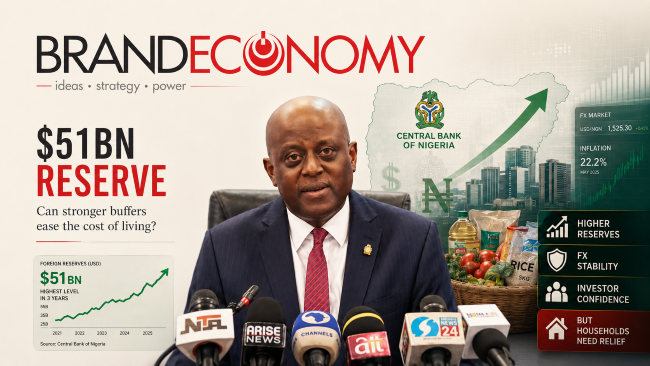 Nigeria’s foreign reserves have climbed to their strongest level in about 17 years. But for households battling food inflation, high rents, transport costs and shrinking purchasing power, the key question is not how much the country has saved—it is whether greater macroeconomic stability can translate into a more affordable daily life.
Nigeria’s foreign-exchange reserves are rising again. For policymakers, investors and international markets, that is an important signal of strengthening external buffers, improved confidence and a greater ability to withstand shocks.




For many Nigerian households, however, the reaction is likely to be more direct: will this make food cheaper, stabilise the naira, lower transport costs, improve wages or make essential medicines more affordable?
That tension sits at the heart of Nigeria’s current economic conversation.
Recent Central Bank of Nigeria data showed that the country’s gross external reserves crossed the $50 billion mark in June, before rising further to about $51 billion. The level represents Nigeria’s strongest reserve position since 2009 and provides a more comfortable cushion for meeting external obligations, supporting foreign-exchange market stability and managing volatility in global commodity prices or capital flows.
CBN Governor, Olayemi Cardoso, has described the reserve recovery as an important policy buffer, strengthened by market-driven reforms, improved export receipts, diaspora remittances, better foreign-exchange management and growing investor confidence.
The numbers matter.
But numbers alone do not feed families.
For millions of Nigerians, the real economy is still defined by expensive food, high electricity costs, rising transport fares, pressure on household income and businesses operating under difficult conditions.
The challenge for government is therefore not simply to accumulate reserves. It is to convert macroeconomic stability into microeconomic relief.
What Rising Reserves Actually Mean
Foreign reserves are not a national savings account that can simply be shared directly with citizens.
They are foreign-currency assets held by the central bank to support the country’s ability to pay for imports, service external obligations, manage exchange-rate pressure and protect the economy against sudden shocks.
A stronger reserve position can improve confidence in the naira. It can make it easier for the central bank to manage disorderly volatility in the foreign-exchange market. It can reassure investors, lenders and international trading partners that Nigeria has a stronger capacity to meet external commitments.
In practical terms, reserves are an economic shock absorber.
They matter when oil prices fall. They matter when foreign investors withdraw capital. They matter when import demand rises. They matter when the country needs to manage food, fuel, medical, industrial or infrastructure-related import requirements.
They also matter because Nigeria remains deeply exposed to external pressures.
A country with weak reserves can find itself forced into abrupt currency adjustments, import restrictions, debt stress or emergency borrowing. A country with stronger buffers has more room to respond calmly.
That is the macroeconomic benefit.
But stronger reserves do not automatically reduce market prices.
The transmission from reserves to households must pass through exchange-rate stability, lower inflation expectations, reduced import costs, stronger production, improved incomes and more effective public policy.
That is where Nigeria’s real test now begins.
The Cost-of-Living Question
Economist Bayo Dada argues that macroeconomic performance should not be judged only through foreign reserve figures, growth data or policy announcements.
The ultimate measure, he says, is whether ordinary Nigerians can afford basic needs, whether businesses are expanding, whether jobs are being created and whether families are better off than they were before.
His argument captures a widespread public sentiment.
Many Nigerians do not experience the economy through reserve statistics. They experience it through the price of rice, cooking gas, medicines, school fees, rent, transportation and electricity.
“People do not live inside economic reports; they live in the real economy,” Dada said.
That is the political and economic challenge facing the Federal Government.
The country may be improving its macroeconomic credibility. But the benefits must become visible in the cost structure of households and businesses.
If foreign reserves rise while food, housing, fuel, logistics and borrowing costs remain painfully high, public confidence in economic reform will remain limited.
Why Foreign Reserves Matter to Inflation
Stronger reserves can support lower inflation, but only indirectly.
When the foreign-exchange market is more stable, importers are better able to plan. Manufacturers can price raw materials with greater certainty. Pharmacies can manage medicine imports more predictably. Airlines, transport operators, food processors and retailers can make decisions without constantly repricing products for currency volatility.
That stability can reduce one source of inflation.
But Nigeria’s inflation challenge is wider than foreign exchange.
Food prices are also shaped by insecurity, farm productivity, storage gaps, transport costs, middlemen margins, climate risks, energy costs and poor rural infrastructure. Housing costs are influenced by building materials, land prices, finance, urban migration and weak affordable-housing supply. Transport costs are affected by fuel prices, road conditions and the cost of maintaining vehicles.
A stronger foreign reserve position can help stabilise the economy. It cannot by itself fix structural supply problems.
This is why the next phase of reform must move beyond stabilisation into production.
Nigeria needs more food, more local manufacturing, more affordable logistics, more energy reliability and more jobs that improve household purchasing power.
“Do Not Just Accumulate Assets—Build Productive Capacity”
Policy analyst Sule Aliu argues that the importance of foreign reserves should be measured by whether they support wider economic transformation.
For him, the goal is not simply to hold more foreign assets. It is to create a diversified, productive economy that can sustain growth and improve citizens’ welfare over time.
That distinction is critical.
A reserve build-up driven solely by short-term portfolio inflows can be vulnerable if investors later exit. A reserve build-up supported by oil receipts, non-oil exports, diaspora remittances, foreign direct investment, stronger manufacturing and improved services exports is more durable.
The quality of reserves matters as much as the quantity.
Nigeria must therefore continue to broaden the sources of foreign exchange.
Oil remains important. But a more resilient external sector will depend increasingly on agricultural exports, digital services, creative industries, manufacturing, solid minerals, tourism, logistics, technology and diaspora investment.
The country’s long-term aim should be to earn foreign exchange through production—not merely manage scarcity more efficiently.
Why Nigerians Are Demanding More
For civil servants, workers, pensioners, small-business owners and informal traders, reserve growth can feel distant from everyday survival.
Ibrahim Muhammed, a civil servant, questioned the practical relevance of rising reserves in an environment where households are still struggling with the purchasing power of wages.
He pointed to the ₦70,000 minimum wage, unpaid wage-award arrears and the wider gap between official economic progress and the lived reality of workers.
His concern reflects a broader issue: macroeconomic recovery must eventually reach incomes.
An economy cannot sustain reform momentum if wage earners, entrepreneurs and vulnerable households feel excluded from its benefits.
Nigeria’s policy challenge is therefore twofold.
The first is to protect the gains already achieved in foreign-exchange stability, reserve accumulation and investor confidence.
The second is to accelerate reforms that lower the cost of producing, moving and consuming essential goods.
What Government Should Do With the Stability Dividend
The Federal Government should resist the temptation to treat stronger reserves as an excuse for uncontrolled spending or artificial exchange-rate defence.
Reserves must remain a strategic buffer.
But the stability they create should enable more decisive economic action.
The priority areas are clear.
Nigeria needs a food-cost reduction plan built around security, irrigation, storage, rural roads, fertiliser access, mechanisation and more efficient market linkages.
It needs lower energy costs for manufacturers, SMEs and households through reforms in power generation, transmission, distribution and decentralised renewable-energy systems.
It needs targeted support for local manufacturing, particularly in sectors that reduce import dependence and create jobs.
It needs better logistics infrastructure to lower the cost of moving goods from farms and factories to markets.
It needs affordable housing finance and stronger urban-planning responses to rising rents.
And it needs a more credible wage and social-protection framework for workers facing high living costs.
The objective should not be to spend reserves directly on consumption. It should be to use macroeconomic stability as a platform for reforms that make the economy more productive and less expensive to live in.
Market Implications: A Stronger Signal to Investors
For investors, the rise in external reserves is positive.
It reduces the perception of external-sector vulnerability. It supports confidence in the foreign-exchange market. It improves Nigeria’s ability to meet external obligations. It can also reduce uncertainty for companies that depend on imported equipment, raw materials, technology or foreign-currency financing.
Banks, manufacturers, airlines, telecoms operators, pharmaceuticals companies, consumer-goods firms and infrastructure developers all benefit from a more predictable foreign-exchange environment.
However, investors will look beyond reserve figures.
They will want to see whether reserve growth is sustained, whether the naira remains stable, whether inflation continues to moderate, whether foreign-exchange liquidity improves and whether productive sectors can access credit at viable rates.
The reserve number is an important indicator. It is not the whole investment case.
Brand Implications: Government Must Connect Reform to Reality
For the Federal Government and the CBN, communication is now as important as achievement.
A reserve milestone can strengthen Nigeria’s economic brand abroad. It signals improved policy credibility, stronger buffers and a more resilient external position.
But domestically, government must explain how macroeconomic gains will become household gains.
Citizens need to understand the pathway from reserves to stability, from stability to lower inflation, from lower inflation to stronger purchasing power, and from stronger purchasing power to improved quality of life.
Without that connection, reserve growth may be seen as a technical achievement with little human meaning.
The strongest national economic brands are built when policy credibility and citizen welfare move together.
BRANDECONOMY Insight
Nigeria’s rising foreign reserves are good news. They represent a stronger national cushion and a better foundation for exchange-rate stability, investor confidence and external resilience.
But reserves are not the destination.
They are the breathing space Nigeria needs to solve deeper problems.
The true success of a $51 billion reserve position will not be measured by the headline figure alone. It will be measured by whether food becomes more affordable, whether manufacturers can produce more competitively, whether wages regain value, whether jobs expand and whether households begin to feel relief.
Nigeria has rebuilt an important macroeconomic buffer.
The next task is to turn that buffer into better living conditions.
That is the difference between an economy that looks stronger on paper and one that feels stronger in people’s lives.