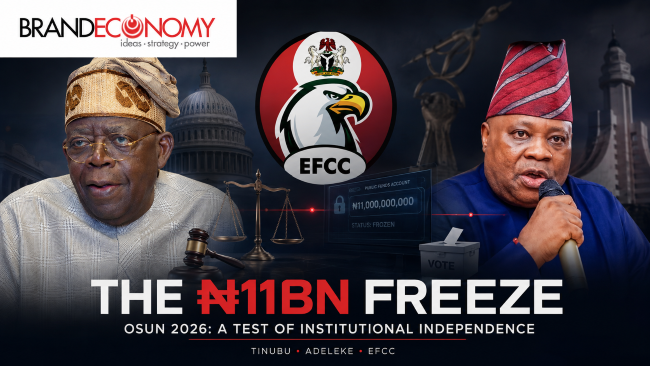
Tinubu, EFCC and the Frozen ₦11bn: The Osun Election Has Become a Test of Institutional Independence

 There are moments when a democracy is tested not principally by who wins an election, but by how its institutions behave while the contest is still undecided.
Nigeria may have arrived at one of those moments in Osun State.




Barely inside the final ten days before the August 15, 2026 governorship election, President Bola Ahmed Tinubu has reportedly directed the Economic and Financial Crimes Commission to return to court and seek the lifting of an order freezing accounts belonging to the Osun State Government.
The President’s stated concern goes to the heart of electoral legitimacy: an enforcement action of such magnitude, arriving so close to an election, could damage public confidence in the neutrality of the process.
Yet the intervention creates an uncomfortable second question.
If presidential intervention is required to stop an anti-corruption agency from taking an action capable of distorting electoral perceptions, does that demonstrate responsible presidential restraint—or does it inadvertently confirm that the agency’s operational decisions remain susceptible to presidential direction?
That is why this story is ultimately bigger than Governor Ademola Adeleke, President Tinubu, the EFCC or even the disputed ₦11 billion.
It is about the architecture of Nigerian institutional power.
The ₦11bn question
According to the EFCC’s account of the investigation, the Commission has been examining the handling of approximately ₦11 billion involving ecology funds, intervention monies and Federation Account Allocation Committee receipts.
The investigation reportedly began in March, meaning it did not originate during the final days of the campaign.
The Commission is also examining transactions it considers suspicious, including more recent transfers. Osun State disputes the allegations and has argued that the investigation, particularly its timing and coercive consequences, carries the appearance of political motivation.
Those are competing positions. Neither should be converted into a verdict.
A suspicious transaction is not proof of theft. An investigation is not a conviction. Equally, an allegation of political persecution cannot by itself invalidate evidence of financial impropriety if credible evidence exists.
The appropriate destination for both propositions is evidence, due process and ultimately the courts—not campaign rhetoric.
This distinction becomes particularly important because account freezing is primarily a preservative investigative measure. It can prevent suspected proceeds from disappearing while investigators establish their provenance. It does not constitute a judicial determination that the account holder has committed an offence.
The court is not a footnote
The legal architecture matters.
Under the EFCC framework, the Commission can approach a court for an order freezing an account when statutory conditions are met. The judicial component is important precisely because freezing assets is an extraordinary interference with access to property and money.
That means Tinubu cannot simply “unfreeze” Osun’s accounts by presidential pronouncement.
If a competent court made the order, the proper route for altering or discharging that order is another judicial decision. Directing the EFCC to return to court therefore respects an essential separation-of-powers boundary: the President is not substituting himself for the judge.
But that answers only the narrow procedural question.
It does not dispose of the institutional one.
Why should the President be determining whether the EFCC ought to persist with a case-specific asset-preservation measure in the first place?
Independence problem number one: Why now?
The EFCC faces an exceptionally difficult dilemma.
If credible evidence suggests that public money is about to be dissipated, an anti-corruption institution cannot suspend the law merely because politicians are campaigning.
An automatic “no enforcement before elections” rule would create an extraordinary immunity window. Political officeholders could schedule questionable transactions around election periods knowing that enforcement agencies would be afraid to act.
That would be absurd.
Institutional neutrality therefore cannot mean institutional paralysis.
But neutrality also requires agencies to recognise the extraordinary coercive power of the state during elections.
Freezing a government’s operational accounts shortly before citizens vote is qualitatively different from issuing an invitation for questioning or continuing a forensic audit.
Depending on the breadth of the order, an account freeze can affect salaries, contractors, healthcare programmes, schools, vendors and other government obligations. The economic impact may move rapidly from a legal dispute in Abuja into household incomes and business cash flows across Osun.
That makes timing, proportionality and necessity legitimate questions.
If the investigation began in March but the need for a freeze became urgent only days before the election, the EFCC should be able—without compromising confidential evidence—to explain what materially changed.
Was there a new transaction?
Was money at imminent risk of disappearing?
Was the order narrowly targeted at accounts or sums connected with the suspected transactions?
Could the investigative objective have been secured while ring-fencing essential public expenditure?
These are not questions designed to obstruct anti-corruption enforcement. They are precisely the questions a professional enforcement institution should expect when exercising extraordinary powers.
Independence problem number two: Who ordered the retreat?
Here lies the deeper paradox.
President Tinubu’s intervention may reduce the immediate danger that the freeze becomes a defining issue in the August 15 election. It may reassure voters that the federal government does not wish to use a financial enforcement mechanism to handicap an opposition-controlled state at the ballot box.
But what protects today’s beneficial intervention from becoming tomorrow’s harmful one?
If a President may tell an enforcement institution to retreat from a sensitive case because the timing is politically damaging, could another President tell it to accelerate one because the timing is politically useful?
Institutional independence cannot depend on whether presidential instructions are benevolent.
It must depend on whether presidents need to give such case-specific instructions at all.
That distinction matters because international anti-corruption standards do not merely require specialised agencies to exist. They emphasise the operational independence necessary to perform their functions effectively and without undue influence.
Nigeria’s own institutional history makes this particularly sensitive. The statutory architecture of the EFCC gives the Presidency significant influence over its leadership, including appointment and removal powers. That arrangement has repeatedly generated calls for stronger structural protection for the Commission.
The Osun controversy demonstrates why the debate is not academic.
The objective should not be an EFCC hostile to the Presidency. It should be an EFCC professionally indifferent to presidential political interests.
An election already carrying institutional baggage
The timing could hardly be more combustible.
Governor Adeleke, now seeking another term on the platform of Accord, goes into the election against an APC machine seeking to return Osun to its column. The APC candidate, Bola Oyebamiji, has publicly projected himself as enjoying President Tinubu’s political backing.
Osun has also spent a prolonged period locked in a separate battle with federal authorities over local-government allocations.
None of those facts establishes that the present EFCC investigation is politically motivated.
They do, however, create the context within which citizens will interpret it.
Institutions do not operate in a laboratory. Credibility depends both on what they do and whether similarly situated actors can reasonably expect similar treatment.
An enforcement decision that might appear routine in the middle of a governing term can assume enormous political significance days before voting.
This is why institutional reputation is an asset that must be managed with the same seriousness as legal authority.
Public money cannot become electoral ammunition
There is another danger.
The underlying allegations themselves must not disappear beneath the politics.
Ecology funds, intervention financing and FAAC receipts are public resources. If money intended for public purposes has been illegally diverted, Nigerians deserve an investigation regardless of which party controls the affected government.
Osun’s strongest defence, therefore, cannot merely be that the investigation is political.
It should be documentary transparency.
The state should be prepared to establish the origin, destination, approval trail and public purpose of every material transaction questioned by investigators.
Bank statements, payment mandates, appropriation authority, procurement records and beneficiary documentation ultimately carry more weight than political outrage.
Conversely, EFCC must show through professional conduct that its investigation is about following money—not shaping votes.
The standard must survive election day.
If the Commission considers the transactions worthy of investigation on August 6, they should remain worthy of investigation on August 16, irrespective of who wins.
That continuity would be one of the strongest possible demonstrations that the investigation was institutional rather than electoral.
Market Implications: Political risk has a balance sheet
Investors should pay attention because the controversy illustrates a dimension of Nigerian political risk often underestimated.
Political risk is not limited to violence, coups or disputed election results. It includes whether institutions apply rules predictably, whether government accounts can become entangled in political contests, whether court orders are respected and whether enforcement decisions are insulated from partisan calculations.
For businesses operating in Osun, a broad government-account freeze could potentially affect receivables, contracts and supply chains if public payments are interrupted.
For lenders and institutional investors evaluating Nigeria more broadly, repeated conflict between federal institutions and subnational governments raises questions about fiscal predictability.
At sovereign level, institutional quality ultimately enters the cost of capital.
Investors place a premium on countries where regulators, prosecutors, courts and governments operate through predictable rules rather than discretionary interventions. The reverse produces what may be called a governance discount: more risk must be priced into investment decisions because institutional outcomes are harder to anticipate.
That is why an ₦11 billion dispute in Osun can carry meaning far beyond ₦11 billion.
Brand Implications: Four reputations are on trial
For the EFCC, the core brand promise is fearless enforcement without partisan preference. Its most valuable currency is not arrest statistics; it is public confidence that the same evidence produces the same institutional response regardless of party.
For the Tinubu Presidency, instructing the EFCC to seek judicial reconsideration may project restraint and concern for electoral legitimacy. But the Presidency must avoid leaving an even more damaging impression—that enforcement decisions are adjustable from Aso Rock.
For the Osun State Government, victimhood is not a substitute for accountability. If it believes the allegations are false, radical financial transparency offers the most powerful answer.
For Nigeria’s democratic brand, particularly before diplomatic missions, election observers and foreign investors, the question is whether powerful institutions can exercise authority without contaminating political competition.
INEC may have nothing to do with the EFCC investigation, but confidence in an election is ecological. Actions by police, prosecutors, security agencies, courts, governments and financial institutions can collectively strengthen or weaken perceptions of fairness.
The protocol Nigeria now needs
The answer is neither an anti-corruption holiday before elections nor unrestricted enforcement without regard for electoral consequences.
Nigeria needs a formal election-period enforcement protocol for anti-corruption agencies.
Investigations should continue uninterrupted. Urgent asset-preservation measures should remain available where evidence establishes genuine risk. But extraordinary interventions close to elections should carry enhanced requirements for documented necessity, proportionality and internal professional review.
Where public-service accounts are involved, courts should be encouraged to distinguish suspected funds from unrelated operational money wherever practicable.
Agencies should disclose the chronology and legal basis of major actions to the extent permissible without compromising investigations.
Most importantly, exactly the same investigation should continue after the election.
Such a framework would protect the agency from two opposite dangers: pressure to attack political opponents and pressure to protect political allies.
BRANDECONOMY Insight
The defining sentence from the Osun affair should be this:
Anti-corruption institutions must be protected from both partisan acceleration and partisan braking.
If EFCC rushed an otherwise non-urgent freeze because an election was approaching, institutional independence would have failed.
If EFCC abandons a legitimate investigation because a President says its timing has become politically inconvenient, independence would also have failed.
The mature solution lies between those extremes.
Let the court determine whether the freezing order remains necessary and proportionate. Let the EFCC continue following the evidence. Let Osun State produce the complete financial trail. Let politicians stop converting investigative allegations into campaign verdicts. And after August 15, let precisely the same investigative standard remain in force.
President Tinubu’s immediate intervention may defuse an electoral grenade. But Nigeria should not require presidential discretion every time institutional power collides with political timing.
The real reform is to build institutions strong enough that the President neither needs to order them forward nor call them back.
That is the collector’s-item lesson of Osun 2026.
The true contest is not Tinubu versus Adeleke, EFCC versus Osun or APC versus Accord.
It is rules versus discretion.
And long after the ballots have been counted, that contest will matter more to Nigeria’s democracy, investment climate and national brand than the name of the next occupant of the Osun Government House.