Nigeria’s Digital Consumer Trap: Can AI Turn the Country from Buyer to Builder?

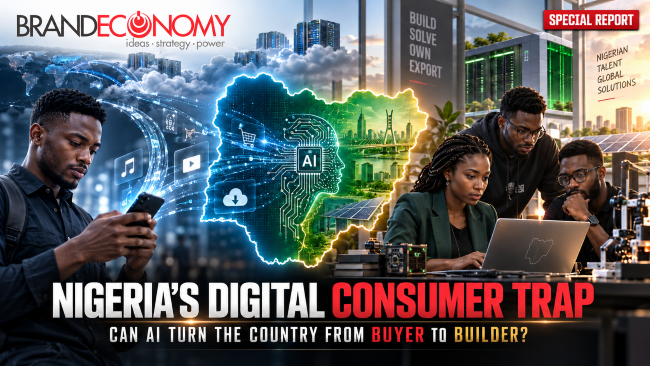 Nigeria has become an enormous market for devices, platforms, cloud services and now generative AI. The next contest is not about how quickly the country adopts the technology, but how much of the digital intelligence, infrastructure, intellectual property and income it can own.
| 11.74% Information & Communication share of real GDP, Q2 2026 | 55.67% Broadband penetration by April 2026 | $4.8tn Projected global AI market by 2033 | 0.2% → 4% Africa’s 10-year GDP gain: current path vs stronger foundations |


A giant market at the shallow end of the value chain
Every morning, millions of Nigerians wake up inside a digital economy largely designed, financed and hosted elsewhere. A trader promotes stock on WhatsApp. A student asks a foreign chatbot to explain an assignment. A bank runs customer analytics on imported cloud infrastructure. A creative studio pays for image, video and copy tools priced in dollars. A small business buys ads from global platforms to reach customers who already live down the road.
There is real value in this behaviour. Digital tools reduce friction, widen access and increase productivity. Consumption is not failure. Permanent consumption, however, is a development strategy with a ceiling. When the devices are imported, the operating systems are foreign, the cloud bill leaves in hard currency, the models are trained elsewhere and the most valuable behavioural data strengthens someone else’s platform, a large user base can coexist with thin domestic value capture.
That is Nigeria’s digital consumer trap: scale without proportionate ownership; adoption without sufficient production; traffic without enough intellectual property. The country supplies attention, data, culture, labour and demand, but captures too little of the infrastructure rent, software margin, model value and export income generated around them.
The paradox is especially stark because the digital economy is no longer peripheral. National Bureau of Statistics data show that Information and Communication accounted for 11.74 per cent of real GDP in the second quarter of 2026. Yet telecommunications and information services alone supplied 9.72 per cent of GDP, meaning much of the sector’s weight still comes from connectivity and distribution rather than a broad layer of locally owned software, advanced computing and high-value digital products.
Nigeria is undeniably online. Broadband penetration reached about 55.67 per cent by April 2026, while active internet subscriptions were roughly 153.8 million in March. But connectivity measures the size of the doorway, not who owns the shop beyond it.
| The real AI race is not between countries that use the technology and countries that do not. It is between countries that convert use into capability and those that convert it into another import bill. |
AI arrives as both ladder and trapdoor
Artificial intelligence changes the economics of building. A small Nigerian team can now prototype software, translate content, analyse records, generate code and serve customers at a speed that once required a large company. Open-source models reduce entry barriers. Cloud access allows firms to rent computing power instead of owning a data centre. This can compress the distance between an idea in Yaba, Kano or Aba and a product sold across Africa.
But the same technology can deepen dependency. Every foreign-model subscription paid in dollars, every local workflow surrendered to a proprietary platform and every public dataset uploaded without enforceable rights can move Nigeria further downstream. The country may become more efficient while remaining structurally dependent: better at using other people’s intelligence, but no better at owning the systems that organise its economy.
UN Trade and Development projects the global AI market to grow from about $189 billion in 2023 to $4.8 trillion by 2033. That extraordinary expansion will not be evenly shared. Compute, advanced chips, foundational models, cloud distribution and venture finance are already concentrated among a small group of countries and companies. In this market, late adoption is risky, but shallow adoption may be just as costly.
The International Monetary Fund puts the choice in development terms. On present preparedness, it estimates AI may add only about 0.2 per cent to sub-Saharan Africa’s GDP over the next decade. With reliable electricity, affordable internet, stronger skills, trusted rules and diffusion beyond elite firms, the gain could approach 4 per cent. The difference is not produced by enthusiasm. It is produced by foundations.
Nigeria therefore needs to avoid two seductive errors. The first is to mistake prompt proficiency for technological sovereignty. A nation does not become an AI power because many citizens can use chatbots. The second is to believe sovereignty requires reproducing every layer of the American or Chinese AI stack. Nigeria does not need to spend tens of billions of dollars training the world’s largest frontier model. It does need enough capacity to adapt models, secure sensitive data, build domain products, bargain with global providers and keep a meaningful share of the resulting value at home.
The builder test: who owns what?
The buyer-to-builder shift should be measured across a value ladder, not celebrated through isolated launches. At the bottom is access: Nigerians can connect to AI tools. Next is adoption: organisations use them in existing work. Adaptation follows: models are tuned to Nigerian languages, records and constraints. Production comes when local teams build products that customers pay for. Ownership is achieved when Nigerian entities control defensible data, intellectual property, distribution, infrastructure or standards. Export power arrives when those assets earn revenue beyond the country.
Most public debate stops at adoption. The economically decisive steps begin after it.
| Stage | What it means | Value captured | National test |
| Access | Citizens can use AI tools | Convenience | Is access affordable and inclusive? |
| Adoption | Firms add AI to workflows | Productivity | Does it improve output, jobs and service? |
| Adaptation | Models learn local data and context | Relevance | Are language, culture and sector realities represented? |
| Production | Local teams sell AI products | Revenue and jobs | Are Nigerian solutions winning paying customers? |
| Ownership | Local actors control IP, data or infrastructure | Rents and bargaining power | Who owns the moat and sets the terms? |
| Export | Products scale across Africa and beyond | Foreign earnings | Can Nigerian AI travel? |
Nigeria is not starting from zero
The most useful evidence is Nigeria’s own fintech history. The country once depended almost entirely on imported financial software and cash-heavy banking. It then built national payment rails, switching infrastructure, merchant tools and consumer platforms around stubborn local frictions. NIBSS says Nigeria’s digital payments ecosystem processed about ₦1.07 quadrillion in transaction value in 2024 across 11.2 billion transfers. Companies such as Interswitch, Paystack, Flutterwave and Moniepoint did not invent the internet or the payment card. They combined existing technologies with local knowledge, regulatory access, distribution and relentless problem-solving.
That is the more realistic AI template. Nigeria’s advantage will rarely be the base model alone. It will be the last mile: the agricultural records a foreign laboratory does not possess; the multilingual voice interface that works for a low-literacy user; the fraud patterns inside local payment networks; the distribution relationship with millions of merchants; the clinical workflow that matches an overstretched hospital; the trust required for a citizen to act on an automated recommendation.
Early building blocks are appearing. The National Artificial Intelligence Strategy, released in 2025, organises the national ambition around infrastructure, ecosystem development, sector adoption, responsible use and governance. N-ATLAS, developed with Awarri, was launched as an open-source multilingual language model intended to represent Nigerian voices. GovGuide Nigeria, built locally on open-source models, offers voice and text access to government information in English, Hausa, Igbo and Yoruba. The 3 Million Technical Talent programme says its first two phases are designed to train 300,000 people, with AI, machine learning, cloud computing, software development, data science and cybersecurity among the focus areas.
These are signals of intent, not proof of transformation. A model launch does not automatically produce a product ecosystem. A training certificate does not guarantee a job, research capability or exportable intellectual property. A strategy is not an execution budget. Nigeria has often been excellent at announcing platforms and less consistent at maintaining, measuring and procuring from them.
The country’s own AI strategy is candid about the weaknesses: unreliable energy and telecommunications infrastructure, limited investment in research and development, brain drain, governance uncertainty and scarce high-performance computing. It cites national R&D expenditure of roughly 0.2 per cent of GDP against a global average of about 2.2 per cent. That gap is not a footnote. It is the distance between using yesterday’s tools and helping to shape tomorrow’s.
A cloud policy aimed at the heart of the problem
The National Digital Cloud Policy unveiled in August 2026 may be the clearest official acknowledgement yet that Nigeria must move beyond being a large customer of global infrastructure. It proposes government demand aggregation, a national digital marketplace, incentives for data-centre and cloud investment, defined safeguards for sensitive data, technology-transfer obligations and regional digital-service exports.
The initial targets are material: $250 million in private investment within 12 months and $750 million within 24 months, alongside Project BRIDGE’s plan for at least 90,000 kilometres of additional fibre. The policy also treats government procurement as anchor demand capable of making domestic infrastructure bankable.
This is the right industrial logic. Yet execution will decide whether it creates genuine capability or merely subsidises imported equipment and foreign providers. Incentives must be tied to local engineering depth, uptime, energy efficiency, cybersecurity, skills transfer, open standards and measurable export earnings. ‘Hosted in Nigeria’ is not identical to ‘owned by Nigeria’; nor is ownership meaningful if the service is unreliable, uncompetitive or cut off from world-class technology.
The winning posture is therefore open sovereignty: collaborate globally, preserve competition and use the best available models, while retaining control over critical data, public-interest systems, negotiation leverage and local value creation. Digital autarky would be expensive and obsolete. Digital helplessness would be worse.
| Nigeria does not have to own every layer of AI. It must own enough strategic layers to prevent its market, data and talent from becoming raw materials for somebody else’s prosperity. |
Six conversion engines from consumption to capability
1. Build around Nigerian problems, not imported demos
Nigeria’s AI opportunity is strongest where complexity, scarcity and scale meet. The most investable products will not be generic chatbot wrappers with fragile margins. They will solve expensive, repeated problems in agriculture, healthcare, education, logistics, manufacturing, financial services, energy and government.
A smallholder tool should work through voice, local language and low bandwidth, not assume a premium smartphone. A clinical assistant should support nurses and doctors without pretending to replace them. A retail product should understand informal inventory, cash conversion and fragmented distribution. A tax or customs system should improve compliance while preserving contestability and human review. Local constraint is not an embarrassment; it is product intelligence and, potentially, an export advantage across similar markets.
2. Turn data into governed national productive capital
AI depends on data, but ‘more data’ is not a strategy. Nigeria needs interoperable, machine-readable and privacy-respecting datasets in high-value domains: crop conditions, disease patterns, transport flows, education outcomes, climate risk, commerce, languages and public administration. These should be assembled with clear consent, provenance, access rules, security and benefit sharing.
The Nigeria Data Protection Act and its implementation framework provide a trust foundation. The next step is operational: standard contracts for data partnerships, independent audits for high-risk systems, impact assessments, secure research environments and rules preventing public data from being exchanged for vague promises of innovation. Trust is not a brake on AI. In sectors such as finance and health, it is the licence to scale.
3. Treat compute, power and fibre as productive infrastructure
Compute is to the AI economy what machine tools were to industrialisation: not glamorous to the average consumer, but decisive for producers. Nigeria’s 2024 pilot commitments—more than one petabyte of storage for AI projects and over $2 million in graphics-processing investment—were useful seeds. They remain small beside the scale of global infrastructure.
The answer is not a prestige supercomputer operating at low utilisation. It is a tiered compute system: subsidised research credits; shared facilities for universities and startups; commercially operated data centres; edge computing for latency-sensitive services; and regional partnerships for workloads Nigeria cannot economically host alone. Every tier requires reliable energy. The International Energy Agency estimates that a typical AI-focused data centre can consume electricity comparable to 100,000 households. Power planning and AI planning are now the same conversation.
4. Use procurement as industrial policy—with discipline
Government is Nigeria’s largest potential buyer of civic AI. Its purchasing power can create the first serious customer for local products in health, education, identity, agriculture, revenue, justice and public information. But local preference without performance standards can protect mediocrity and political patronage.
Procurement should therefore be challenge-based, transparent and milestone-driven. Agencies should publish problems and datasets; competing teams should build pilots; independent users should test outcomes; contracts should expand only when accuracy, inclusion, cost and service benchmarks are met. The state should buy outcomes, not slogans. Where public money creates reusable code or data infrastructure, open standards and appropriate public-interest rights should be the default.
5. Finance patient products, not fashionable pitches
African technology funding rebounded in 2025, with Partech reporting $4.1 billion raised across the continent, but the structure of capital still matters. AI businesses selling to farms, hospitals, factories and government often face long validation and procurement cycles. They cannot be financed solely by short-duration venture capital chasing rapid consumer growth.
Nigeria needs a blended capital stack: grants for research and datasets; seed equity for teams; concessional debt for infrastructure; corporate venture funding tied to real use cases; procurement-backed finance; and growth capital for exporters. Pension funds and insurers should not be pushed into speculative startup bets, but regulated vehicles can give institutional capital diversified exposure to digital infrastructure and proven technology companies.
6. Convert training into teams, products and patents
Mass training is necessary, but Nigeria should stop treating the number of learners as the ultimate output. The builder metrics are harder: completed apprenticeships, deployed products, research citations, patents, open datasets, locally retained engineers, export revenue, and firms that survive beyond grant cycles.
Universities require shared compute, industry-sponsored laboratories and promotion systems that reward applied research and commercialisation. Companies need apprenticeship pipelines that place product managers, domain experts, software engineers, designers and ethicists together. The country’s diaspora should be engaged through joint laboratories, visiting appointments, co-investment and remote mentorship—not only through appeals to return permanently.
Where Nigeria can build defensible AI
Agriculture and food systems: Local weather, soil, crop, market and logistics data can power advisory services, disease detection, credit scoring and demand forecasting. The moat is the field network and verified data—not the chatbot interface.
Health and life sciences: Clinical decision support, imaging assistance, claims analytics, drug-supply forecasting and voice-based triage can extend scarce expertise. Strong validation, data governance and human accountability are non-negotiable.
Financial services and commerce: Nigeria’s payment rails and merchant networks offer rich distribution for fraud detection, credit, customer service and SME operating tools. The danger is opaque exclusion: automated decisions must remain explainable and appealable.
Education and workforce: Low-cost tutors can personalise learning, translate instruction and support teachers. Products must align with curricula, work on weak connections and prove learning gains rather than merely generate answers.
Manufacturing, energy and logistics: Predictive maintenance, route optimisation, quality inspection, load management and procurement intelligence can shift AI from consumer novelty to industrial productivity.
Languages, media and culture: Nigeria’s linguistic and creative diversity is a strategic dataset. Speech, translation, dubbing, search, rights management and culturally grounded models can become export products—if creators are compensated and intellectual property is protected.
Market implications: the margin migrates
AI will reduce the cost of routine production in marketing, customer service, analysis, software and administration. That does not mean value disappears; it moves. Generic output becomes cheaper. Proprietary data, distribution, judgement, trust, integration and accountability become more valuable.
Telecom operators can move from selling data bundles to providing edge services, identity, cloud, cybersecurity and enterprise AI infrastructure. Banks can evolve from using AI only for cost reduction into platforms that help customers manage cash flow, trade and risk. FMCG companies can build demand-sensing and route-to-market intelligence across fragmented retail. Insurers can improve claims and underwriting while designing products for previously invisible customers. Media companies can use AI to widen language reach, but their premium advantage will be verified reporting, authority and distinctive analysis—not undifferentiated volume.
For small firms, AI lowers the cost of capability but raises the standard of competition. A Lagos agency is no longer competing only with the agency next door; it is competing with a global freelancer using the same tools. The defence is domain expertise, client intimacy, proprietary processes and the ability to convert AI output into commercial outcomes.
Brand implications: trust becomes technological capital
Brands face a deceptively simple choice: deploy AI as an invisible cost cutter or build it as a visible trust system. Consumers will judge not only whether an automated service is fast, but whether it is accurate, fair, understandable, secure and culturally literate.
A Nigerian brand’s AI advantage will come from five disciplines: disclose when customers are dealing with a machine; obtain meaningful consent for data use; retain human escalation for consequential decisions; test performance across language, gender, region and income groups; and measure the customer outcome, not merely the reduction in headcount.
Companies that treat customer conversations as free training material may win a short-term efficiency and lose long-term legitimacy. Companies that build privacy, accountability and local relevance into the experience can turn trust into a moat. In the AI age, brand promise and model behaviour become the same thing.
Investor relevance: follow ownership, not noise
The most compelling Nigerian AI investments may sit outside headline-grabbing consumer apps. The picks-and-shovels layer—reliable power, fibre, data centres, cybersecurity, data engineering, identity, payments, model evaluation and compliance—can earn across multiple use cases. Vertical software in regulated or operationally complex sectors can also defend margins because it is embedded in workflows and difficult to replace.
Investors should ask six questions before accepting an ‘AI company’ label:
- Is the product solving a costly and frequent problem, or merely adding a chatbot to an existing service?
- What does the company own: data rights, distribution, workflow integration, intellectual property, specialised talent or customer trust?
- How exposed are its costs to dollar-priced cloud services, foreign APIs and naira volatility?
- Can it operate under Nigeria’s power, bandwidth and device constraints?
- Does the model’s performance improve with locally generated data—and can that data be used lawfully?
- Is there a credible path from Nigerian product-market fit to regional export revenue?
Risks are equally clear: regulatory uncertainty, weak data quality, public-sector payment delays, cyber breaches, talent flight, infrastructure cost and dependence on a single foreign model provider. The best companies will design around these risks rather than hide them in a pitch deck.
The scoreboard Nigeria actually needs
Nigeria’s AI progress should be published on a public annual dashboard. Useful indicators would include domestic AI and R&D investment; accessible compute hours; cost and uptime of cloud services; number of high-quality local datasets; revenue and exports from Nigerian AI products; public-sector contracts won on merit; deployed systems independently audited; talent placed in paid work; women and regions represented; and productivity gains in priority sectors.
A country can rise in an AI-readiness ranking while still importing most of its digital intelligence. Nigeria’s first-place African position in the 2026 Global Index on Responsible AI and its climb to 72nd in the Oxford Insights Government AI Readiness Index are encouraging. They measure preparedness and governance progress. The more demanding proof will be productive capacity: companies built, problems solved, wages raised, exports earned and public services improved.
BRANDECONOMY Insight
| THE STRATEGIC VERDICT AI will not automatically liberate Nigeria from digital dependence. Left to market gravity, it may strengthen the platforms that already own the compute, models, distribution and global capital. Nigeria becomes a builder only when adoption is deliberately converted into assets it can defend: governed data, local intellectual property, reliable infrastructure, specialised talent, trusted distribution and exportable products. The winning ambition is not technological isolation. It is strategic participation—open to global technology, ruthless about local digital value capture. |
Can AI turn Nigeria from digital buyer to builder?
Yes—but not by magic, and not by usage statistics alone. Nigeria has the market, entrepreneurial reflex, payment infrastructure, youthful talent, languages and development problems from which globally relevant products can emerge. It now has a clearer policy architecture: an AI strategy, a startup law, a data-protection regime, a cloud policy, a fibre ambition and early public digital products.
What remains is the difficult middle between announcement and scale: dependable power; affordable compute; research money; procurement that rewards performance; patient capital; talent connected to products; and institutions that protect citizens without paralysing innovators.
The nation should welcome every productivity gain that foreign AI can deliver. But it must use those tools as scaffolding, not as a permanent address. The strategic question for every ministry, boardroom, university, investor and founder is no longer, ‘Are we using AI?’ It is, ‘What capability are we building because we used it—and who will own the value five years from now?’
If Nigeria answers that question with discipline, AI can do more than make the country a faster buyer. It can help create a new generation of builders: companies that encode Nigerian knowledge, solve African problems and sell intelligence back to the world.