Moniepoint CEO to Chair Askya AI Programme Offering Up to $200,000 Each to 10 African Startups

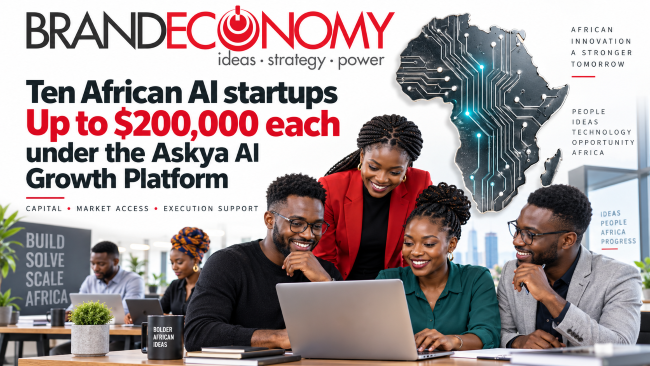 Ten African AI startups stand to receive up to $200,000 each through the Askya AI Growth Platform, with Moniepoint Chief Executive Officer Tosin Eniolorunda chairing its inaugural cohort. The proposition goes beyond funding: it seeks to address the difficult passage from promising technology to products customers will consistently pay to use.
Moniepoint disclosed the initiative in a statement on Tuesday, saying selected businesses would receive strategic guidance, market access and support to establish product-market fit before expanding across Africa. Launched by Askya Investment Partners, the pan-African programme will charge no participation fees and take no equity from participating startups.




Applications are open to African AI-native startups, with shortlisted candidates expected to be announced in October. The announced ceiling implies potential support of up to $2 million across ten businesses if every participant receives the maximum. It should not be confused with a confirmed aggregate disbursement or an identical allocation to each company.
Eniolorunda’s message was that African founders can serve international markets, but ambition needs practical commercial support. He identified artificial intelligence as a particularly compelling opportunity to demonstrate that capability, while emphasising the importance of execution assistance and access to customers. As cohort chair, he will contribute strategic direction and market connections.
Babacar Seck, Founder and Managing Partner of Askya Investment Partners, said Eniolorunda’s experience developing a technology business around African needs would benefit emerging entrepreneurs. Seck described the programme’s priorities as helping founders establish product-market fit, generate commercial traction and prepare for expansion across the continent.
Why market access matters
For participating founders, the most consequential benefit could be the opportunity to test demand with credible buyers. A technically impressive demonstration does not establish a viable business. Customers must see measurable improvements in cost, speed, reliability or revenue, while founders must establish that delivering those improvements leaves a sustainable margin.
That distinction is especially important for AI-native businesses, whose products depend fundamentally on artificial intelligence. Access to models alone is unlikely to secure lasting differentiation. More durable advantages may emerge from permissioned proprietary data, specialised workflows, effective distribution and deep understanding of the industries being served.
Potential applications include business administration, agricultural decision support, logistics and financial services. These are illustrative opportunities, not announced programme categories. The investment case in each would depend on evidence that the technology solves a sufficiently valuable problem, performs reliably and fits the customer’s operating environment.
Continental expansion requires similar discipline. Africa is not a single procurement system or regulatory jurisdiction. Language, payment arrangements and customer purchasing power can alter the economics of a product between markets. Founders should therefore treat expansion as a sequence of locally validated business decisions, not simply a larger addressable-market slide.
The investor test
The free, equity-free structure preserves founders’ ownership while providing room to strengthen their businesses. However, the statement does not specify the composition of the support, disbursement conditions or detailed selection criteria. Those details matter when assessing how much usable runway the headline amount will actually provide.
For prospective investors, the cohort could offer a useful pipeline of businesses with stronger customer evidence. Programme selection, however, cannot substitute for due diligence. Relevant tests include recurring revenue, customer retention, delivery costs, data rights and dependence on external technology providers. A successful pilot must eventually become repeatable commercial demand.
For enterprise buyers, trust will be part of that equation. Founders should be able to explain how customer information is handled, where human oversight remains necessary and how errors are addressed. Commercial credibility depends on operational accountability, not persuasive branding.
Investors should also distinguish between adoption and defensibility. A startup can attract users without building an advantage competitors cannot cheaply replicate. The strongest candidates will need to show why customers stay, how margins improve with scale and whether their differentiation survives changes in underlying AI models or pricing.
Brand value and development impact
For Askya, the structure creates an opportunity to build a founder-friendly reputation through practical support for African AI startups and the AI Ecosystem. Eniolorunda’s involvement also associates Moniepoint’s leadership with a wider African innovation agenda. Neither reputational benefit is automatic: the credibility of both associations will depend on transparent selection, meaningful engagement and demonstrable founder outcomes.
Moniepoint cited an African Development Bank estimate that inclusive AI deployment could contribute up to $1 trillion to Africa’s gross domestic product by 2035. The conditional language matters. Such potential is not a forecast of guaranteed startup returns, and ten supported businesses cannot independently deliver that continent-wide transformation.
The development question is who captures the productivity gains. Broader benefits would require affordable adoption, relevant skills and infrastructure that enables smaller enterprises to participate. An AI product that expands access to useful services offers a different development proposition from one that merely adds expensive functionality for already well-served customers.
BRANDECONOMY Insight
Askya’s most important wager is that capital becomes more productive when paired with customers and experienced execution support. Its success should be judged by durable businesses, not cohort publicity. For founders, the challenge is to convert AI capability into trusted, economically useful products. For investors, it is to identify value that remains after the excitement subsides. For Africa, the prize is a larger share of the income generated by technologies its entrepreneurs help build. That requires commercial discipline alongside technical ambition.