PAPSS Targets Seamless Cross-Border Payments for Africa’s Creative Economy

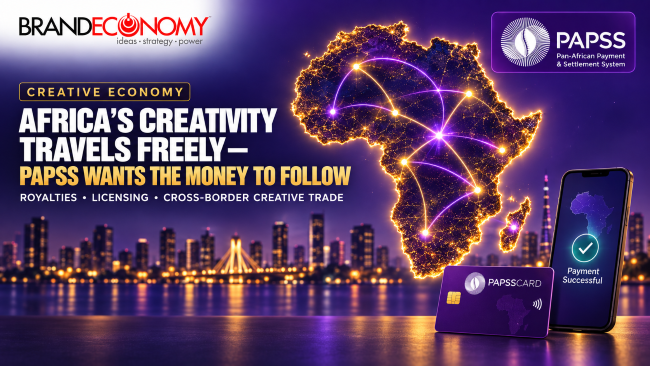
African creativity has become global, but many creators still struggle to receive payments across the continent. PAPSS is developing solutions for royalties, licensing, tickets, merchandise and other creative earnings—with CANEX Lagos serving as an important pilot.



Afrobeats fills stadiums and streaming playlists. African fashion increasingly influences global runways. Films, literature, visual art, animation, gaming and digital content are expanding the continent’s cultural reach.
Yet while African creativity crosses borders with remarkable ease, the money earned from it often does not.
An artist can build an audience across several African countries and still struggle to receive royalties, licensing income or merchandise payments efficiently. A fashion designer may attract buyers at a continental exhibition but encounter difficulty accepting their local currencies. Filmmakers and publishers can negotiate cross-border distribution only to lose time and value within fragmented payment systems.
This is the commercial contradiction the Pan-African Payment and Settlement System is seeking to resolve.
PAPSS, developed by African Export-Import Bank in collaboration with the African Union, is positioning its continental payment infrastructure as an important enabler of Africa’s creative economy—connecting cultural influence to trade, income, employment and scalable enterprise.
When cultural reach exceeds financial reach
Africa’s creative surge is not simply an entertainment phenomenon. It represents a multi-billion-dollar economic ecosystem spanning intellectual property, production, distribution, events, advertising, technology, tourism and merchandise.
Each successful song supports producers, composers, managers, dancers, video directors, photographers, marketers and live-event professionals. Film productions create demand for actors, writers, costume designers, editors, caterers, equipment suppliers and locations. Fashion connects designers with textile producers, models, stylists, retailers and logistics providers.
The employment potential is particularly important for a continent with a large and youthful population.
However, creative businesses cannot scale sustainably if payments remain slow, expensive, uncertain or dependent on complicated intermediary arrangements.
Cross-border financial friction can discourage smaller transactions, reduce margins and make it difficult for independent creators to commercialise audiences outside their home markets. It also weakens the record of earnings that creators need to qualify for financing.
PAPSS is attempting to provide the rails on which a more integrated African creative marketplace can operate.
From Niamey to a continental payment system
Afreximbank and the African Union first unveiled PAPSS in Niamey in 2019 as part of the continent’s wider economic-integration agenda.
The system subsequently became a strategic instrument supporting the African Continental Free Trade Area, whose ambition depends not only on moving goods and services across borders, but also on enabling buyers and sellers to exchange value efficiently.
In December 2020, African Union leaders directed Afreximbank to conclude the system’s development and expand its accessibility across the continent.
PAPSS was formally launched in Accra in January 2022, bringing instant cross-border payment capability closer to banks, businesses and the public.
The platform has since worked to connect central banks, commercial financial institutions and enterprises within a shared payment ecosystem.
Its architecture now includes three principal solutions: the PAPSS Instant Payment System, the African Currency Marketplace and PAPSSCARD.
Together, these products seek to reduce friction in intra-African commerce by improving payment speed, currency access and transaction convenience.
For the creative economy, the proposition is straightforward: a buyer should be able to pay in a familiar local currency while the creator receives value through an integrated African payment channel.
The complexity lies in making that experience affordable, reliable and available at scale.
Designing payment infrastructure around creators
PAPSS Chief Executive Officer, Mike Ogbalu III, said Afreximbank views the creative industry not merely as culture and entertainment, but as a structured economic value chain capable of creating employment and strengthening African economies.
That distinction is important.
Creators are frequently discussed as talented individuals rather than entrepreneurs operating within investible industries. This can lead policymakers and financiers to celebrate cultural success while neglecting the payment, intellectual-property, legal and financial infrastructure required to sustain it.
Ogbalu said PAPSS had engaged artists and other creative-industry participants to understand their practical payment difficulties and shape relevant solutions.
The approach has two dimensions.
First, external technology and payment companies will be able to connect specialised products to PAPSS infrastructure. Second, PAPSS is developing additional solutions internally, some of which remain in the pipeline.
The emerging environment is intended to support services designed for digital creators, including royalty payments, licensing income and other forms of cross-border earnings.
This reflects a structural shift in commerce. Traditional payment systems were largely designed around physical goods, conventional merchants and established banking relationships. Creative value is increasingly digital, divisible and distributed across multiple territories and platforms.
A song may have several rights owners. A film can generate revenue from cinemas, streaming, television licensing and international distribution. Digital artwork may be purchased instantly by a buyer in another country. Payments may need to be divided among creators, producers, publishers, agents and investors.
Modern creative commerce therefore requires more than transferring money from one account to another. It needs payment infrastructure capable of connecting verified rights, contractual obligations and transparent revenue allocation.
CANEX Lagos becomes a real-world test
Afreximbank plans to test elements of its creative-payment strategy at the Creative Africa Nexus event scheduled for Lagos in November.
Papa Samba Thiongane, Head of Marketing and Communications for PAPSS, said the institution was working with the CANEX team and other partners to help exhibitors receive payments from local buyers more easily.
Creative entrepreneurs often travel across Africa to display artwork, clothing, books, films, music products and professional services. Despite reaching interested customers, some still struggle to complete transactions in the buyer’s local market.
The CANEX pilot is expected to explore how exhibitors can accept payments for tickets, artworks, merchandise and services without forcing customers through complicated cross-border processes.
The event will consequently serve as more than a showcase for African creativity. It can function as a controlled commercial laboratory where PAPSS and its partners observe transaction behaviour, merchant onboarding, payment failures, settlement speed and customer experience.
Its value will depend on what happens after the exhibition.
A successful pilot should produce a repeatable solution that can be used at festivals, fashion weeks, film markets, art fairs, literary events and online creative marketplaces across the continent.
What PAPSS can—and cannot—solve
PAPSS can address an important part of the creative-economy problem: moving value securely and efficiently across African borders.
It cannot, by itself, correct weak copyright enforcement, incomplete ownership records, disputed royalty statements or opaque platform contracts.
A payment system can distribute royalties only when the underlying rights, beneficiaries and allocation percentages are accurately identified. Faster settlement of inaccurate royalty data merely accelerates the wrong payment.
The wider ecosystem must therefore include reliable intellectual-property registration, rights-management databases, digital contracts, transparent collection societies and effective dispute-resolution mechanisms.
Merchant onboarding must also be simple enough for independent creators and small businesses, not only large entertainment companies. Charges, currency-conversion rates and settlement timelines must be clear. Consumers must have dependable complaint, refund and fraud-protection channels.
The winning experience will feel effortless at the front end even though it rests on sophisticated compliance and settlement infrastructure.
Market implications
Efficient cross-border payments could expand the addressable market for African music, film, publishing, fashion, visual art, gaming, live events and digital services.
Creators would be better positioned to sell directly to continental audiences, while marketplaces could introduce local-currency pricing and reduce abandoned transactions caused by payment difficulty.
The infrastructure could also strengthen formalisation. When creative earnings become more visible and traceable, creators can build financial records, demonstrate cash flow and improve their eligibility for credit, insurance and investment.
Banks, fintech companies, mobile-money providers, ticketing platforms, streaming services and creative marketplaces will have opportunities to build specialised products on PAPSS rails.
These may include royalty wallets, split-payment services, event-payment applications, licensing marketplaces, merchant tools and working-capital products tied to verifiable creative income.
Investor relevance
For investors, better payment visibility can reduce one of the creative economy’s largest information gaps: uncertainty about when, where and how revenue is earned.
Reliable transaction data could support royalty-backed financing, film-distribution funding, inventory finance for fashion businesses and revenue-based investment in digital creators.
But infrastructure adoption remains the decisive variable.
Investors should examine the number of participating institutions, geographic reach, transaction costs, settlement performance, currency liquidity, dispute resolution and the ease with which third-party products can integrate with PAPSS.
The opportunity is not only to invest in celebrated artists. It is to finance the platforms, rights systems, marketplaces and professional services that allow thousands of creators to earn consistently.
Brand implications
For PAPSS, the creative economy offers a powerful opportunity to humanise continental payment integration.
Trade infrastructure can appear abstract. A musician receiving royalties, a designer selling to a visiting buyer or an illustrator licensing work across borders makes the value proposition visible.
The brand challenge is reliability. Creators will judge PAPSS through the applications and institutions that connect to it. Failed payments, hidden charges or difficult onboarding will damage trust even when the underlying infrastructure is not directly responsible.
For Afreximbank, the initiative broadens its identity from financier of physical trade to enabler of intellectual property and cultural commerce.
Creative brands also stand to benefit. Easier continental purchasing can transform an audience into a customer base and cultural popularity into measurable commercial reach.
BRANDECONOMY Insight
Africa does not lack creative talent, global attention or cultural energy. It lacks a sufficiently integrated commercial system for converting those assets into durable African-owned value.
PAPSS can become an important foundation, but payments are only one layer.
A complete creative-commerce stack should connect identity verification, intellectual-property ownership, licensing contracts, split payments, currency conversion, tax treatment, escrow, refunds, royalty reporting and access to finance.
The CANEX pilot should therefore be measured against a public scorecard: participating exhibitors, payment success rate, average settlement time, transaction cost, local currencies used, disputes resolved and repeat usage after the event.
PAPSS should also ensure that third-party developers can build for independent creators, not merely established entertainment corporations.
The strategic prize is not simply faster payment. It is an African market in which a creator in one country can produce, license, sell and receive value from customers across the continent without surrendering excessive income to friction.
Africa’s creativity already moves at the speed of culture. PAPSS now has the opportunity to make African money move with it.