 Cross River State says internally generated revenue has more than doubled in two years, digital collection is expanding and locally raised income now meets a meaningful share of its financial commitments.
The harder question is whether this represents genuine economic transformation or simply a more efficient tax system collecting from the same narrow base.



Dr Edwin Okon, Chairman of the Cross River Internal Revenue Service, said during a revenue review in Calabar on Thursday that the state was gradually reducing its dependence on Federation Account allocations. He credited reforms introduced under Governor Bassey Otu.
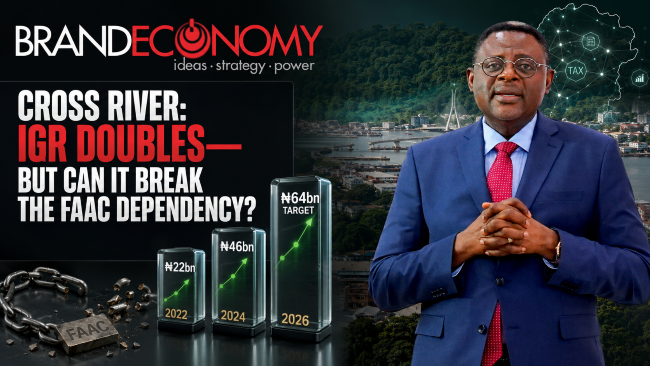
According to Okon, annual IGR rose from ₦22 billion by December 2022 to ₦46 billion by December 2024—roughly 109 per cent. He said it now covers about 30 per cent of the state’s fiscal obligations and more than 30 per cent of monthly capital needs.
CRIRS targets ₦64 billion in 2026. More than ₦31 billion collected at half-year puts it near the required pace, but does not yet prove the target will be exceeded.
From stronger collection to stronger economy
Okon listed automated payments, tighter collection procedures, leakage controls and data-mining units identifying revenue sources outside the system. Digitisation can reduce cash handling, improve reconciliation, widen the taxpayer register and frustrate diversion.
Yet a state cannot tax itself into prosperity. Durable IGR comes from a larger productive economy: profitable enterprises, formal jobs, valuable property, tourism, trade and rising incomes.
Cross River must show that higher receipts reflect economic deepening and better compliance—not arbitrary assessments, multiple taxation or heavier pressure on formal businesses. That distinction will determine whether reform attracts investment or raises operating costs.
The “30 per cent” claim requires a published denominator. Fiscal obligations could mean recurrent commitments, cash-backed expenditure, debt service or some capital payments. Without an audited comparison of IGR, federal transfers and actual spending, the FAAC habit cannot be declared broken.
Forestry’s fourfold rise—and its hidden test
Forestry is a standout. Okon said monthly receipts rose from about ₦100 million to between ₦400 million and ₦450 million—₦4.8 billion to ₦5.4 billion annualised if sustained. Mining and other sectors also improved.
The increase raises a question revenue tables cannot answer. Better royalty capture, traceability and enforcement would be positive; income produced by accelerated logging would not be.
Cross River’s forests are assets, climate buffers and livelihoods. Government should disclose production volumes, licence payments, enforcement, reforestation and community benefits alongside collections. It should earn more from each legal, sustainable unit—not deplete natural capital for short-term cash.
Mining needs the same discipline: formalisation, environmental safeguards, transparent titles and credible host-community engagement. Revenue that creates ecological liabilities transfers today’s budget problem to tomorrow’s citizens.
Market implications
Predictable own-source revenue can help maintain roads, fund counterpart obligations and support business services. Automation should reduce payment friction and improve planning data.
CRIRS must pair enforcement with service. A single assessment record, accessible dispute resolution, published rates and coordinated collectors would reduce uncertainty for retailers, hotels, transporters, farmers and manufacturers. Trust scales better than intimidation.
Publishing tax expenditures and incentives would further reveal whether the state is widening its base fairly or granting opaque concessions that shift the burden from politically connected firms to smaller, less powerful taxpayers.
The opportunity is to connect taxation with an enterprise strategy spanning tourism, agriculture, agro-processing, logistics, the creative economy and responsible resource development. Helping firms grow expands the tax base without repeated rate increases.
Investor relevance
For investors and lenders, improving IGR can signal stronger fiscal resilience, greater capacity to maintain infrastructure and less exposure to volatile federal transfers. It may also strengthen confidence in the state’s ability to honour project commitments.
Investors will nevertheless look beyond headline collections. They will examine audited accounts, collection costs, debt obligations, the predictability of tax rules and whether assessments can be changed retrospectively. They will also test whether digital systems protect commercial data and whether resource-sector growth meets environmental standards.
Brand implications
The Otu administration has an opportunity to reposition Cross River from an allocation-dependent government into an enterprise-minded state. But that brand cannot be built by revenue announcements alone.
Every additional naira collected creates an expectation of visible value: safer roads, cleaner markets, dependable public services and a business environment that respects taxpayers. If citizens experience taxation without service, the reform story becomes extraction. If they see taxes converted into opportunity, compliance becomes part of a credible social contract.
BRANDECONOMY Insight
Cross River’s acceleration is encouraging, but the breakthrough is not collecting more from the economy; it is growing the economy from which the state collects.
CRIRS should publish a quarterly IGR Quality Dashboard covering receipts, collection costs, active taxpayers, sector shares, disputes, refunds, IGR’s share of total revenue and services financed. Forestry and mining need parallel sustainability indicators.
The state should define a measurable five-year path for reducing FAAC dependence, rather than treating every increase as proof of independence.
Fiscal credibility is earned when numbers are transparent, taxes are predictable and collections become services citizens and investors can see. Cross River has strengthened the collection machine. Its next task is to prove that the machine can produce broad-based prosperity.