
AfDB, WEF Push New Financing Roadmap for Africa’s Frontier Markets

 How the Humanitarian and Resilience Investing Roadmap could help move fragile economies from aid dependency to investment-led development
 How the Humanitarian and Resilience Investing Roadmap could help move fragile economies from aid dependency to investment-led development
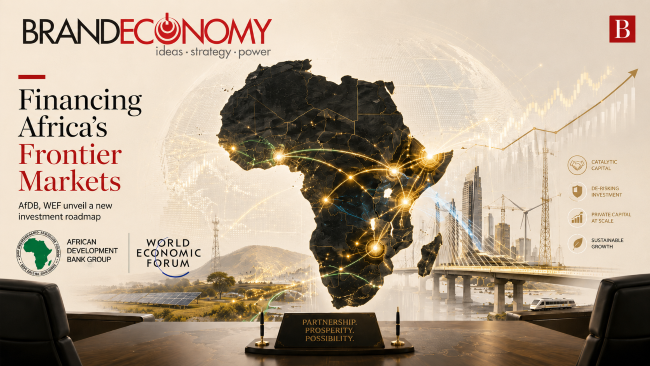
The African Development Bank Group and the World Economic Forum have launched a new financing roadmap aimed at drawing private capital into some of Africa’s most fragile, underserved and investment-starved economies.
Unveiled during the 2026 Annual Meetings of the AfDB Group in Brazzaville, Republic of Congo, the Humanitarian and Resilience Investing Roadmap for Africa seeks to mobilise commercial and catalytic capital for frontier markets and transition states where conventional investment flows remain thin, risk perceptions are high and development needs are urgent. The AfDB describes the roadmap as a coordinated, country-led approach to unlocking investment in underserved frontier markets.




The initiative is already being piloted in Liberia, Somalia, Mozambique and Djibouti — four markets whose development needs reflect the broader challenge of financing resilience in economies affected by fragility, institutional constraints, climate shocks, security pressures or weak private-sector depth.
For Africa, the timing is significant. The 2026 AfDB Annual Meetings are being held under the theme “Mobilising Africa’s Development Financing at Scale in a Fragmented World,” a theme that speaks directly to a continent facing tighter fiscal space, shrinking aid flows, debt vulnerabilities and an annual development-financing gap estimated at about $400 billion.
From aid dependency to investment-led resilience
Speaking at the launch, AfDB President Sidi Ould Tah said Africa must make a decisive shift from aid dependency to investment-led development.
Represented by the Bank’s Senior Vice-President, Marie-Laure Akin-Olugbade, Tah argued that the development-finance model must evolve from direct substitution to market catalysis.
“The time for a paradigm shift from aid dependency to investment-led development is now,” he said. “The HRI Roadmap creates that foundation by positioning development finance as a catalyst, not a substitute.”
That distinction matters. For decades, fragile economies have often been treated as aid destinations rather than investable markets. The result has been a persistent financing paradox: countries with the greatest need for jobs, infrastructure, resilience and productive capital often face the highest cost of funds, the weakest investor appetite and the thinnest institutional support.
The HRI Roadmap attempts to break that cycle by creating a framework through which development-finance institutions, governments, private investors, humanitarian actors and catalytic-capital providers can better coordinate investment into sectors that build long-term resilience.
Why frontier markets matter
Africa’s frontier and transition economies are not marginal to the continent’s future. They are central to it. Many host young populations, untapped agricultural potential, emerging ports, mineral resources, strategic corridors and large infrastructure gaps. Yet they remain constrained by weak pipelines, political risk, currency concerns, policy uncertainty and limited risk-sharing instruments.
That is why the roadmap’s emphasis on de-risking is critical. Private capital rarely moves into fragile markets on goodwill alone. It needs bankable projects, predictable regulation, blended finance, concessional buffers, guarantees, insurance instruments, credible data and local partners that understand operating realities.
Somalia’s Finance Minister, Bihi Egeh, made that point during a panel discussion, stressing the need for stronger financial inclusion and de-risking mechanisms in fragile African economies. Other speakers highlighted regulatory reform, digital infrastructure and concessional financing as essential tools for crowding private capital into markets that are too often written off as too difficult.
The World Economic Forum’s Managing Director, Sheba Crocker, said vulnerable African communities require investments capable of supporting durable economic growth. According to her, the roadmap reflects a shift from fragmented interventions toward more coordinated, investment-led approaches.
That is the deeper significance of the launch: the roadmap is not merely about funding projects. It is about changing how fragile economies are perceived, structured and financed.
Africa’s financing contradiction
The numbers underline the urgency. Africa accounts for a significant share of global development need, yet attracts only a small fraction of global foreign direct investment. The partners observed that, despite having about 17 per cent of the world’s population, Africa receives only about 3.5 per cent of global FDI.
This mismatch has become more troubling as traditional development assistance faces pressure. Recent reporting around the AfDB meetings noted falling foreign-aid flows from wealthy economies and growing concern over how Africa will finance energy, food security, climate resilience, infrastructure and job creation in a more fragmented global economy.
For finance ministers and development bankers, the implication is clear: Africa cannot close its development gap through aid alone. Nor can fragile states simply wait for markets to discover them. The future lies in structured capital mobilisation — blending concessional funds, domestic savings, multilateral balance sheets, private equity, guarantees, project preparation and policy reform into investable frameworks.
That is where the HRI Roadmap may prove useful, if implemented with discipline.
Alignment with AfDB’s wider financing agenda
The roadmap also fits into the AfDB’s broader push for a new development-finance architecture on the continent. It aligns with the Bank’s New African Financial Architecture for Development, which seeks to mobilise capital at scale, and with the Affirmative Finance Action for Women in Africa, which focuses on expanding finance for women-led businesses.
This connection is important because fragility is not gender-neutral. Women and young people are often among the most affected by conflict, displacement, unemployment, weak infrastructure and financial exclusion. Yet they are also central to rebuilding local economies through trade, agriculture, services, small industry and digital enterprise.
If the roadmap is well executed, it could help shift development finance from emergency response to enterprise formation; from humanitarian spending to resilience-building; from short-term relief to long-term productive capacity.
The hard test: execution
Still, roadmaps do not build economies. Implementation does.
The HRI Roadmap will have to overcome several familiar obstacles: weak project pipelines, bureaucratic inertia, policy inconsistency, high transaction costs, limited local-currency finance, fragile institutions and investor scepticism.
For private investors, the key question will not be whether frontier markets need capital. That is obvious. The question will be whether risks can be priced, shared and mitigated in ways that make investment commercially rational.
For African governments, the message is equally direct. Capital follows credibility. Frontier markets seeking investment must improve regulatory clarity, protect contracts, strengthen public-private partnership frameworks, expand digital infrastructure, improve data quality, and reduce avoidable administrative friction.
For development-finance institutions, the task is to move beyond seminars and communiqués into measurable execution: projects prepared, guarantees issued, capital mobilised, businesses financed, jobs created and communities made more resilient.
Why this matters for Nigeria and Africa
For Nigeria and other large African economies, the roadmap carries a wider lesson. Even where markets are larger and more liquid, investment gaps remain stubborn in regions affected by insecurity, weak infrastructure, environmental degradation and poverty. Northern Nigeria, the Niger Delta, border communities and underserved rural economies all face versions of the same financing problem: capital is available globally, but it rarely reaches the places where resilience is most needed.
That is why the roadmap should be watched closely by policymakers, banks, pension funds, insurers, impact investors and development agencies. It could provide a template for financing difficult but necessary markets — including infrastructure, agriculture, renewable energy, logistics, climate adaptation, women-led enterprise and SME value chains.
The AfDB-WEF initiative is not a silver bullet. But it is a useful signal that Africa’s development conversation is moving from dependency to mobilisation, from charity to investability, and from fragmented interventions to coordinated capital architecture.
If the roadmap succeeds, the real beneficiaries will not only be Liberia, Somalia, Mozambique and Djibouti. The larger prize will be a new investment logic for Africa’s most overlooked economies.
BRANDECONOMY Insight
The launch of the Humanitarian and Resilience Investing Roadmap for Africa is a timely intervention in a continent caught between rising development needs and tightening global finance. Its real value lies in reframing fragile African economies as investable markets rather than permanent aid destinations.
For the roadmap to matter, however, it must do three things well. First, it must create bankable project pipelines in countries where private investors struggle to identify structured opportunities. Second, it must use concessional finance and guarantees to reduce real and perceived risks. Third, it must compel governments to improve regulation, contract certainty and digital infrastructure.
Africa’s frontier markets do not suffer from lack of need. They suffer from lack of investable structure. If AfDB and WEF can help build that structure, the roadmap could become one of the more consequential development-finance tools for fragile states.
The business lesson is clear: resilience is no longer just a humanitarian concern. It is an investment category.