
Over 3,000 Delegates Head to AfDB Annual Meetings to Focus on Africa’s $400bn Financing Gap
New African Financial Architecture for Development

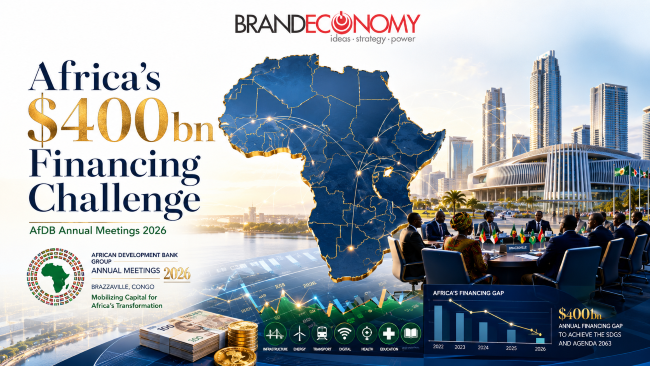 More than 3,000 delegates are expected in Brazzaville, Republic of Congo, as the African Development Bank Group convenes its 2026 Annual Meetings from May 25 to 29, with Africa’s widening development-financing gap at the centre of deliberations.
The meetings will mark the 61st Annual Meeting of the African Development Bank and the 52nd meeting of the African Development Fund, bringing together delegates from the Bank’s 81 member countries under the theme: “Mobilising Africa’s Development Financing at Scale in a Fragmented World.”


The theme captures the scale of the challenge facing the continent. Africa’s development-financing gap is estimated at about $400 billion annually, at a time when aid flows are weakening, borrowing costs remain elevated and global financial conditions are tightening. For a continent still in urgent need of investments in infrastructure, energy, food security, climate adaptation, industrialisation and jobs, the financing question is no longer technical. It is existential.
The meetings will be the first under the leadership of Sidi Ould Tah, who assumed office in September 2025. One of his early milestones was the successful mobilisation of an $11 billion replenishment for the African Development Fund in December 2025. The concessional arm of the Bank provides grants and soft loans to low-income and fragile African economies. Significantly, 24 African countries pledged about $182.7 million to the replenishment process, a symbolic step toward greater African ownership of the continent’s development-finance agenda.
A major focus in Brazzaville will be the New African Financial Architecture for Development, an initiative designed to mobilise Africa’s estimated $4 trillion in pension funds and sovereign wealth assets for development. The framework, endorsed by African Union leaders in Addis Ababa in February 2026, seeks to strengthen Africa’s financial sovereignty by channelling more domestic capital into infrastructure, small businesses and long-term productive investment.
Heads of State, finance ministers, central bank governors, private-sector leaders, development partners and policy experts are expected to participate in high-level dialogues, consultative sessions and knowledge-sharing events.
A key highlight will be the launch of the 2026 African Economic Outlook report on May 26. The report remains one of the continent’s most important economic reference documents, offering forecasts, policy analysis and country-level insights for governments, investors and development institutions.
For Africa, the larger question is clear: how does a continent with vast human and natural capital finance its transformation in a world where traditional sources of concessional funding are shrinking and geopolitical fragmentation is reshaping global capital flows?
The Brazzaville AfDB Annual Meetings will not answer that question alone. But it may help sharpen the conversation around a new financing model — one that depends less on external generosity and more on African capital, stronger institutions, smarter risk-sharing and bolder development ambition.
BRANDECONOMY Insight
Africa’s $400 billion annual financing gap is not merely a funding shortfall. It is a development bottleneck.
The continent needs roads, ports, power systems, digital infrastructure, irrigation, agro-processing capacity, health systems, schools and climate-resilient cities. Yet many African governments are constrained by debt-service pressures, expensive borrowing and volatile capital markets.
That is why the AfDB Annual Meetings matter. The discussion is shifting from “who will help Africa?” to “how can Africa mobilise its own capital at scale?”
The proposed New African Financial Architecture for Development is important because Africa is not as capital-poor as it often appears. Pension funds, sovereign wealth assets, insurance pools and domestic savings exist. The challenge is how to structure them safely into bankable, long-term development projects.
If Africa can de-risk infrastructure, deepen local capital markets, strengthen project preparation and improve governance, it can unlock far more domestic and regional financing. External funding will still matter, but the future of African development finance must be built on African balance sheets.
The real test for the AfDB under Sidi Ould Tah will be whether it can move from policy ambition to financial architecture that actually crowds in capital, reduces risk and accelerates transformation.