
NCAA Pauses Enforcement Action Against Indebted Airlines Amid Fuel Cost Pressure

 The regulator’s temporary retreat reflects a delicate balancing act: recover statutory debts without tipping domestic airlines deeper into operational distress.
 The regulator’s temporary retreat reflects a delicate
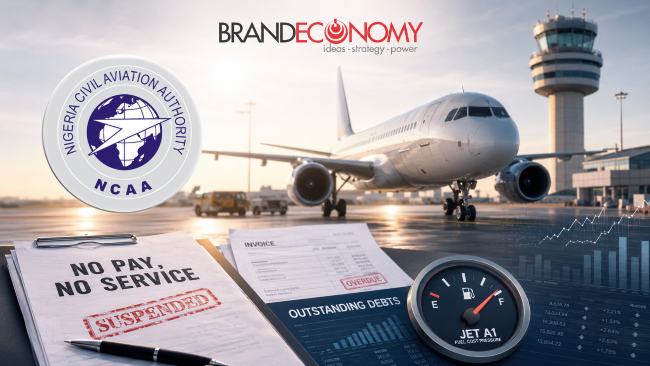
The Nigeria Civil Aviation Authority (NCAA) has temporarily suspended enforcement of its “No Pay, No Service” directive against domestic airlines owing statutory remittances, citing the difficult operating realities currently confronting the aviation industry.




The Director-General of the NCAA, Capt. Chris Najomo, said the decision followed consultations and a review of the pressures facing airline operators, particularly the rising cost of Jet A1 aviation fuel, which has become one of the most destabilising cost centres in Nigerian aviation.
Najomo, however, stressed that the suspension should not be read as debt forgiveness, waiver or cancellation. According to him, all affected airlines remain fully liable for outstanding statutory obligations and will be engaged individually through structured repayment arrangements.
The NCAA had earlier placed 11 domestic operators on its updated “No Pay, No Service” list over unpaid statutory charges. The affected airlines were Air Peace, Ibom Air, Arik Air, United Nigeria Airlines, Umza Air, NG Eagle, Max Air, Caverton Helicopters, Overland Airways, Rano Air and ValueJet.
Under the suspended directive, NCAA departments were instructed to withhold regulatory and administrative services from affected operators until they cleared their debts or entered repayment plans.
A Regulatory Pause, Not a Free Pass
Najomo said the temporary suspension forms part of a broader effort to avoid operational disruption in the aviation sector while ensuring that debts owed to the aviation ecosystem are ultimately recovered.
The regulator recalled that President Bola Tinubu had earlier approved a 30 per cent discount on outstanding fees owed by domestic airlines to aviation agencies, including the NCAA. The discount was intended to cushion operators from the impact of escalating fuel costs and other industry-wide pressures.
For airlines, the pause offers short-term breathing room. For the regulator, it is a pragmatic retreat designed to preserve industry stability while keeping debt recovery on the table.
The NCAA’s position is clear: enforcement may be softened temporarily, but statutory debt remains enforceable.
Why the Five Per Cent Charge Matters
At the heart of the dispute is the five per cent Ticket and Cargo Sales Charge, a statutory levy established under the Civil Aviation Act and embedded in the cost of passenger tickets and cargo services.
Najomo explained that airlines collect the charge at the point of ticket and cargo sales on behalf of the aviation ecosystem. It is therefore not airline revenue and should not be treated as operating income or profit.
He said the funds, once remitted, are shared among the NCAA and key aviation service providers that perform essential functions required to sustain safe, efficient and internationally compliant aviation operations.
This is the central regulatory argument. Airlines serve as collecting agents for a statutory charge already paid by passengers and cargo customers. Failure to remit the funds weakens the institutions responsible for oversight, safety regulation, air navigation, infrastructure and other critical aviation services.
NCAA’s Cost-Recovery Challenge
Najomo also noted that the NCAA operates largely on a cost-recovery basis and does not receive direct Federal Government funding for its routine regulatory operations.
That makes statutory remittances essential to the authority’s ability to discharge its oversight responsibilities. Aviation regulation is expensive. It requires technical inspections, certification, surveillance, personnel training, safety audits, enforcement systems, international compliance processes and continuous monitoring of operators.
If statutory payments are delayed or withheld, the financial stress does not end with the regulator. It can weaken the wider aviation safety and service architecture.
This is why the debt issue is more than a balance-sheet disagreement between airlines and the NCAA. It touches the sustainability of aviation governance.
Airlines Caught Between Cost Pressure and Compliance
The NCAA’s softened stance also acknowledges the harsh realities of Nigerian airline operations.
Domestic carriers have faced persistent cost pressures from aviation fuel, foreign-exchange volatility, aircraft maintenance obligations, spare-parts imports, insurance costs, airport charges, financing constraints and weak passenger purchasing power.
In such an environment, liquidity becomes the daily battle. Airlines may sell tickets, but much of the revenue is quickly consumed by fuel, leasing, maintenance, staff costs and operational disruptions.
Even so, statutory remittances cannot be permanently sacrificed to operating pressure. If airlines collect charges on behalf of the aviation system, those funds must eventually reach the institutions for which they were collected.
The regulator’s challenge is therefore to avoid a destructive enforcement shock while preventing a culture of non-remittance from becoming normal.
BRANDECONOMY Insight
Aviation Debt Recovery Must Not Break the Airlines — But It Must Not Break the System Either
The NCAA’s suspension of the “No Pay, No Service” directive is a sensible short-term intervention in a fragile aviation market. Nigerian airlines are operating under severe cost pressure, especially from Jet A1 fuel, foreign exchange and maintenance costs. A blunt enforcement action could disrupt services, hurt passengers and deepen instability.
But the regulator is also right to insist that statutory debts remain payable.
The five per cent Ticket and Cargo Sales Charge is not an optional contribution. It is part of the aviation financing framework. Passengers and cargo users pay it through tickets and cargo transactions. Airlines collect it on behalf of the system. Keeping it as working capital creates a dangerous distortion.
The bigger lesson is that Nigerian aviation needs a more disciplined financial compact. Airlines need realistic repayment plans, fuel-cost relief where possible, better access to affordable finance and a more stable operating environment. Regulators need predictable statutory funding to maintain safety and compliance. Passengers need a system that is both safe and reliable.
The NCAA has chosen negotiation over disruption. That is prudent. But the next phase must deliver structured recovery, transparent timelines and firm consequences for persistent default.
Aviation is too safety-sensitive to be run on unpaid statutory obligations.