
Dangote Cuts Diesel Price by ₦200 as Import Rivalry Reshapes Downstream Market
Local Refining Versus Import Dependence

 The refinery’s price reduction is more than a commercial adjustment. It is a signal that Nigeria’s downstream petroleum market has entered a new phase in which local refining, import licensing, energy security and consumer pricing are now locked in a high-stakes battle.
 The refinery’s price reduction is more than a commercial adjustment. It is a signal that Nigeria’s downstream petroleum market has entered
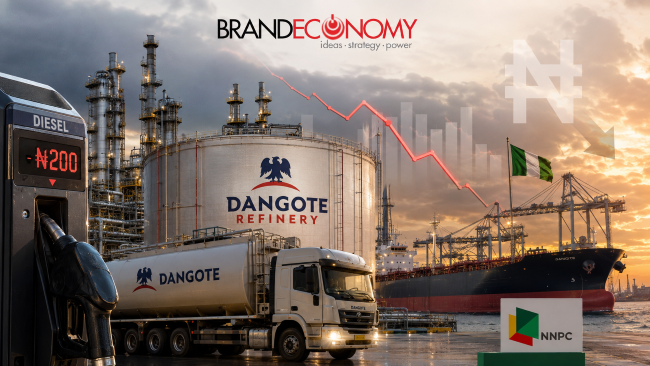
Dangote Petroleum Refinery has reduced the depot price of Automotive Gas Oil, popularly known as diesel, by ₦200 per litre, cutting the price from ₦1,800 to ₦1,600.




The move has intensified competition in Nigeria’s downstream petroleum market and raised fresh questions about the future balance between domestic refining and imported petroleum products.
The price adjustment comes shortly after several vessels carrying imported petroleum products reportedly arrived at Nigerian ports. It also follows recent legal action by Dangote Refinery against the Nigerian Midstream and Downstream Petroleum Regulatory Authority over import licences granted to some marketers.
Industry observers say the timing is significant. Dangote’s new diesel price is said to be lower than the current landing cost faced by marketers who recently imported diesel from the international market. The reduction is therefore being interpreted as a strategic attempt to defend market share, undercut imported supply and strengthen the refinery’s position in the domestic diesel market.
For consumers, however, the immediate implication is simpler: competition appears to be pushing prices down.
Dr Joseph Obele, National Public Relations Officer of the Petroleum Products Retail Outlets Owners Association of Nigeria, described the price cut as evidence that rivalry in the downstream sector can deliver benefits to consumers.
“All hail competition and say no to monopoly in the petroleum industry. The more the competition, the better prices consumers will enjoy,” Obele said.
He noted that the reduction represents one of the sharpest single diesel price drops since deregulation and could mark the beginning of a more aggressive pricing contest between local refining and import-backed supply.
Local Refining Versus Import Dependence
The diesel price cut comes amid a broader debate over whether Nigeria should continue granting import licences for refined petroleum products when the Dangote Refinery is now positioned as a major domestic supplier.
Former President of the Nigerian Association of Chambers of Commerce, Industry, Mines and Agriculture, Dele Oye, has argued that Dangote Refinery could save Nigeria more than ₦15 trillion annually in fuel import costs if fully integrated into the national supply architecture.
Oye, who is also Chairman of the Alliance for Economic Research and Ethics LTD/GTE, said the 650,000 barrels-per-day refinery could generate about $11 billion in foreign-exchange inflows through local refining and petroleum exports.
According to him, Nigeria’s continued reliance on imported refined petroleum products remains a major drain on foreign-exchange reserves and a structural weakness in the country’s energy economy.
He argued that the refinery has the capacity to meet a large share of Nigeria’s domestic demand for refined products, including petrol, diesel, kerosene and aviation fuel, while also producing surplus volumes for export.
In his view, defending import licences in the name of competition risks entrenching dependency on foreign refineries and undermining domestic industrialisation.
The Monopoly Question
The central policy tension is clear: how does Nigeria support a world-scale domestic refinery without creating a monopoly that could later weaken competition?
NNPC and other defenders of import flexibility argue that restricting import permits could expose the country to supply disruptions, price instability and concentration risk. Their position is that Nigeria must maintain alternative supply channels to avoid overdependence on a single refinery, however large.
Oye disagrees. He argues that the real issue is not monopoly, but import dependence. In his view, continued importation when domestic refining capacity exists effectively rewards foreign suppliers and penalises local industrial investment.
He described the Dangote Refinery as a major sovereignty achievement and said Nigeria’s legal and policy framework, including the Petroleum Industry Act 2021 and local-content legislation, supports domestic refining and value addition.
The debate is not merely commercial. It goes to the heart of Nigeria’s energy-security model. For decades, the country exported crude oil and imported refined products, losing jobs, foreign exchange, industrial capacity and pricing control in the process. Dangote Refinery represents an attempt to reverse that model.
But policymakers must now manage the transition carefully. Domestic refining should be encouraged. Competition should be protected. Consumers should benefit from lower prices. Supply security must not be compromised.
Why the Price Cut Matters
Diesel is a critical fuel in Nigeria’s real economy. It powers logistics, factories, farms, telecoms infrastructure, construction sites, generators, haulage fleets, schools, hospitals and small businesses.
A reduction in diesel prices can therefore have wider economic effects. If sustained and transmitted through the supply chain, it could reduce operating costs for manufacturers, transporters and service providers. It could also ease inflationary pressure in sectors where diesel is a major cost component.
However, the benefit will depend on market transmission. Depot price reductions do not always translate fully into lower retail prices, especially where distribution, storage, transport margins and regional supply costs remain high.
The key question is whether the ₦200 cut will reach end-users meaningfully — from truck operators and industrial customers to SMEs and households dependent on diesel-powered generators.
Importers Under Pressure
The reported arrival of imported diesel cargoes created a competitive test for Dangote Refinery. If the refinery can supply at prices below import landing cost, marketers holding imported stock may face margin pressure.
That could discourage future importation if local supply remains consistent and competitively priced. But if local supply becomes unreliable or pricing becomes less competitive, imports may regain relevance.
The downstream market is therefore entering a more fluid phase. Importers, domestic refiners, regulators, retailers and consumers are all adjusting to a new pricing environment.
In a properly functioning market, this rivalry should produce efficiency. But in a fragile market, it could also produce legal battles, lobbying pressure, supply uncertainty and policy confusion.
This is why regulatory clarity is vital.
The Case for Transparent Policy
Nigeria needs a clear downstream petroleum framework that answers three practical questions.
First, what role should imports play when domestic refining capacity is available?
Second, how should regulators prevent monopoly abuse while still encouraging investment in local refining?
Third, how can consumers be protected through transparent pricing, product availability and fair competition?
A policy that simply opens the door to imports without regard to local capacity could weaken domestic refining investment. A policy that shuts out imports completely could create supply risk and price-setting concerns. The best option is a disciplined middle path: prioritise local refining where capacity, quality and pricing are competitive, while retaining regulated import flexibility as a supply-security backstop.
BRANDECONOMY Insight
Dangote’s Diesel Cut Is a Price War — But Also a Policy Test
Dangote Refinery’s ₦200 diesel price cut is not just good news for consumers. It is a preview of the battle for Nigeria’s downstream future.
For the first time in decades, a major domestic refinery is challenging the economics of imported refined products at scale. That is a profound shift. If sustained, it could reduce foreign-exchange pressure, strengthen local value addition, create industrial jobs, stabilise supply and give Nigeria more control over its energy destiny.
But the monopoly argument cannot be dismissed casually. A country should not replace import dependence with domestic overdependence on a single supplier. Energy security requires capacity, competition, regulation and transparency.
The right policy response is not to frustrate Dangote Refinery. It is to use its success to reset the market. Nigeria should encourage more private refining investment, protect consumers from anti-competitive behaviour, ensure transparent product pricing and prevent import licensing from becoming a loophole for rent-seeking.
The deeper lesson is that industrial sovereignty is built, not wished into existence. Dangote Refinery is proof that Nigeria can build world-scale energy infrastructure. But it must now be governed within a clear competition and energy-security framework.
If the result is lower diesel prices, stronger local refining and less pressure on the naira, then the consumer and the economy win.