

Patriotism, Pressure and the Psychology of Champions Inside the Super Eagles Camp
In elite tournament football, moments of tension like the Osimhen–Lookman issue are often mistaken for cracks. In truth, they are frequently the by-products of ambition.
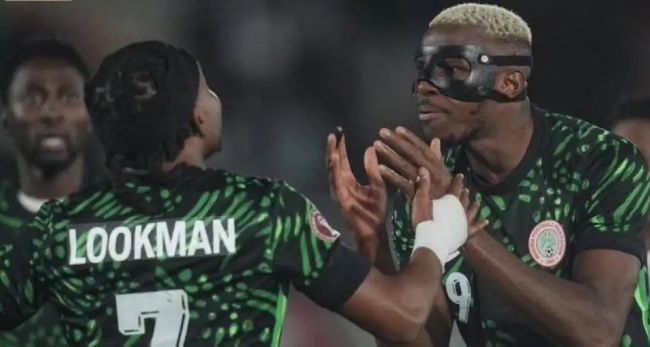
That reality played out during Nigeria’s emphatic Round of 16 victory over Mozambique at the 2025 Africa Cup of Nations, when a brief on-pitch confrontation between Victor Osimhen and Ademola Lookman sparked outsized reaction across social media and sports commentary circles.




Away from the noise, the message from inside the Nigerian camp has been clear: this was not indiscipline—it was intensity.
The Moment That Triggered the Debate
Midway through the second half, with Nigeria already in control, Osimhen reacted visibly after Lookman elected to shoot rather than square a pass to the striker, who appeared well-positioned in the box.
The moment lasted seconds. The online fallout lasted days.
In modern football, where every camera angle is dissected in real time, such flashes are often stripped of context and inflated into narratives of ego or division. But within the Super Eagles setup, the interpretation has been markedly different.
Patriotism, Not Petulance
According to Lanre Onilu, the Director-General of National Orientation Agency, Osimhen’s reaction was driven by competitive patriotism, not personal grievance.
At the highest level, forwards like Osimhen are wired to see opportunities instantly—and to react when margins for excellence are missed. That instinct is not coached out of elite strikers; it is sharpened.
Crucially, Lookman himself has publicly played down the incident, reaffirming unity within the squad and dismissing any suggestion of disrespect or discord.
In elite teams, clarity inside the dressing room matters more than optics outside it.
Inside a High-Performance Team Culture
What the Osimhen–Lookman moment reveals is not a fracture, but a high-performance environment where:
- Players hold one another to exacting standards
- Expectations remain high regardless of the scoreline
- Emotional investment is channelled toward a collective objective
Championship-winning teams are rarely quiet. They are demanding, intense, and relentlessly self-critical—even in dominance.
Nigeria’s current squad reflects that mindset.
AFCON as a National Unifier
Beyond the pitch, Nigeria’s presence in Morocco has taken on a broader significance. The National Orientation Agency has mobilised supporters, distributed thousands of Nigerian flags, and turned match venues into seas of green and white.
The effect has been tangible: players repeatedly reference the atmosphere in Fès as “home away from home.”
This fusion of football, identity, and national pride underscores why AFCON remains Africa’s most emotionally charged sporting asset—not a secondary tournament, but a continental crown.
Why AFCON Still Matters—Deeply
In an era where European club football dominates media cycles, AFCON continues to test players in ways club competitions cannot:
- Compressed schedules
- Hostile or partisan environments
- National expectation layered onto personal ambition
Winning AFCON is not about form—it is about character, resilience, and unity under pressure.
That is precisely why moments like Osimhen’s reaction matter. They reveal how badly players want it.
BRANDECONOMY INSIGHT
Great teams argue in the pursuit of greatness.
Mediocre teams stay polite and fall short.
Nigeria’s Super Eagles are not fractured—they are locked in.
The Osimhen–Lookman moment is not a distraction; it is a signal of a squad playing with urgency, accountability, and belief. In tournament football, those traits are not liabilities—they are assets.
As AFCON 2025 deepens, Nigeria’s edge may lie not just in talent, but in the emotional intensity that separates contenders from champions.