
Burna Boy Presents Saka’s Sócrates Award as Nigeria’s Music-Football Influence Grows

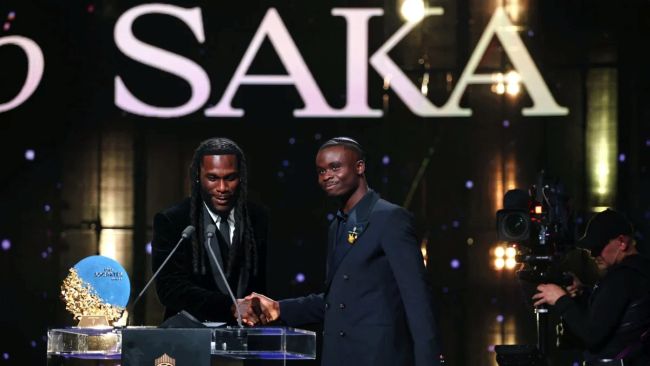 The Ballon d’Or appearance connects Afrobeats, diaspora achievement and social impact—but Nigeria’s bigger opportunity lies in turning global attention into lasting institutions as Burna Boy presents the Sócrates Award.
Nigerian music star Burna Boy brought the country’s cultural influence into one of football’s most prestigious settings on Monday, presenting the 2026 Sócrates Award to Arsenal forward and England international Bukayo Saka at the London Palladium.


The Grammy-winning artiste, whose real name is Damini Ogulu, handed over an honour recognising humanitarian contribution rather than sporting performance. Saka received the award for his work with BigShoe, which helps children access medical treatment in Nigeria and other African countries.
The encounter carried a distinctive Nigerian connection: a globally successful musician recognising an England footballer of Nigerian heritage for work benefiting communities beyond the game. Its significance extends beyond celebrity visibility to the growing intersection of sport, entertainment and social investment.
Saka’s recognition puts impact ahead of image
Established in 2022, the Sócrates Award honours football figures who deploy their influence and resources to improve lives. Named after the late Brazilian footballer and doctor, it was created by the Ballon d’Or organisation with Peace and Sport and the Sócrates family.
Its previous recipients include Senegal’s Sadio Mané, Brazil’s Vinícius Júnior and Spain’s Jenni Hermoso. The award broadens the definition of footballing distinction: commercial success and sporting achievement create influence, but how that influence is used matters too.
Saka’s contribution has a documented Nigerian foundation. Arsenal reported in February 2024 that his support for BigShoe had helped fund 120 life-changing operations for children in Kano since 2022. BigShoe also records subsequent eye-care initiatives involving Saka in Ghana, Nigeria and Rwanda.
Such interventions have consequences beyond individual treatment. Improved health can restore school attendance, reduce pressure on families and expand children’s future opportunities. However, philanthropy should complement—not become a substitute for—reliable public healthcare.
Burna Boy links global recognition to grassroots ambition
Speaking at the ceremony, Burna Boy discussed his football academy in Nigeria, explaining that he established it to support the country’s football culture. He expressed the hope that a player emerging from the initiative would eventually receive recognition at the Ballon d’Or.
That ambition connects his international visibility to a domestic development proposition.
Reports announcing the academy in 2024 identified training centres in Lagos, Abuja and Port Harcourt, with programmes combining football development, education and discipline.
Yet the distance between a promising academy and an internationally competitive player is considerable. It requires qualified coaches, safe facilities, competitive fixtures, medical support, educational continuity and credible progression opportunities.
Celebrity involvement can attract participants and sponsors. Sustainable development depends on the less glamorous infrastructure that remains when cameras leave. An academy’s strongest evidence of success is not its founder’s fame, but the quality of its training, the welfare of its players and the opportunities it creates.
The commercial logic of music meeting football
Burna Boy’s presence at the ceremony continues an established relationship with international football. In June 2023, he co-headlined the UEFA Champions League Final Kick Off Show with Anitta at Istanbul’s Atatürk Olympic Stadium.
For rights holders and sponsors, the commercial logic is clear. Music can bring audiences into football’s orbit, while football introduces performers to viewers who may not otherwise encounter their work. The overlap creates opportunities in sponsorship, licensing, merchandise, content and live experiences.
Nigerian artistes therefore offer more than entertainment between sporting presentations. They bring cultural relevance and connections with African and diaspora audiences.
Nevertheless, visibility is not a balance-sheet entry. No commercial return from Burna Boy’s award presentation has been established in the material reviewed. The economic opportunity is prospective: converting attention into negotiated partnerships, professional services and intellectual property that retain value for Nigerian businesses.
Brand trust requires more than a famous face
For sponsors, the Burna Boy–Saka moment suggests a partnership model stronger than conventional celebrity endorsement: connect cultural reach with a credible programme delivering measurable benefits.
Banks, telecommunications companies, insurers and consumer brands could support youth development, medical access or educational opportunities through such collaborations. Their credibility would depend on clear objectives, competent delivery partners, safeguarding and transparent reporting.
The danger is treating social impact as an advertising backdrop. Beneficiaries deserve dignity and privacy, while claims about treatments funded or players developed require verification.
For investors, the more durable opportunities may sit behind the personalities: academy operations, sports medicine, coaching education, facilities management and properly governed content businesses. These require commercial discipline, not assumptions that celebrity guarantees demand.
Nor should a football-development investment depend entirely on producing one exceptional player. Revenue models, operating costs and realistic participation levels matter. So does a duty of care towards young people whose sporting ambitions may never become professional careers.
BRANDECONOMY Insight
Burna Boy presenting Saka’s Sócrates Award offers a compelling picture of Nigerian influence travelling across borders. Music supplies cultural reach; football supplies a powerful global platform; humanitarian work supplies a purpose larger than either industry.
But Nigeria must distinguish recognition from development.
A celebrated appearance does not automatically strengthen grassroots football, improve healthcare or generate investment. Those outcomes require institutions capable of converting attention into patient funding, professional delivery and verifiable results.
The strategic opportunity is to build that bridge. Artistes can open doors. Diaspora athletes can mobilise resources. Businesses can provide capital and distribution. Accountable organisations must turn those contributions into sustained opportunities.
The most valuable legacy of this moment would not be another claim to a historic “first”. It would be more children receiving treatment, more young players developing safely and more Nigerian enterprises capturing value from the country’s cultural appeal.
Global applause is welcome. Enduring capacity is the greater prize.