

Spain’s FIFA World Cup Triumph: The Strategy, Talent System and Brand Machine Behind a New Global Champion

 How Spain converted patient talent development, coaching continuity, tactical evolution and commercial discipline into a second world title—and a masterclass in building enduring national advantage
 How Spain converted patient talent development, coaching continuity, tactical evolution and commercial discipline into a second world title—and a
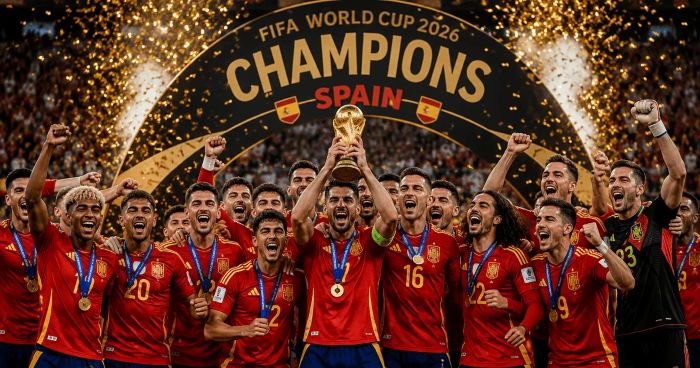
 At precisely the 106th minute inside the packed New York New Jersey Stadium, Ferran Torres completed a journey that began long before Spain arrived in North America.
His extra-time goal did more than break Argentina’s resistance. It delivered Spain’s second FIFA World Cup, restored La Roja to the summit of men’s football 16 years after Andrés Iniesta’s famous strike in Johannesburg, and validated one of the most sophisticated talent-development systems in global sport.




Spain’s 1–0 victory was the dramatic climax of the first 48-team, 104-match FIFA World Cup. Yet the result cannot be adequately explained by the final, the brilliance of one player or the tactical decisions made from the touchline.
This was a triumph manufactured across decades.
It was built in municipal pitches, regional competitions, club academies, coaching classrooms, scouting networks and federation programmes. It came from a football culture that treats technique as infrastructure, coaching as intellectual capital and youth development as a strategic investment rather than an emergency response.
Spain did not merely assemble a winning team. It built a football production system—and then wrapped that system in one of sport’s most recognisable national brands.
One Goal, One Trophy—and Years of Preparation
The final itself was a contest of patience.
Argentina arrived as the defending champion and one of the tournament’s most productive attacking teams. Spain, however, refused to be seduced into recklessness. Luis de la Fuente’s players controlled space, protected the centre, pressed intelligently and waited for the decisive opening.
When Torres struck in extra time, the goal carried powerful historical symmetry. Iniesta had scored Spain’s winner in the 116th minute of the 2010 final. Sixteen years later, another late intervention secured another star.
But the 2026 champions were not simply a recreation of the 2010 team.
That earlier generation became synonymous with overwhelming possession, short passing and suffocating control. The new Spain preserved those technical foundations while adding greater speed, width, direct running, defensive flexibility and physical intensity.
This was possession with a destination.
Spain could dominate the ball, attack through wide areas, counter quickly or defend without panic. It could win beautifully, but it no longer needed every victory to conform to a rigid stylistic script.
That adaptability proved decisive throughout the knockout phase.
Mikel Merino delivered the late goal that eliminated Portugal. Fabián Ruiz and Merino scored as Belgium were edged out in the quarter-final. Mikel Oyarzabal and Pedro Porro struck in the 2–0 semi-final victory over France. Torres then became the final’s match-winner.
The spread of decisive contributions revealed one of Spain’s greatest strengths: responsibility did not sit on the shoulders of a single superstar.
The Defence Behind the Spectacle
For a country celebrated for its midfielders and technical artists, Spain’s most striking tournament statistic came at the other end of the pitch.
The champions conceded just one goal throughout the competition—the fewest surrendered by any World Cup-winning team.
That record transformed the familiar story of Spanish football.
The 2026 team did not regard defensive discipline as the opposite of creativity. Its press began with the forwards; its midfield protected possession responsibly; its defenders were comfortable receiving the ball under pressure; and goalkeeper Unai Simón provided calmness behind the entire structure.
Spain’s individual awards reflected this balance.
Rodri received the Golden Ball as the tournament’s outstanding player. Simón collected the Golden Glove, while 19-year-old Pau Cubarsí was recognised as the competition’s leading young player.
Those honours told the story of a complete team: intelligence in midfield, authority in goal and generational renewal in defence.
Spain also became the first country to hold the men’s and women’s FIFA World Cup titles simultaneously. That distinction significantly enlarges the meaning of the victory. Spain’s competitive advantage is no longer confined to one national team; it increasingly reflects a broader football ecosystem capable of developing talent across the game.
Luis de la Fuente: The Triumph of Institutional Memory
The appointment of Luis de la Fuente initially lacked the glamour traditionally associated with elite international management. He was neither a celebrity coach imported to create instant excitement nor a revolutionary outsider promising to demolish everything that came before him.
He was something more valuable: an institutional insider who understood the pathway.
Before taking charge of the senior side after the 2022 World Cup, De la Fuente had worked with Spain’s national youth teams. He led the Under-19 side to the European title in 2015 and the Under-21 team to continental success in 2019. He also managed Spain’s Olympic team before moving into the senior role.
Within seven months of his appointment, Spain won the 2023 UEFA Nations League. In 2024, it became European champion. In 2026—on De la Fuente’s 50th match in charge—it conquered the world.
That progression represents a powerful management lesson.
Spain did not separate youth development from senior-team performance. It created continuity between them. De la Fuente had coached some of the players before they became established international stars. He understood their personalities, technical education and responses to pressure.
The federation, in turn, promoted someone who understood its football language.
This reduced the disruption that often accompanies leadership changes. Players were not repeatedly forced to abandon one philosophy and learn an entirely unrelated one. The national team evolved, but it did so from a recognisable base.
In business, this would be described as succession planning and institutional knowledge retention. In football, it is too often dismissed as familiarity.
Spain turned it into a competitive asset.
Spain’s Real Talent Factory Is a Network
La Masia, Barcelona’s celebrated academy, occupies a central place in the mythology of Spanish football. Its graduates have shaped some of the most influential club and national teams of the modern era.
The emergence of Lamine Yamal and Pau Cubarsí has reinforced the academy’s global reputation. Both reached football’s summit at 19, demonstrating how early technical education can be translated into senior-level composure.
But Spain’s talent advantage is far bigger than Barcelona.
Real Madrid’s La Fábrica, Athletic Club’s Lezama, Real Sociedad’s Zubieta and the academies operated by Valencia, Villarreal, Sevilla, Atlético Madrid, Osasuna and numerous smaller clubs form a decentralised production network.
Each academy carries a distinct regional identity. Yet most share important principles: technical competence, tactical literacy, structured competition, qualified coaching and a pathway from youth football into increasingly demanding senior environments.
This diversity matters.
Spain is not dependent on a single academy, one city or one generation. When one club’s production cycle slows, another can supply the national pool. A player developed in the Basque Country can combine naturally with one schooled in Catalonia, Madrid, Andalusia or Valencia because the wider football culture gives them a broadly compatible technical language.
The federation sits above this network—not as the sole creator of talent, but as its coordinator, selector and final integrator.
That is the hidden strength of the Spanish model. It combines local identity with national coherence.
Training Intelligence, Not Just Athletic Ability
Spain’s academy system is designed to produce players who understand football, not merely athletes who can participate in it.
Young players are repeatedly placed in situations that demand scanning, positioning, rapid decision-making, spatial awareness and comfort under pressure. Ball mastery remains important, but it is developed alongside tactical comprehension.
The best academies also integrate formal education, sports science, psychological support, nutrition and personal development. The objective is not simply to identify the most physically advanced child. It is to create an environment in which technically gifted players can mature intelligently.
This is particularly important because early physical dominance can be deceptive. A youth system obsessed with size and speed may overlook players whose greatest assets are anticipation, balance, imagination and decision-making.
Spain’s football history is filled with players who might have been underestimated by less patient systems.
The 2026 team again demonstrated the commercial wisdom of that patience. Academies do not merely supply players; they create valuable intellectual property, transfer assets, club identities, supporter relationships and national-team depth.
A well-run academy is simultaneously a sporting institution, an educational platform and an investment portfolio.
From Tiki-Taka to a More Dangerous Spain
The first great Spain dynasty—from 2008 to 2012—changed football’s strategic conversation. It demonstrated how technical superiority and positional control could overcome more physically imposing opponents.
But successful ideas can eventually become predictable.
Spain’s football declined when possession became an end rather than a means. The team could dominate matches statistically without creating enough danger. Opponents learned to defend compactly, surrender harmless areas and wait for transitions.
De la Fuente’s Spain retained control but restored penetration.
Wide attackers were encouraged to challenge defenders. Midfielders could carry the ball forward rather than always circulating it. Full-backs created overloads. The press became more aggressive, while direct passes were no longer treated as a betrayal of Spanish identity.
The result was a more complete proposition: a team capable of controlling tempo but also changing it.
This evolution offers another lesson for businesses and brands. Heritage is an asset only when it remains responsive to the market. A successful organisation must know which elements of its identity are sacred and which must evolve.
Spain preserved its technical DNA while modernising its competitive expression.
The Federation’s Financial Architecture
Football philosophy requires financing.
The Royal Spanish Football Federation approved a €403.5 million budget for 2026, including €38.9 million in capital investment. Projected sponsorship income was placed at €89.1 million, while combined sponsorship and audiovisual revenues were expected to exceed €200 million.
More importantly, the federation budget established pathways through which commercial success could support the base of the game.
Approximately €87 million was earmarked for financial-support programmes for clubs in national competitions. Funding was increased for youth academies and scouting structures, while regional associations were allocated €40.3 million. Investment was also planned for infrastructure, information technology and the modernisation of the national football complex.
The principle is clear: the apex must help finance the pyramid.
A national team cannot remain sustainably successful if federation revenues are consumed entirely by administration, travel and short-term competition expenses. Commercial income must continually renew the system that produces the players.
Spain’s victory will now increase the attractiveness of its sponsorship inventory, merchandise, international content, exhibition matches and licensing opportunities. The critical test will be whether this additional value is reinvested intelligently.
Trophies generate attention. Systems convert attention into lasting wealth.
Football as a Serious Spanish Industry
Spain’s football power cannot be separated from the economic scale of its domestic game.
A KPMG assessment commissioned by LaLiga estimated that professional football generated €18.35 billion in economic activity during the 2021–22 season—equivalent to approximately 1.44 per cent of Spanish gross domestic product.
The industry supported an estimated 194,381 jobs and contributed approximately €8.39 billion in taxes. Its effects extended beyond clubs into broadcasting, telecommunications, hospitality, transport, construction, retail, advertising and digital services.
These figures predate Spain’s latest World Cup victory, but they establish the size of the platform upon which the triumph has landed.
Football in Spain is not treated merely as weekend recreation. It is a productive sector with supply chains, exports, intellectual property, human capital, technology and international customers.
The national team is therefore both a sporting representative and the flagship of a wider industrial ecosystem.
The Brand Machine Behind La Roja
Spain’s football brand possesses several characteristics that conventional brands spend enormous sums trying to manufacture.
It is distinctive. The red shirt, the national crest and the identity of La Roja are instantly recognisable.
It is consistent. Supporters broadly understand the type of football Spain wants to play, even as its tactical expression evolves.
It is multigenerational. The legacy of Xavi, Iniesta, Iker Casillas, Sergio Ramos, David Villa and other 2010 heroes now connects with Rodri, Yamal, Cubarsí, Simón, Pedri, Oyarzabal, Merino and Torres.
It is emotionally charged. Millions do not merely watch the product; they participate in it.
And, crucially, it now has fresh proof of performance.
Brands associated with Spanish football acquire more than logo exposure. They gain access to national pride, youth culture, international audiences and compelling human stories. The commercial portfolio surrounding the federation spans technology, telecommunications, insurance, travel, transport, consumer goods, fashion, electronics and automotive services.
The World Cup victory raises the value of that association—but only for partners capable of activating it creatively.
Passive sponsorship will produce visibility. Intelligent sponsorship can create customer acquisition, data, content, retail traffic, employee engagement and long-term brand preference.
Market Implications
Spain’s triumph will influence several connected markets.
Demand for national-team merchandise should rise, particularly around the second championship star. Broadcasters and digital platforms will have stronger content propositions. Sponsors can develop campaigns around the champions, while clubs with winning players gain additional storytelling and commercial leverage.
Spanish academies may also attract greater international interest from investors, football institutions and families seeking elite development environments. Sports-technology companies can use the ecosystem as a testing ground for performance analysis, scouting, injury prevention and fan engagement.
Tourism authorities will have an opportunity to connect football with Spain’s wider cultural proposition. Madrid, Barcelona, Bilbao, San Sebastián, Valencia, Seville and other football centres can be marketed not only as destinations but as components of a living sporting culture.
Player valuations may also benefit from the credibility created by tournament performance. Yet investors should distinguish between short-lived tournament excitement and sustainable commercial fundamentals.
Not every player associated with a winning team will automatically produce durable value. Contract length, age, club fit, injury history, media appeal and competitive consistency will remain decisive.
Brand Implications
The central brand lesson is that reputation is produced by repeated organisational behaviour.
Spain’s football identity is believable because the promise made by the senior team is supported by what happens in its academies, domestic clubs, coaching system and national competitions.
Many brands make ambitious external claims that are contradicted by weak internal systems. Spain demonstrates the reverse: build the operating culture first, then allow performance to authenticate the promise.
The Spanish model also shows the power of renewal.
A legacy brand cannot survive solely on nostalgia. Spain honours 2010 without living inside it. It has introduced new personalities, tactical ideas and narratives while retaining the deeper characteristics that make its football recognisable.
That is how heritage becomes momentum.
Investor Relevance
For investors, Spain’s victory strengthens an already mature football marketplace rather than creating one from nothing.
Opportunities exist across media rights, sponsorship activation, merchandise, academies, women’s football, sports technology, data analytics, tourism, stadium experiences and international training partnerships.
The federation’s expanding commercial revenue and the wider economic contribution of professional football indicate a functioning value chain. The presence of globally recognised clubs gives Spanish football constant international distribution, while the national team provides periodic surges of collective attention.
However, the trophy should not obscure important risks.
Player workload must be managed. Commercial expansion should not overwhelm sporting priorities. Clubs and federations must protect competitive integrity, maintain financial discipline and continue investing in the grassroots institutions that produced the success.
The greatest danger after victory is believing the system no longer requires improvement.
What Nigeria and Africa Must Learn
Nigeria’s lesson is not to copy Spain’s formation, passing patterns or academy names. It is to understand the architecture behind the outcome.
Nigeria does not lack talent. It lacks a sufficiently reliable system for identifying, developing, educating, measuring and retaining that talent.
A credible Nigerian renewal would require:
- A properly financed national youth-development strategy extending across regions and age groups.
- Regular, competitive youth leagues rather than occasional tournaments assembled close to international qualifiers.
- Transparent academy-licensing standards covering coaching, safeguarding, education, medical support and facilities.
- A national scouting and player-data platform connecting schools, grassroots clubs, academies, professional teams and national selectors.
- Structured career pathways for Nigerian coaches, including promotion from youth teams into senior national responsibilities.
- Stronger domestic clubs capable of developing players, retaining commercial value and creating deeper supporter relationships.
- Federation budgets that disclose how sponsorship and broadcasting revenue is reinvested in the football pyramid.
- Sponsorship models tied to measurable development outcomes—not merely shirt branding and ceremonial presentations.
The decisive shift must be from talent celebration to talent production.
Nigeria often discovers exceptional players despite the system. Spain produces elite players through the system. That distinction explains why one country waits anxiously for a golden generation while the other continually manufactures replacements.
BRANDECONOMY Insight
Spain’s second World Cup is not primarily a story about abundance. It is a story about alignment.
The academies develop intelligent players. The clubs expose them to elite competition. The federation connects the age-group teams. The coach understands the pathway. The national team expresses a recognisable identity. Commercial partners finance and amplify the product. Victory then increases the value available for reinvestment.
Every component reinforces the others.
That is what separates a collection of talented individuals from a high-performance economy.
Spain’s most valuable asset is therefore not the trophy now returning to Madrid. It is the institutional machinery capable of producing another team after this one has passed.
Ferran Torres supplied the winning goal. But Spain’s system scored it.