Export Dreams, Idle Factories: Why Nigeria Still Struggles to Turn AfCFTA into Prosperity

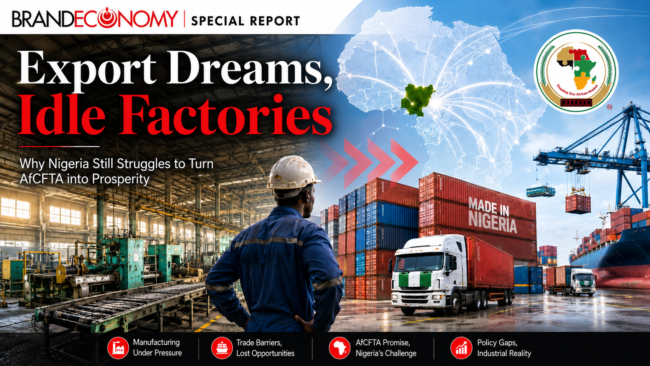 Nigeria entered the African Continental Free Trade Area with one of the continent’s largest consumer markets, an extensive entrepreneurial base and the ambition to become a manufacturing and export powerhouse.
Yet the country’s Idle Factories remain trapped between continental opportunity and domestic constraint.




For many manufacturers, AfCFTA promises access to a unified African market in which Nigerian food products, pharmaceuticals, chemicals, building materials, textiles, household goods and industrial inputs can reach consumers beyond national borders.
In practice, however, expensive credit, unreliable electricity, port congestion, fragmented logistics and high production costs continue to weaken the competitiveness of Nigerian goods.
The result is an uncomfortable contradiction: Nigeria dreams of exports while too many factories operate below their potential.
Manufacturing capacity utilisation has remained constrained by elevated production costs, weak consumer demand and the difficult operating environment. Although parts of the sector have recorded modest improvement, the recovery remains fragile and vulnerable to high energy costs, expensive financing and policy uncertainty.
AfCFTA can create markets. It cannot manufacture competitiveness.
The factory-floor reality
Nigeria’s manufacturers face serious disadvantages long before their products reach a border.
Industry operators have repeatedly identified inadequate electricity, costly energy, high interest rates, foreign-exchange instability, weak infrastructure, regulatory burdens and logistics bottlenecks as major barriers to production.
Energy alone accounts for a significant proportion of manufacturing costs for many operators, as factories rely on diesel, gas, solar systems and other alternatives to compensate for unreliable grid supply.
Financing is equally punishing. Commercial lending rates make long-term industrial investment difficult, particularly for small and medium-sized manufacturers.
A company borrowing at elevated rates must recover its financing costs through higher product prices. Once logistics, electricity, taxes and imported inputs are added, Nigerian products often enter African markets carrying a cost burden that many competitors do not face.
Tariff removal cannot compensate for an inefficient factory.
AfCFTA remains a major manufacturing opportunity
Despite the constraints, the continental opportunity is real.
Intra-African trade offers a stronger market for manufactured and value-added goods than Africa’s traditional external trade, which remains heavily dependent on commodities.
That distinction matters.
AfCFTA can support Nigeria’s industrialisation by creating wider markets for processed foods, garments, pharmaceuticals, chemicals, building materials, household products and engineering goods.
But access to a larger market is not the same as success within it.
Nigerian factories must be able to produce consistently, meet standards, deliver on schedule and compete on price. Without these capabilities, domestic manufacturers risk losing market share not only across Africa, but also at home.
The agreement may open borders for Nigerian products. It also opens Nigeria’s market more widely to products from other African countries.
AfCFTA therefore represents both an opportunity and a competitive warning.
Can customs modernisation change the equation?
Border reform is one of the strongest potential accelerators of Nigeria’s export ambition.
The Nigeria Customs Service has been expanding digital trade processes designed to simplify documentation, improve transparency and reduce delays.
For manufacturers, faster customs processing can lower demurrage, storage charges, production interruptions and uncertainty.
But digital customs cannot repair bad roads, eliminate multiple checkpoints or resolve congestion between factories, ports and land borders.
Modernisation must extend across the entire trade corridor—from the factory gate to warehouses, ports, border posts and destination markets.
Nigeria needs export corridors that treat time as a competitive asset.
Dedicated industrial and agricultural export routes, integrated inspections, electronic certification, harmonised agency operations and reliable cargo-tracking systems could turn customs reform into a genuine commercial advantage.
The real measure of customs modernisation will not be the number of digital platforms introduced. It will be the reduction in the time and cost required to move Nigerian goods across borders.
Export finance must reach real producers
Trade finance remains another critical missing link.
Afreximbank, the Bank of Industry, commercial banks and export institutions can provide working capital, guarantees and structured financing. Yet many small and medium-sized manufacturers remain unable to secure affordable funding for machinery, certification, packaging, inventory and market entry.
The Pan-African Payment and Settlement System offers the prospect of making cross-border payments in African currencies, reducing some dependence on hard currency and lowering conversion friction.
That could help Nigerian businesses trade more efficiently across the continent.
But payment systems become relevant only after goods have been produced.
Manufacturers still need affordable capital before production begins.
Export-credit programmes should prioritise businesses with confirmed orders, measurable local value addition, credible governance and demonstrated market demand.
Financing must also move beyond a narrow group of large corporations to include capable SMEs that can participate in regional supply chains.
From idle capacity to industrial opportunity
For investors, Nigeria’s idle manufacturing capacity should not be viewed only as evidence of weakness.
It also represents potentially recoverable productive infrastructure.
Factories operating below capacity may be able to expand output faster than entirely new facilities if energy, financing and market-access constraints improve.
Investment opportunities exist in industrial parks, embedded power, warehouses, export logistics, packaging, quality certification, supply-chain technology and local raw-material development.
However, investors will demand stable policies, predictable taxes, efficient ports, enforceable contracts and greater confidence in the wider business environment.
Capital is attracted by opportunity, but it remains where institutions are credible.
The brand challenge for Nigerian products
AfCFTA is also a major brand test for Nigeria.
“Made in Nigeria” must evolve from a patriotic slogan into a credible continental promise built around quality, affordability, reliability and strong distribution.
Nigerian brands entering African markets must understand local tastes, languages, regulations and retail channels.
A product that succeeds in Lagos may require different packaging, pricing, messaging or distribution in Accra, Nairobi, Kigali or Abidjan.
Export competitiveness is therefore both an industrial challenge and a brand-building discipline.
Companies must invest in research, product quality, compliance, customer experience and after-sales support.
The brands that win under AfCFTA will not necessarily be the loudest. They will be those that understand African consumers and deliver consistently.
Market implications
If Nigeria resolves its production constraints, AfCFTA could stimulate growth across manufacturing, logistics, financial services, warehousing, transportation and professional services.
Higher exports could improve foreign-exchange earnings, support job creation and reduce dependence on crude oil revenues.
But if domestic constraints remain unresolved, imports from more competitive African producers could gain ground in Nigeria.
The agreement therefore increases the urgency of domestic reform.
Nigeria cannot seek preferential access to African markets while leaving its manufacturers exposed to unstable power, costly finance and inefficient logistics.
Investor relevance
Investors should focus on sectors where Nigeria possesses strong demand, local raw materials and potential regional advantage.
These include agro-processing, pharmaceuticals, textiles, household products, building materials and selected engineering goods.
The most attractive opportunities may lie in enabling infrastructure rather than finished goods alone.
Companies that provide reliable energy, logistics, digital trade services, certification, storage and distribution could benefit from the expansion of intra-African commerce.
The key risk remains execution.
AfCFTA will reward countries that combine policy ambition with industrial discipline.
BRANDECONOMY Insight
Nigeria cannot export what its factories cannot competitively produce.
AfCFTA has widened the market, but prosperity will depend on what happens behind Nigeria’s factory gates.
Customs modernisation, payment systems, export finance and new trade corridors can reduce friction. They cannot substitute for reliable power, affordable capital, productive infrastructure and disciplined industrial policy.
Nigeria’s strategic task is clear: convert idle capacity into production, production into trusted brands and trusted brands into continental market share.
AfCFTA is not an automatic prosperity machine.
It is an invitation to compete—and Nigeria must first build the economy capable of accepting it.