

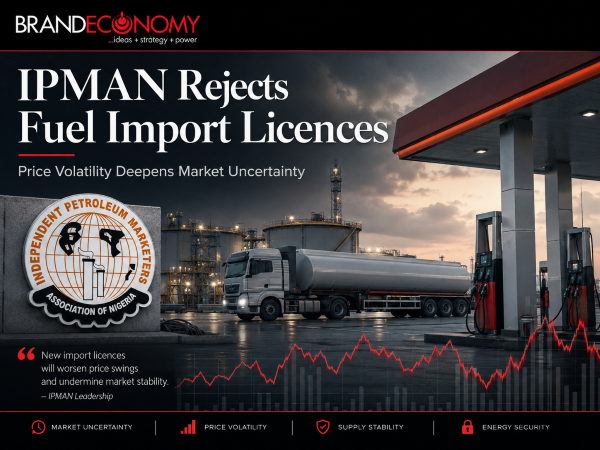
 The Independent Petroleum Marketers Association of Nigeria has called for a review of licences granted to companies for the importation of petroleum products, warning that the policy is worsening price instability, increasing pressure on the naira and undermining the economic case for domestic refining.
IPMAN’s National Publicity Secretary, Chinedu Ukadike, made the association’s position known in a voice note released to journalists in Abuja on Sunday.




Ukadike said independent marketers had closely examined recent developments in the downstream petroleum market, including volatile depot prices, the import-licensing regime and the sale of petroleum products in foreign currency.
The association concluded that issuing additional import licences was not delivering the expected benefit to consumers or marketers.
According to Ukadike, the Federal Government, through the Nigerian Midstream and Downstream Petroleum Regulatory Authority, should transparently review the policy and determine whether continued importation remains economically justified while locally refined products are available.
He argued that the landing cost of imported petrol was about ₦1,350 per litre—roughly 20 per cent above the price reportedly offered by the Dangote Refinery.
Importing fuel at a higher cost than locally available supply, he said, was counterproductive and imposed avoidable pressure on Nigeria’s foreign-exchange market.
Import dependence and the naira problem
Ukadike linked petroleum import licences to increased demand for dollars and the recent depreciation of the naira to about ₦1,400 to the dollar.
Because imported products are priced largely in foreign currency, exchange-rate movements flow quickly into depot and pump prices.
This means that even where international crude and product prices are relatively stable, a weaker naira can raise the local cost of petrol, diesel and other refined products.
For Nigeria, the issue goes beyond fuel pricing. Petroleum imports consume foreign exchange that could otherwise support machinery, industrial inputs and other productive sectors.
Ukadike said one major gain from the emergence of local refining had been the reduction of the prolonged supply shortages that historically disrupted transport, business activity and household life.
“If we have a continuous, uninterrupted supply, our problem is pricing,” he said.
He questioned whether it would not be more productive for government, regulators, refiners and marketers to address domestic pricing concerns rather than issue import licences that could inflate costs further.
Support local refining, IPMAN tells government
IPMAN urged the Federal Government to strengthen domestic refining capacity, including government-owned refineries and the Dangote Refinery.
Ukadike said local production was central to Nigeria’s energy security, stable supply and foreign-exchange conservation.
He maintained that the perennial scarcity that once characterised Nigeria’s downstream market had eased considerably since the Dangote Refinery began supplying products thus making further issuance Import licences untenable.
The country should therefore prioritise local refining, support competitive domestic production and create conditions for Nigeria to export surplus petroleum products, he said.
That strategy could improve supply resilience while reducing the economy’s vulnerability to shipping costs, foreign-exchange shocks and disruptions in international product markets.
However, supporting local refining must not mean replacing import dependence with an uncompetitive domestic monopoly.
The regulatory challenge is to protect consumers and energy security while ensuring that local refiners operate under transparent pricing, open access and fair competition.
Marketers suspend purchases amid price uncertainty
The dispute over imports emerged as uncertainty in the petrol market forced some independent marketers to suspend fresh purchases and temporarily close filling stations.
IPMAN’s Western Zone Chairman, Chief Oyewole Akanni, told the News Agency of Nigeria in Ibadan that the disruption followed the suspension of Premium Motor Spirit loading at the Dangote Refinery about four days earlier.
According to him, marketers were compelled to source products from private depots at significantly higher prices.
The lowest ex-depot prices in Lagos were said to range between ₦1,200 and ₦1,220 per litre, excluding transportation and other distribution costs.
Marketers who purchased petrol on Friday reportedly paid between ₦1,210 and ₦1,220 per litre, while some depots were offering the product for as much as ₦1,250.
Nipco and Aiteo were said to be selling at about ₦1,200 per litre.
Akanni explained that many filling stations that had exhausted their stock were waiting to see whether prices would decline after the refinery resumed loading or rise further.
Only a limited number of marketers were buying products because of the risk of purchasing at a high depot price and being forced to sell at a loss if prices fell shortly afterwards.
“No scarcity”—but supply pressure is visible
Akanni insisted that Nigeria was not experiencing an outright fuel scarcity and urged motorists to avoid panic buying.
He nevertheless warned that pump prices could rise if the current situation persisted.
The marketer said Dangote Refinery neither gave prior notice nor explained why loading had been suspended.
Four truckloads of petrol intended for his stations had remained at the refinery for four days, he said, adding that the company’s own trucks were also parked.
The Nigerian National Petroleum Company Limited was reportedly affected because it also sourced products from the refinery.
Across Ibadan, several filling stations were closed, leaving motorists uncertain about the availability and direction of petrol prices.
Market and investor implications
The current disruption illustrates how dependent the downstream market has become on a limited number of supply points.
Local refining has improved supply security, but temporary suspension at a major refinery can quickly push marketers towards costlier private depots.
For investors, this points to opportunities in refining, storage, coastal distribution, trucking, pipelines and depot infrastructure.
It also demonstrates the need for a diversified supply system in which no single refinery, importer or depot operator can destabilise the national market.
Brand implications
For the Federal Government and NMDPRA, the import-licensing debate is a test of policy coherence.
Government cannot promote domestic refining while simultaneously approving imports that appear more expensive, unless it can clearly explain the energy-security or competition rationale.
For Dangote Refinery, the absence of prior communication around loading disruptions could affect confidence among marketers and commercial partners.
In the fuel market, reliability and transparent communication are central brand assets.
BRANDECONOMY Insight
Nigeria’s downstream petroleum market is caught between two competing risks: unbridled and incoherent dependence on imports and excessive dependence on one dominant domestic refinery.
IPMAN is right to question the economic logic of importing products at prices above local supply. But the answer cannot be a punishing import racket against local refiners and hapless consumers.
The stronger policy is a transparent, competitive domestic market backed by strategic import flexibility when there is a clear and manifest need, multiple refineries, adequate storage and clear pricing rules. The resort to incoherent issuance of Import licences must be put to a stop.
Nigeria must support local refining without allowing supply concentration to become a new source of instability.
The goal should be simple: dependable supply, fair competition, lower foreign-exchange exposure and prices that reflect efficient production rather than regulatory confusion.