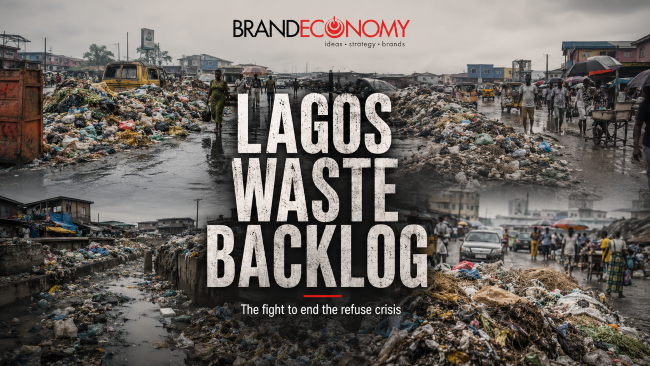
 The Lagos Waste Management Authority (LAWMA) has unveiled a broad package of infrastructure, regulatory and operational reforms aimed at ending persistent waste backlogs and improving sanitation across Nigeria’s commercial capital.
The Managing Director of LAWMA, Dr Muyiwa Gbadegesin, disclosed the measures during a live interview on Lagos Traffic Radio’s Talk Time programme.


Gbadegesin attributed the recent accumulation of refuse on major roads and inner streets to ageing disposal facilities, heavy rainfall, rising waste volumes and inadequate collection and processing infrastructure.
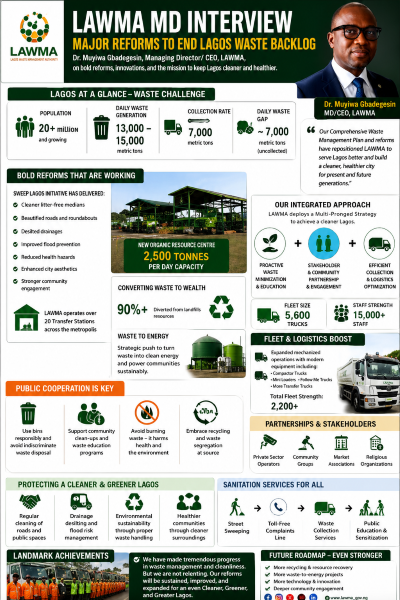
Lagos, with an estimated population of about 22 million people, generates between 13,000 and 15,000 tonnes of waste daily. That scale has placed severe pressure on existing disposal sites and collection systems.
“The challenge is not just population growth,” Gbadegesin said. “Two of our major disposal sites, Olusosun and Solous III, have reached the end of their operational lives.”
He explained that the authority was managing their end-of-life operations while moving Lagos towards a more modern waste-management model.
 From dumpsites to modern processing facilities
 From dumpsites to modern processing facilities
Gbadegesin said conventional dumpsites were no longer sustainable for Lagos because of its coastal environment, limited land and expanding urban population.
The state is therefore replacing the traditional landfill model with Transfer Loading Stations, Material Recovery Facilities and waste-to-energy plants.
Transfer loading stations being developed at Olusosun and Solous are expected to receive large volumes of waste before onward transportation to modern processing facilities.
The Olusosun station alone is projected to handle about 2,500 tonnes daily.
A Material Recovery Facility under construction in Ikorodu is also expected to mechanically recover approximately 90 per cent of incoming waste.
Organic materials will be converted into compost or energy, plastics will be recycled into products such as waste bins, while only a small residual fraction will be sent to engineered landfills.
Gbadegesin said the projects could create about 5,000 direct jobs and are expected to become operational in the first quarter of 2027.
Waste-to-energy enters the mix
LAWMA has also started deploying waste-to-energy technologies, including biodigesters designed to convert market waste into electricity and cooking gas.
Gbadegesin cited the recently commissioned biodigester at Ikoyi Fruit Market, where organic waste from fruits is being processed into renewable energy.
The development reflects a wider shift in urban waste management—from seeing refuse solely as a disposal problem to treating it as a potential source of energy, industrial input and commercial value.
For Lagos, the opportunity is significant. The state generates recyclable materials estimated at about $2.5 billion annually, creating potential for private investment in recycling, composting, circular manufacturing and clean energy.
PSP failures and consumer compliance
The LAWMA chief identified poor public compliance as another major obstacle.
He said every household was legally required to maintain waste bins and subscribe to licensed Private Sector Participation operators for regular collection.
However, a significant number of residents fail to pay collection charges, weakening the financial capacity of operators and reducing service quality.
“When residents refuse to pay PSP operators, operators struggle financially and service delivery suffers. It becomes a vicious cycle,” he said.
Gbadegesin urged residents not to dump refuse on roads whenever collection is delayed.
He said residents should report defaulting operators to LAWMA, which provides backup evacuation services and targets a 48-hour response time.
Responding to complaints from Ogba, Magodo and Osi, he said LAWMA would investigate the affected operators and deploy backup trucks where necessary.
The authority monitors all licensed PSP operators monthly and may issue warnings or withdraw licences from persistent defaulters.
Enforcement against illegal dumping
Gbadegesin described indiscriminate dumping as an act of sabotage because of its effect on flooding, traffic congestion and public infrastructure.
LAWMA has strengthened surveillance through Project WISE—Waste Investigation, Surveillance and Enforcement.
Undercover teams monitor known illegal-dumping locations, apprehend offenders and prosecute them before environmental courts.
According to him, thousands of convictions have been secured, with some offenders serving jail terms and others performing community service by cleaning illegal dumpsites.
LAWMA is also working with the Ministry of the Environment and the Lagos State House of Assembly to review environmental laws and introduce tougher penalties.
Community-based collection and recycling
The authority is expanding a tricycle-based door-to-door waste collection system in communities that compactor trucks cannot easily access.
The model, already operating in Ibeju-Lekki and Lagos Island, allows residents to pay per collection and could improve service in densely populated or difficult terrain.
LAWMA also plans to establish community recycling centres where residents can exchange recyclable materials for cash.
Gbadegesin said local waste-management task forces had been created across the state’s 57 local governments and local council development areas.
The task forces bring together community leaders, environmental officers and PSP operators to improve grassroots sanitation.
Truck and infrastructure deficit remains
The authority recently received 10 additional compactor trucks from the Lagos State Lottery Board and expects about 150 more before year-end.
However, Gbadegesin said Lagos requires approximately 2,000 compactor trucks for efficient statewide collection and remains below half of that requirement.
LAWMA is also constructing or rehabilitating seven Transfer Loading Stations at Olusosun, Solous, Ikorodu, Iberekodo, Ijegun, Agege and Oshodi.
The state ultimately requires about 20 stations under its three-year infrastructure plan.
Market and investor implications
The reforms could open opportunities across recycling, logistics, waste-to-energy, equipment leasing, compost production and circular manufacturing.
Investors will, however, look for transparent concession arrangements, dependable waste supply, payment security and clear environmental standards.
A more efficient sanitation system would also improve urban mobility, public health and the operating environment for businesses.
Brand implications
For Lagos, sanitation is inseparable from its megacity brand.
A city positioning itself as Africa’s leading commercial and investment hub cannot afford persistent refuse heaps, blocked drainage and unreliable collection.
For LAWMA, credibility will depend on visible improvements—not only announcements.
BRANDECONOMY Insight
Lagos’ waste challenge is no longer a simple collection problem. It is an infrastructure, financing, enforcement and behavioural challenge.
The proposed reforms are ambitious and directionally sound. But the state must move quickly from construction plans to functioning facilities.
Residents must pay for legitimate services. PSP operators must meet standards. LAWMA must enforce rules fairly and maintain reliable backup systems.
The real breakthrough will come when waste is no longer merely removed from streets, but converted into jobs, energy, recycled products and economic value.