A title won by nerve, detail, culture and belief — as Mikel Arteta’s long project finally returned Arsenal to the summit of English football
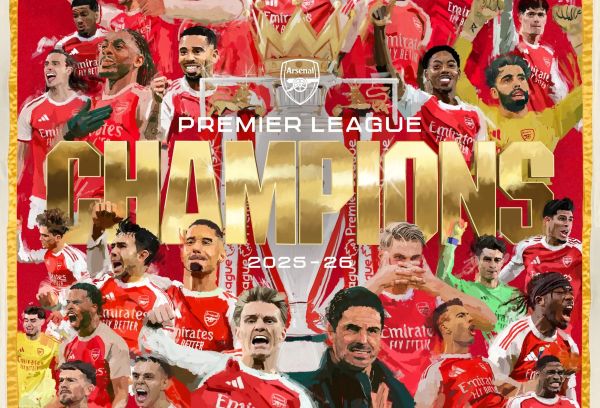 A title won by nerve, detail, culture and belief — as Mikel Arteta’s long project finally returned Arsenal to the summit of English football
For 22 long years, Arsenal’s supporters carried the memory of greatness like a cherished family photograph: the Invincibles of 2003/04, the swagger of Thierry Henry, the intelligence of Dennis Bergkamp, the commanding aura of Patrick Vieira, and a club that once seemed to define the very beauty of English football.




On Tuesday, May 19, 2026, that long wait ended.
Arsenal were crowned English Premier League champions after Manchester City were held 1–1 by Bournemouth at the Vitality Stadium, leaving Mikel Arteta’s side four points clear with one game remaining. The coronation came barely 24 hours after Arsenal had ground out a tense 1–0 victory over Burnley at the Emirates Stadium, courtesy of a Kai Havertz header from Bukayo Saka’s corner, a goal that pushed the Gunners to the brink and forced City into a must-win assignment they could not complete.
It was Arsenal’s 14th top-flight English title, their first league crown since the “Invincibles” season, and the crowning reward for a project that had endured ridicule, near-misses, setbacks and serious pressure before arriving, at last, in glory.
But this title was not won in one decisive match, one transfer window or one moment of late-season fortune. It was built over years — in recruitment meetings, in lonely afternoons after painful defeats, in tactical reinvention, in the academy, in boardroom patience, in supporters learning once again to believe, and, remarkably, in symbols as unusual as a boat, a training-ground fire and an AI-generated TikTok song.
The Night the Waiting Ended
Arsenal did not win the title on the pitch. They won it while watching another match unfold.
At their training ground, players and staff gathered as Bournemouth faced Manchester City, knowing a City victory would drag the title race into the final day, while any dropped points would confirm Arsenal as champions. Bournemouth struck first through Eli Junior Kroupi, whose superb finish put City under pressure. Erling Haaland equalised in stoppage time, but the draw was insufficient. When the whistle blew, North London exploded. Players celebrated at the training centre; fans poured into the streets around the Emirates Stadium; a generation of emotional debt was released in one night.
The scenes captured the depth of the achievement. Arsenal had not merely ended a barren spell. They had overcome the emotional fatigue of three successive second-place finishes, the late-season trauma of repeatedly chasing Manchester City, and the suspicion in some quarters that Arteta’s admirable project might forever remain nearly-but-not-quite.
This time, they endured.
The Burnley Win That Held the Nerve
Before Bournemouth delivered the final arithmetic, Arsenal had to handle their own responsibility. Their 1–0 victory over Burnley was not one of the season’s great artistic performances. It was something more precious in a title run-in: controlled tension, patience and refusal to panic.
Burnley resisted stubbornly until Havertz rose to meet Saka’s corner shortly before half-time. The goal was emblematic of Arsenal’s title-winning identity: not always flamboyant, but precise; not always overwhelming, but increasingly mature; capable of finding decisive moments through set-piece discipline and collective concentration.
The win moved Arsenal five points clear and placed the title within touching distance. In that moment, Arteta’s side did what champions often do: they found the one action that mattered on a night when rhythm was imperfect.
A Six-Year Project, Not a One-Season Miracle
The great temptation after any title triumph is to explain it through the season alone. That would misread Arsenal’s return.
This title was the culmination of a six-year reconstruction that began when Mikel Arteta was appointed in late 2019 and insisted, during a difficult early phase, that supporters should “trust the process.” The phrase became mocked, debated and eventually vindicated.
Arteta inherited a club searching for identity after the Arsène Wenger era and the short-lived Unai Emery transition. Over time, he reshaped Arsenal in his own image: demanding without apology, emotionally intense, tactically exacting and utterly committed to restoring standards. The transformation was not always smooth. Arsenal endured setbacks, periods of public doubt and painful near-misses. Yet those experiences hardened the group rather than hollowing it out.
By 2026, Arsenal were no longer a project in progress. They were a fully formed elite side — defensively rigorous, tactically adaptable, set-piece sharp, psychologically resilient and deep enough to survive the bruises of a demanding season.
Arteta’s Arsenal: Fire, Feeling and Football Intelligence
Arteta’s managerial genius lies partly in his football ideas, but also in his ability to turn symbols into emotional fuel.
When Arsenal hit a difficult patch in the title race, accounts of the club’s internal culture reported that Arteta had players discard negative thoughts into a fire at the training ground — a theatrical gesture, yes, but entirely consistent with a manager who understands that elite performance is as much psychological as physical.
Earlier in the year, after a painful defeat by Manchester United, Arteta urged supporters to “jump on the boat” because the journey ahead would be worth it. It sounded, at the time, like another emotive rallying cry. By May, it felt almost prophetic.
Then there was the AI-generated TikTok anthem that reportedly became a favourite within the squad, carrying one of Arteta’s recurring messages: “make it happen.” On the surface, it was a quirky dressing-room detail. At a deeper level, it captured the unity of a team that had turned shared culture into competitive energy.
Arteta is not merely a tactician. He is a brand builder within a football club — constructing language, symbols, rituals and emotional continuity. Great clubs do not win only because they possess talent. They win because talent is organised inside a compelling belief system. Arsenal’s 2025/26 season was proof. This is an interpretation grounded in the club-culture accounts surrounding the title run.
The Sporting Structure Behind the Glory
While Arteta will rightly command much of the acclaim, Arsenal’s title was also a triumph of institutional alignment.
The club’s recruitment and football operations had been reshaped over several seasons. Edu Gaspar, before his departure, helped assemble much of the core squad that grew into championship material. His exit was followed by the appointment of Andrea Berta as sporting director in 2025, bringing experience from Atlético Madrid and a reputation for disciplined football planning.
Arsenal also strengthened executive leadership when Richard Garlick was elevated to chief executive in 2025, while the Kroenke ownership became increasingly visible in the club’s strategic direction. The transformation was not a case of one charismatic manager carrying a fractured institution; it was a coherent rebuilding effort that aligned ownership, executive management, recruitment and coaching.
This alignment matters from a sports-business perspective. Modern title-winning clubs are not simply squads; they are systems. Arsenal became champions because their system stopped contradicting itself. The football philosophy, transfer strategy, academy pathway, supporter engagement and executive patience began to point in the same direction. This is an analysis supported by the structural changes reported around the club’s title rise.
A Squad Built to Endure
The champions were fashioned from a careful blend of academy soul, elite recruitment and tactical clarity.
Bukayo Saka, a Hale End graduate, remained the emotional and technical heartbeat of the side. Myles Lewis-Skelly, Ethan Nwaneri and Max Dowman embodied the club’s faith in its youth system and the continuity of Arsenal’s identity as a club that still wants to grow its own.
Around them stood a squad strengthened by serious investment and targeted additions, including players such as Eberechi Eze, Viktor Gyökeres, Martin Zubimendi, Noni Madueke, Piero Hincapié and others who increased depth and resilience. Arsenal’s recruitment was not merely about signing names; it was about ensuring the squad could survive injuries, pressure and fixture congestion without losing its core shape.
The result was a team capable of winning in multiple ways. Arsenal could dominate the ball, suffer without collapsing, score from corners, absorb transitions, and manage emotional momentum across the season. That versatility became decisive when the title race tightened.
The Setback That Nearly Changed Everything
This Arsenal title was not a procession.
In the spring, the Gunners lost the Carabao Cup final 2–0 to Manchester City, a defeat that denied them early silverware and briefly threatened to impose familiar doubts. They later lost in the league to City as well, narrowing the gap at the top and giving their rivals hope of yet another late-season overhaul.
The Carabao Cup final produced one of the campaign’s rare misjudgments, with Arteta’s decision to use Kepa Arrizabalaga rather than his regular No. 1 appearing, in hindsight, a costly sentimental choice. That defeat mattered — not only because Arsenal lost a trophy, but because it forced the side to confront whether they were once again on the brink of emotional derailment.
Instead, they hardened.
The champions’ great achievement was not that they avoided pressure. It was that they processed it better than before. They were not flawless. They were finally resilient enough.
From Nearly Men to Champions
For three seasons, Arsenal had looked increasingly like the heir apparent to Manchester City’s reign, only to fall short. The 2025/26 campaign changed that. This time, when City surged, Arsenal did not disintegrate. When their lead narrowed, they did not surrender control. When the football became tense, they still found ways to win.
The title, therefore, represents more than a table-topping total. It is a psychological breakthrough. Arsenal have crossed the line from promise to proof.
That transformation has enormous brand value. Clubs live not only on trophies, but on the stories attached to them. Arsenal’s long-awaited title is a narrative of patience rewarded, identity restored and faith vindicated. It refreshes the club’s global commercial appeal, deepens fan loyalty and strengthens the aura around Arteta’s project at a time when European football’s competitive hierarchy is under constant revision. This is a brand and sports-business interpretation anchored in the club’s title success and wider commercial context.
The Champions League Dream Still Awaits
Even as Arsenal celebrated their Premier League triumph, another extraordinary chapter remained unwritten. The club had already reached the UEFA Champions League final, where they are scheduled to face Paris Saint-Germain in Budapest on May 30. A victory there would deliver the first European Cup in Arsenal’s history and complete one of the most remarkable seasons ever assembled by the club.
The Premier League title is already historic. But the Champions League final offers Arsenal the chance to become legendary.
BRANDECONOMY Insight
Arsenal’s Title Was a Triumph of Brand Restoration as Much as Football Excellence
Arsenal’s Premier League victory is one of the great modern stories of institutional patience paying off.
In an era when clubs often change managers in panic and confuse spending with strategy, Arsenal chose a more difficult path. They stayed with Mikel Arteta through turbulence. They rebuilt recruitment. They invested in youth. They backed executive stability. They cultivated an emotional compact between team and supporters. They turned the club from a frustrated giant into a confident, coherent football enterprise.
That is why this title matters beyond the trophy cabinet.
For years, Arsenal’s brand lived in the shadow of memory — elegant, historic, admired, but no longer feared. The 2025/26 champions have changed that perception. They have reintroduced Arsenal to the world not as a nostalgic institution, but as a contemporary powerhouse: young, sophisticated, emotionally compelling and commercially magnetic.
The unusual details of the campaign — the boat metaphor, the fire ritual, the AI song — will be remembered because they humanise the triumph. But the deeper truth is more serious: Arsenal won because they built a culture before a coronation.
Every great sporting comeback contains a lesson for brands, businesses and institutions. Arsenal’s lesson is clear:
Vision matters. Patience matters. Alignment matters. And when culture, talent and leadership finally converge, history can be rewritten.