
Lagos Eyes ₦4trn Capital Inflows as Global Investors Gather for Invest Lagos 3.0
From Panels to Projects

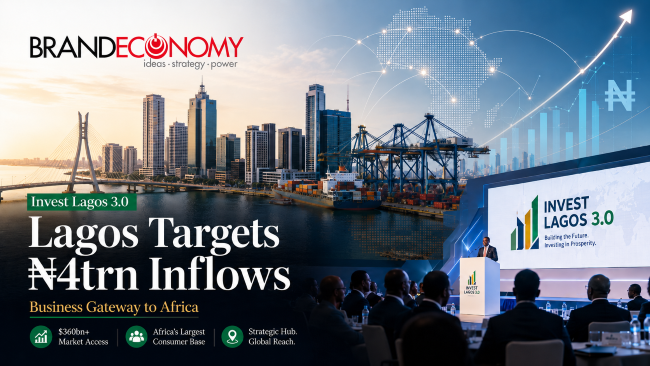 Lagos State is setting its sights on a bold ₦4 trillion investment mobilisation target as it prepares to host Invest Lagos 3.0, the third edition of its flagship investment summit. Scheduled for June 8–9, 2026, the forum is designed to bring together global investors, development institutions, sovereign funds, private-sector leaders and state governments around opportunities in infrastructure, manufacturing, technology, logistics, tourism, energy transition and the creative economy. The bigger ambition is unmistakable: to position Lagos not merely as Nigeria’s commercial capital, but as Africa’s preferred gateway for capital, enterprise and innovation.
A ₦4trn Investment Ambition
The Lagos State Government is preparing to convert investor interest into measurable capital flows, with officials projecting that Invest Lagos 3.0 could help attract about ₦4 trillion in local and foreign direct investment into the state’s economy.

The summit, themed “Lagos: Business Gateway to Africa,” will hold at Eko Hotels and Suites, Victoria Island, and is being organised in collaboration with the Commonwealth Enterprise and Investment Council and private-sector partners. More than 1,000 delegates from Nigeria and abroad are expected to attend, including institutional investors, multilateral organisations, trade networks and development finance actors.
For Lagos, the Invest Lagos 3.0 event is no longer conceived as a ceremonial conference. According to the Commissioner for Commerce, Cooperatives, Trade and Investment, Mrs Folashade Ambrose-Medebem, the summit has evolved into a platform for capital mobilisation, sector partnerships and investor confidence-building. That framing is significant because investment summits often fail when they remain talk shops. Lagos appears keen to present this edition as a deal-oriented forum with stronger implementation intent.
Why Lagos Is Selling Itself Aggressively
Lagos’ investment pitch rests on a compelling foundation. It is Nigeria’s most populous and commercially dense state, home to the country’s largest consumer market, busiest formal and informal business ecosystems, growing innovation clusters, expanding transport infrastructure, major industrial corridors and strategic maritime assets.
Ambrose-Medebem described Lagos as being “at the centre of Africa’s economic story,” citing its infrastructure expansion, industrial base, innovation economy and seaport advantage. The point is well made. Few cities on the continent combine market size, entrepreneurship, port access, digital services, financial concentration and cultural influence in quite the same way.
Yet Lagos’ promise is matched by urgent needs. Its population pressure, transport congestion, housing deficit, energy constraints and infrastructure gaps require more private capital than government budgets alone can provide. The investment summit is therefore not merely about branding; it is also a financing necessity. The city needs long-term capital to sustain its growth, prevent infrastructure from lagging further behind demand and convert economic scale into globally competitive urban productivity. This is an inference from the summit’s sectoral priorities and the state’s emphasis on infrastructure, logistics and energy transition.
The Sectors Lagos Wants Investors to Back
Invest Lagos 3.0 is expected to spotlight investment opportunities across a broad slate of sectors, including:
infrastructure, manufacturing, agriculture, technology, tourism, logistics, financial services, energy transition, industrial parks, special economic zones, export-oriented manufacturing and digital commerce ecosystems.
This sector mix reflects the state’s attempt to balance old-economy and new-economy growth. Infrastructure and logistics address physical productivity. Manufacturing and agriculture support job creation and supply-chain depth. Technology and digital commerce reinforce Lagos’ position as one of Africa’s leading startup markets. Tourism and the creative economy capture cultural value. Energy transition aligns the state with emerging green-capital conversations.
The summit’s format is also designed to go beyond speeches. Organisers say the event will feature keynote sessions, executive roundtables, exhibitions and investment matchmaking meetings, with the aim of translating conversations into partnerships and project pipelines.
From Panels to Projects
The Deputy Chief of Staff to the Lagos State Governor and Co-Chair of the Local Organising Committee, Mr Sam Egube, said more than 29 global speakers had confirmed participation. He added that the summit would focus on measurable investment outcomes across technology, healthcare, transportation, energy, the environment and the creative economy.
Egube also projected the attendance of between 500 and 600 high-level delegates, including sovereign wealth funds, multilateral institutions, structured finance specialists and trade networks. This matters because Lagos is not only courting conventional corporate investors; it is also targeting larger pools of patient capital suited to infrastructure and city-scale development.
The success of the summit, however, will depend on what happens after June 9. Capital markets reward credibility. Investors want bankable projects, predictable regulation, transparent concessions, clear land access, reliable approvals and dispute-resolution mechanisms. If the state can use the summit to move projects from visibility to investability, the event may begin to justify its ambitious ₦4 trillion target. This is an inference grounded in the summit’s stated objective of translating engagement into measurable outcomes.
Project Tours: Lagos as a Living Pitch Deck
One of the more practical features of Invest Lagos 3.0 is the planned tour of major infrastructure and industrial projects for foreign delegates. Technical Committee Co-Chair Ms Toyosi Akerele said more than 400 international delegates are expected to visit key assets such as the Lekki Free Trade Zone, Dangote Refinery, Lekki Deep Sea Port and Lagos rail infrastructure projects.
This approach is strategically sound. Investors are often more persuaded by functioning assets than by presentations. The Lekki axis, in particular, has become one of the most consequential investment belts in West Africa, linking refining, shipping, industrial manufacturing, trade logistics and future urban development.
By turning physical infrastructure into a live showcase, Lagos is attempting to demonstrate that it already possesses scale, proof of execution and investable momentum. The message is simple: this is not a blank slate. It is an economy under construction.
The Governors’ Investment Showcase
A key feature of the summit will be the Governors’ Investment Showcase, conceived as a platform to connect subnational governments with global investors, development institutions and business leaders.
This is potentially important beyond Lagos itself. Nigeria’s states are under growing pressure to attract capital, build infrastructure and diversify local economies. A showcase that gives governors direct access to investors could support a healthier model of subnational economic competition—one based on projects, reforms and investor readiness rather than only federal allocations.
For Lagos, hosting that platform also reinforces its broader role as Nigeria’s economic convening centre: the place where state-level ambition meets regional and global capital.
Youth, SMEs and Inclusion
The Invest Lagos 3.0 summit will also feature a focus on youth entrepreneurship, small and medium enterprises, and technology-driven engagement, according to organisers.
That inclusion is essential. Large capital inflows matter, but the legitimacy of investment strategy increasingly depends on whether growth reaches entrepreneurs, young people and smaller firms. Lagos already has one of Africa’s most energetic startup and SME ecosystems. If new investment strengthens supplier networks, industrial clusters, digital platforms and service businesses, the summit’s impact could spread beyond headline deal values.
The state’s challenge is to ensure that its investment narrative does not become overly elite. Lagos must remain attractive to billion-dollar infrastructure funds, but also accessible to the creative founder in Yaba, the logistics entrepreneur in Oshodi, the manufacturer in Ikorodu and the agribusiness operator seeking distribution through the city’s massive consumer market. This is an inference drawn from the summit’s sectoral positioning and SME emphasis.
The Politics of Positioning Lagos as Africa’s Gateway
Among the dignitaries expected at the summit are Governor Babajide Sanwo-Olu, Deputy Governor Obafemi Hamzat, and the Minister of Industry, Trade and Investment, Dr Jumoke Oduwole.
Their presence underscores the political weight Lagos is attaching to the summit. The state is not merely seeking investment; it is making a statement of continental ambition. The phrase “Business Gateway to Africa” is deliberate. Lagos is competing not only with Nigerian states, but with cities such as Nairobi, Kigali, Johannesburg, Cairo and Accra for investor mindshare, regional headquarters, logistics flows, creative talent and technology capital. This is an inference from the summit’s theme and investor mobilisation strategy.
To win that competition, Lagos must offer more than scale. It must offer certainty.
BRANDECONOMY Insight
Lagos’ ₦4 trillion Invest Lagos 3.0 target is ambitious, but not fanciful. The state has a strong investment story: it is Nigeria’s largest market, its most internationally visible subnational economy, its most sophisticated commercial ecosystem and the focal point of much of the country’s logistics, digital innovation and private-sector dynamism.
The bigger question is not whether Lagos can attract attention. It already has that. The question is whether it can consistently convert attention into bankable capital commitments.
That conversion will depend on five factors:
First, project quality. Investors want clearly structured opportunities, not broad promises.
Second, regulatory predictability. Land access, permitting, taxation and concessions must be transparent.
Third, infrastructure credibility. Rail, roads, ports and power must keep pace with the city’s ambition.
Fourth, execution discipline. Signed deals must survive beyond summit headlines.
Fifth, inclusion. Investments should generate jobs, SME opportunities and broader economic participation, not merely prestige projects.
The summit’s emphasis on infrastructure, logistics, manufacturing, technology, tourism and energy transition suggests that Lagos understands the sectors most likely to shape future competitiveness. The project tours are smart. The Governors’ Investment Showcase is strategically useful. The Commonwealth partnership widens access to investor networks.
But the real scorecard will come later: how much capital was actually committed, how many projects reached financial close, how many jobs were created, and whether Lagos becomes easier—not just louder—to invest in.
If the state gets that right, Invest Lagos 3.0 could be remembered as more than a summit. It could become a milestone in the evolution of Lagos from commercial capital to continental capital magnet.