
VIO Heads to Supreme Court After Appeal Court Affirms Ban on Vehicle Impoundment, Fines

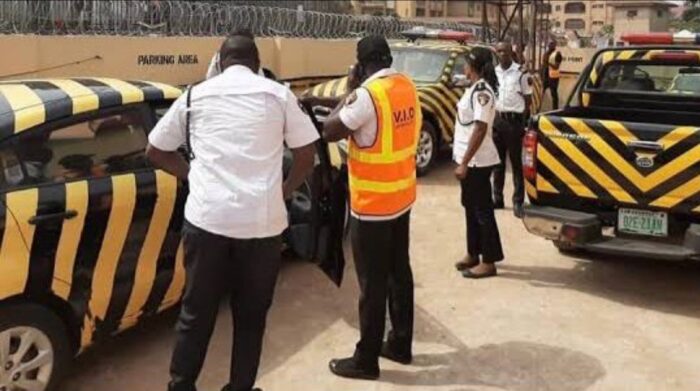
Nigeria’s long-running battle over road traffic enforcement in the Federal Capital Territory reached a decisive new phase on Thursday as the Directorate of Road Traffic Services (DRTS), popularly known as the Vehicle Inspection Office (VIO), vowed to challenge at the Supreme Court a landmark Court of Appeal judgment that bans its officials from stopping motorists, impounding vehicles, or imposing fines.
The move sets the stage for what could become one of the most consequential public-interest legal battles in Nigeria’s modern democratic era — one that touches on civil rights, constitutional powers, and the limits of administrative enforcement.



Appeal Court Upholds Powerful High Court Ruling: “VIO Has No Legal Basis to Impound Vehicles or Issue Fines”
In a unanimous decision, a three-member panel of the Court of Appeal, Abuja Division, dismissed the DRTS’ appeal as lacking merit, affirming the emphatic ruling delivered earlier by Justice Nkeonye Maha of the Federal High Court.
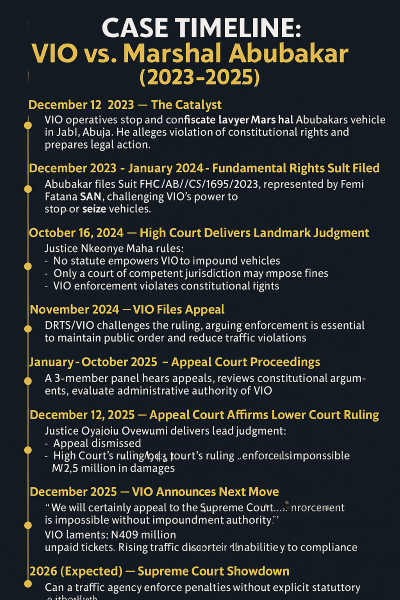
Justice Oyejoju Oyewumi, who delivered the lead judgment, held there was no lawful foundation for overturning the High Court’s October 16, 2024 decision, which had barred VIO officers from:
- Stopping vehicles
- Confiscating or impounding cars
- Imposing fines or administrative penalties
The appellate court agreed wholly with Justice Maha that no statute — federal or FCT — empowers the DRTS to carry out roadside enforcement of this nature. Only a court of competent jurisdiction can impose penalties on motorists.
The Case That Changed Abuja Traffic Enforcement
The suit, filed by public-interest lawyer Marshal Abubakar (represented by Senior Advocate of Nigeria, Femi Falana), stemmed from an incident on December 12, 2023, when VIO operatives forcefully stopped and confiscated his vehicle in the Jabi axis.
Justice Maha ruled that the VIO:
- Violated Abubakar’s fundamental right to freedom of movement
- Violated his right to own property
- Violated his right to fair hearing
- Acted without statutory authority
- Operated in a manner deemed “oppressive, unlawful, and unconstitutional”
She issued:
- A perpetual injunction restraining the DRTS from all forms of vehicle seizures and fines
- A ₦2.5 million damages award against the DRTS and its top officials
She further held that the agency breached Sections 6(6)(b), 36(1), 36(8), 36(12), 41, and 42 of the 1999 Constitution, as well as Articles 2, 7(3), 12, and 14 of the African Charter on Human and Peoples’ Rights.
The Court of Appeal has now validated all these findings.
VIO Reacts: “We Will Certainly Appeal” — DRTS Raises Alarm Over Traffic Disorder
In an exclusive reaction, Acting Director of the DRTS, Deborah Osho, expressed deep frustration and accused motorists of exploiting the court ruling to violate traffic laws in the capital city.
“We will certainly appeal,” she said.
“Look around the city — lawlessness is increasing. Motorists now turn Airport Road into a one-way. If you can’t impound and you can’t fine, and offenders won’t pay tickets, how do you enforce order?”
Osho revealed:
- Over ₦409 million in unpaid traffic tickets
- Traffic violations have surged since the court ruling
- Enforcement has become “practically impossible”
- Abuja risks descending into traffic chaos without “tools of deterrence”
She questioned whether any global city maintains road order without enforcement power.
Legal Experts Weigh In: A Clash Between Constitutional Rights and Urban Governance
Legal analysts describe the situation as a historic clash between:
- Civil liberties protections, and
- Government’s duty to maintain public order
The big question now is whether the Supreme Court will:
- Affirm citizen protections and restrict administrative overreach, or
- Grant the DRTS limited statutory enforcement powers to preserve traffic discipline.
Either outcome will reshape traffic governance across Nigeria.
The Stakes: Precedent for Nationwide Traffic Enforcement
This case may ultimately determine:
- Whether state and FCT traffic agencies can legally stop motorists
- Whether non-police agencies can impose administrative fines
- Whether Nigeria must adopt a court-only penalty system
- Whether digital enforcement — cameras, ANPR systems, and e-ticketing — becomes mandatory
Governments and motorists nationwide are watching closely.
BRANDECONOMY ANALYSIS: A Defining Test for Rule of Law vs Regulatory Necessity
This legal journey now headed to the Supreme Court is more than a traffic dispute — it is a pressure test for democracy.
At its core lies a simple but profound principle:
Can administrative agencies punish citizens without clear statutory authority?
The High Court and Appeal Court say NO.
The DRTS insists YES — or chaos will follow.
The Supreme Court’s answer will echo far beyond Abuja.