
United Capital’s Profit Surges 80% as Digital Scale, Cost Discipline Pay Off

United Capital Plc has delivered a sharp acceleration in profitability for the first half of 2026, strengthening the investment case for diversified financial-services businesses capable of generating income across different market cycles.
The group’s profit before tax rose by 80 per cent to ₦24.78 billion, compared with ₦13.79 billion in the corresponding period of 2025. Profit after tax climbed 77 per cent from ₦11.89 billion to ₦21.10 billion.


Gross earnings increased by 58 per cent to ₦37.49 billion, demonstrating robust activity across United Capital’s investment banking, asset management, securities, trusteeship, wealth management and other financial-service operations.
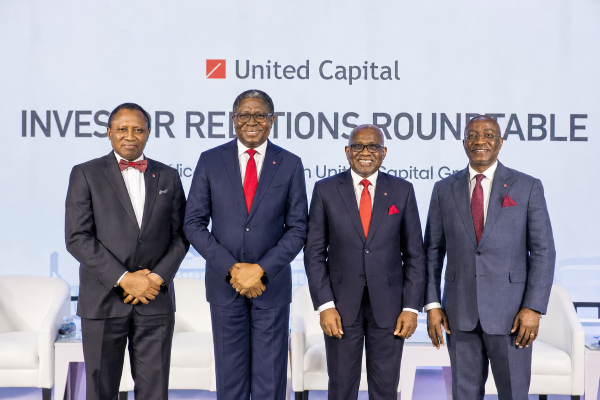
The figures were presented by the Group Chief Finance Officer, Mr Shedrack Onakpoma, at the company’s Investor Relations Roundtable in Lagos. The event was themed, “Decoding Performance: Insights into United Capital’s Growth Drivers and Outlook.”
United Capital’s published H1 2025 results confirm the comparative base of ₦23.76 billion in revenue, ₦13.79 billion in profit before tax and ₦11.89 billion in profit after tax.
Profit grows faster than income
Onakpoma attributed the 2026 performance to disciplined execution, operational efficiency and continued investment in digital capabilities.
The most important signal in the results is that profit grew considerably faster than gross earnings. That suggests improving operating leverage: additional income is translating into profit at a more efficient rate.
United Capital’s cost-to-income ratio declined from 50 per cent in H1 2025 to 44 per cent. For investors, that six-percentage-point improvement provides evidence that digital infrastructure, process optimisation and cost controls may be generating measurable returns.
Fee and commission income increased from ₦11.3 billion to ₦14.3 billion, while investment income advanced from ₦9.6 billion to ₦13.8 billion.
This income mix matters. A financial institution excessively dependent on trading gains may produce spectacular results during favourable market conditions but struggle when yields, exchange rates or asset prices change. Expanding fee income can provide a more recurring earnings foundation, particularly where it is supported by asset management, advisory, securities and trusteeship activities.
A more liquid balance sheet
Shareholders’ funds rose by 25 per cent to ₦187.09 billion, from ₦149.99 billion at the end of December 2025.
Onakpoma said the group exited underperforming assets and reduced expensive borrowings, improving returns and strengthening financial resilience. Cash and cash equivalents consequently increased from 16 per cent to 24 per cent of total assets.
The higher liquidity position gives United Capital greater capacity to respond to investment opportunities, honour short-term obligations and withstand market volatility. The trade-off is that excess cash must eventually be deployed productively or returned to investors to avoid depressing overall returns.
The board’s interim dividend of 30 kobo per share reflects an attempt to balance immediate shareholder rewards with capital retention for longer-term expansion.
Betting on Nigeria’s improving fundamentals
United Capital’s Chief Economist, Mr Ayodele Akinwunmi, said reforms by the Federal Government and the Central Bank of Nigeria were strengthening economic fundamentals and creating new investment opportunities.
He identified non-oil exports, diaspora remittances and stronger foreign-exchange inflows as important sources of confidence and external-sector stability.
Exports of refined petroleum products, aviation fuel and fertiliser are beginning to broaden Nigeria’s foreign-exchange earnings beyond crude oil. This diversification could strengthen the country’s balance of payments, although sustained gains will depend on production reliability, international prices and the competitiveness of Nigerian exports.
Akinwunmi said United Capital was supporting diaspora remittance flows and helping investors interpret opportunities arising from the reforms.
The diaspora proposition is strategically important. Remittances become more economically transformative when they move beyond household consumption into housing, infrastructure, enterprises and professionally managed investment products. Financial institutions able to build trusted, transparent and convenient platforms for diaspora investors could unlock a significant pool of patient capital.
The lithium opportunity
Akinwunmi also identified Nigeria’s lithium deposits as a potential advantage in the global transition to electric vehicles.
United Capital is engaging investors and corporate organisations on structured investments across the solid-minerals value chain.
The bigger development challenge is ensuring that Nigeria does not simply replace crude-oil dependence with the export of unprocessed minerals. Investment structures should encourage exploration, local processing, responsible mining, community participation and domestic value addition.
Market and investor implications
United Capital expects interest rates to moderate during the second half of 2026, potentially reducing borrowing costs and supporting corporate expansion.
The company also projects approximately 11.6 per cent growth in Nigerian equities during the period, with banking, building materials, consumer goods and oil and gas stocks expected to provide momentum.
Akinwunmi further forecast that the naira could appreciate to about ₦1,360 to the dollar by year-end, supported by stronger reserves, lower foreign-exchange demand and increased capital inflows.
These remain forecasts rather than guarantees. Their realisation depends on inflation, monetary policy, oil and non-oil receipts, global risk appetite and the consistency of Nigeria’s reform programme.
Brand implications
United Capital’s strongest brand message is not simply rapid profit growth, but the connection between strategy and measurable execution.
Clients and investors will nevertheless expect digital investment to produce faster service, improved access, stronger security and a consistently superior experience. In financial services, efficiency numbers strengthen reputation only when customers feel the improvement.
BRANDECONOMY Insight
United Capital’s 80 per cent profit growth is impressive, but the quality beneath the number is more consequential: stronger fee income, a lower cost-to-income ratio, improved liquidity and a larger capital base.
The next test is sustainability. If the group can preserve efficiency as interest rates moderate, expand recurring income and deploy liquidity into productive opportunities across Africa, H1 2026 could mark more than another strong reporting period. It could signal the emergence of a genuinely scalable pan-African financial institution.