Nigeria’s External Reserves Rise to $52.52bn as CBN Holds Interest Rate at 26.5%


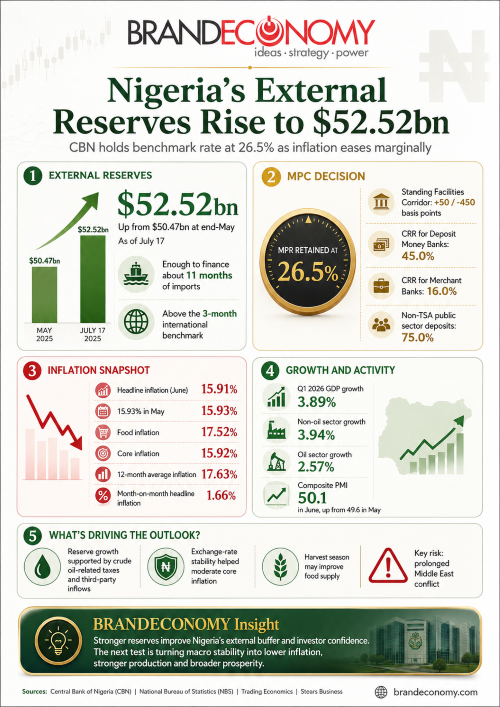
Nigeria’s external reserves have risen to $52.52 billion, strengthening the country’s foreign-exchange buffer and providing approximately 11 months of import cover, the Governor of the Central Bank of Nigeria, Mr Yemi Cardoso, has said.
Cardoso disclosed the figure on Tuesday in Abuja while presenting the communiqué issued at the end of the 306th meeting of the CBN’s Monetary Policy Committee.




The announcement came as the committee retained the Monetary Policy Rate at 26.5 per cent, signalling that the apex bank remains cautious about easing monetary conditions despite marginal improvements in inflation and stronger external reserves.
The MPC also retained the Standing Facilities Corridor around the benchmark rate at +50 and -450 basis points.
The Cash Reserve Requirement for Deposit Money Banks remained at 45 per cent, while the requirement for merchant banks was retained at 16 per cent. The CRR for non-Treasury Single Account public-sector deposits remained at 75 per cent.
 Reserves rise by more than $2bn
 Reserves rise by more than $2bn
According to Cardoso, gross external reserves increased from $50.47 billion at the end of May to $52.52 billion as of July 17.
He attributed the increase mainly to receipts from crude oil-related taxes and inflows from third parties.
“This is sufficient to finance approximately 11 months of imports of goods and services, surpassing the international benchmark of three months’ cover,” the CBN governor said.
The improvement strengthens Nigeria’s capacity to meet external obligations, support the foreign-exchange market and reassure investors about the availability of hard currency.
However, the quality and durability of the reserve growth will remain important.
Reserves supported by stable export earnings and long-term capital inflows provide a stronger foundation than those driven largely by temporary receipts, borrowing or short-term portfolio movements.
Nigeria must therefore continue expanding non-oil exports, improving crude production and attracting productive foreign investment capable of generating sustainable foreign-exchange earnings.
Inflation eases marginally
Cardoso said headline inflation eased slightly to 15.91 per cent in June from 15.93 per cent in May, ending three consecutive months of rising price levels.
The decline reflected a slowdown in the non-food component of inflation, which outweighed a further increase in food prices.
Food inflation rose to 17.52 per cent in June from 16.96 per cent in May, highlighting continuing supply constraints and pressure on household living costs.
Core inflation, which excludes volatile food and energy components, moderated to 15.92 per cent from 16.82 per cent, largely because of greater exchange-rate stability.
The 12-month average inflation rate also declined to 17.63 per cent in June from 18.36 per cent in May, marking the sixth consecutive month of moderation.
On a month-on-month basis, headline inflation slowed to 1.66 per cent from 1.75 per cent, driven by weaker core-price pressures.
The improving trend suggests that previous monetary tightening and greater currency stability are beginning to influence prices.
Yet food inflation remains a major concern because it directly affects household welfare, wage pressure and consumer confidence.
Economy grows by 3.89%
Cardoso said real Gross Domestic Product expanded by 3.89 per cent in the first quarter of 2026, compared with 4.07 per cent in the preceding quarter.
The non-oil sector grew by 3.94 per cent, supported by telecommunications, financial services, trade, transportation and other services.
Oil-sector growth slowed to 2.57 per cent from 6.79 per cent in the fourth quarter of 2025, mainly because of maintenance work on oil facilities and installations.
However, recent indicators suggest improving economic activity. The composite Purchasing Managers’ Index rose to 50.1 points in June from 49.6 points in May, indicating a return to marginal expansion.
Cardoso said output growth was expected to remain resilient, supported by recovering crude production, stronger business activity and the effect of ongoing reforms.
Why the CBN held rates
The decision to retain the policy rate reflects the MPC’s concern that inflation remains above levels consistent with durable price stability.
Although headline inflation is easing, food-price pressure, geopolitical uncertainty and external risks remain significant.
Cardoso said inflation was expected to moderate further in the medium term because of exchange-rate stability, the delayed effect of earlier monetary tightening and improved food supply as the harvest season approached.
He warned, however, that a severe and prolonged escalation of conflict in the Middle East remained a major risk to the outlook.
Such a development could raise global energy, shipping and food costs, placing new pressure on inflation, exchange rates and fiscal balances.
Market and investor implications
The rise in reserves should support confidence in the naira, particularly if the CBN continues meeting legitimate foreign-exchange demand and maintaining greater transparency in the market.
For foreign investors, stronger reserves reduce concerns about convertibility and the ability to repatriate capital and dividends.
However, the 26.5 per cent policy rate continues to imply expensive credit for businesses and households.
Banks may benefit from elevated yields, but manufacturers, small businesses and consumers will remain under pressure from high borrowing costs.
The central policy challenge is balancing inflation control with the need to support investment and growth.
Brand implications
For the CBN, stronger reserves and declining inflation support its positioning as a more disciplined and stability-focused institution.
But public confidence will depend on whether these improvements translate into a more stable naira, lower prices and better access to foreign exchange.
For the Federal Government, the reserve increase strengthens the reform narrative, but Nigerians will judge economic performance through food prices, employment and household purchasing power.
BRANDECONOMY Insight
Nigeria’s $52.52 billion External Reserves position is a welcome sign of improving external resilience.
But reserves are not prosperity by themselves.
Their real value lies in protecting the economy from shocks, supporting currency stability and creating confidence for investment.
The next step is to convert macroeconomic stability into lower inflation, affordable credit, stronger production and rising household incomes.
Nigeria has strengthened its financial buffer. The greater test is whether that buffer can support a broader and more inclusive economic recovery.