The latest NBS food-price data shows a familiar pattern: month-on-month increases are returning across everyday staples, even where year-on-year prices have eased from last year’s peaks. For Nigerian households, the relief remains uneven, fragile and highly location-dependent.
 The latest NBS food-price data shows a familiar pattern:
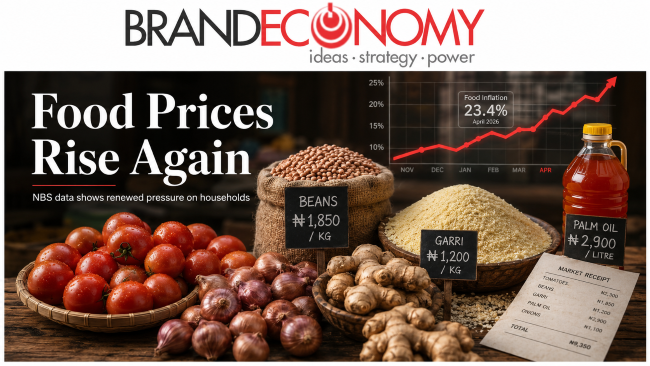
 The cost of key food items rose again in April 2026, with tomatoes, beans, garri, onions, ginger and palm oil recording month-on-month increases, according to the latest Selected Food Prices Watch report released by the National Bureau of Statistics.
The data reinforces a central reality in Nigeria’s consumer economy: even where some food prices are lower than they were a year ago, households are still facing renewed monthly pressure at the market level.




According to the NBS, the average price of 1kg of tomatoes rose by 6.60 per cent from ₦1,104.85 in March 2026 to ₦1,177.92 in April 2026. On a year-on-year basis, however, tomatoes were 8.23 per cent cheaper than the ₦1,283.57 recorded in April 2025.
The average price of 1kg of brown beans increased marginally by 0.99 per cent, rising from ₦1,325.85 in March to ₦1,338.93 in April. Compared with April 2025, when the same quantity sold for ₦2,429.39, the price was down sharply by 44.89 per cent.
The report also showed that 1kg of white garri rose by 0.93 per cent month-on-month, from ₦801.54 in March to ₦808.96 in April. Year-on-year, however, the price fell by 39.86 per cent from ₦1,345.10 recorded in April 2025.
For onions, the average price of 1kg increased by 0.98 per cent, from ₦1,153.14 in March to ₦1,164.39 in April. On a year-on-year basis, onions were 22.56 per cent lower than the ₦1,503.56 recorded in April last year.
The price of 1kg of fresh ginger rose by 0.73 per cent, moving from ₦5,541.25 in March to ₦5,581.82 in April. Unlike most of the other items, ginger also recorded a year-on-year increase, rising by 12.30 per cent from ₦4,970.66 in April 2025.
Palm oil remained under pressure. The average price of one litre increased slightly by 0.12 per cent, from ₦2,393.38 in March to ₦2,396.32 in April. On a year-on-year basis, the commodity rose by 4.77 per cent.
Regional Price Gaps Show Nigeria’s Food Market Fragmentation
Beyond the headline averages, the NBS figures reveal major differences across states and regions, reflecting the fragmented nature of Nigeria’s food supply chain.
In April, Bayelsa recorded the highest average price for 1kg of tomatoes at ₦1,600.73, while Plateau recorded the lowest at ₦730.48.
For brown beans, Oyo had the highest average price at ₦1,938.91, while Taraba recorded the lowest at ₦750.
In the case of white garri, Abia recorded the highest price at ₦1,075.47, while Plateau again recorded the lowest at ₦517.94.
For onions, Abia had one of the highest reported prices, with figures above ₦2,000 per kilogramme, while states such as Kwara and Nasarawa recorded significantly lower prices.
For palm oil, Ekiti recorded the highest average price at ₦2,819.09, while Abia recorded the lowest at ₦2,024.41.
The zonal analysis further underlined these disparities. The South-South recorded the highest average tomato price at ₦1,561.10, followed by the South-East at ₦1,379.57, while the North-West recorded the lowest at ₦822.72.
For brown beans, the South-West and South-South recorded the highest average prices at ₦1,787.09 and ₦1,764.99, respectively, while the North-East recorded the lowest at ₦871.79.
White garri was most expensive in the South-East at ₦944.58, followed closely by the South-South at ₦944.01. The North-Central recorded the lowest average price at ₦673.88.
The South-East and South-South also recorded the highest average onion prices, while the North-Central posted the lowest. For fresh ginger, the South-West recorded the highest average price at ₦6,812.92, followed by the South-East at ₦6,432.15, while the North-East recorded the lowest.
What the Numbers Mean for Households
For consumers, the April figures present a mixed but uncomfortable picture.
On one hand, year-on-year declines in tomatoes, beans, garri and onions suggest that some food prices have retreated from the extreme levels recorded in 2025. On the other hand, renewed month-on-month increases show that food inflationary pressure has not disappeared.
This matters because households experience inflation at the point of purchase, not in statistical averages. A family buying tomatoes, onions, beans and garri in April was likely paying more than it did in March, even if some of those items were cheaper than they were a year earlier.
For low-income households, these modest monthly increases can be significant. Food accounts for a large share of household spending, and price movements in staples immediately affect nutrition, savings, school expenses, transport budgets and healthcare decisions.
The persistence of high prices also forces substitution. Households reduce protein, buy smaller quantities, switch to cheaper staples or cut back on fruits, vegetables and balanced meals. This makes food inflation not only an economic issue, but also a public-health and human-capital issue.
Policy Implications: Nigeria’s Food Problem Is Still Structural
The NBS report again points to the structural weaknesses in Nigeria’s food economy.
The wide gap between tomato prices in Bayelsa and Plateau, or garri prices in Abia and Plateau, reflects more than local demand. It signals the heavy cost of transport, storage inefficiency, poor market integration, insecurity along food corridors, weak cold-chain systems and uneven production clusters.
Nigeria does not merely need more food production. It needs better food movement.
Improved rural roads, storage facilities, irrigation, commodity aggregation, modern wholesale markets, rail-linked logistics, cold chains and digital market information systems are now central to food-price stability.
For policymakers, the lesson is clear: food inflation cannot be solved only by monetary policy. Interest-rate decisions may help manage demand and inflation expectations, but the deeper food challenge is supply-side. Farms must produce more reliably. Goods must move more cheaply. Traders must face fewer security and logistics risks. Seasonal shocks must be managed through storage and processing.
Investor Relevance: Food Inflation Is Also a Market Signal
For investors, the data points to opportunities as much as risks.
High and uneven food prices expose gaps in Nigeria’s agricultural value chain. These gaps create opportunities in storage, processing, cold-chain logistics, warehousing, commodity trading, retail distribution, farm inputs, packaging, irrigation, transport technology and food marketplaces.
Tomatoes, onions, beans, garri, palm oil and ginger are not merely household staples. They are investable value chains.
The challenge is that investors require policy stability, security, infrastructure and predictable regulation. Without these, food-sector investments remain exposed to volatility, spoilage, transport disruptions and uncertain margins.
The food-price data should therefore interest not only consumers and government officials, but also agribusiness investors, logistics companies, development-finance institutions, commodity exchanges and state governments seeking to attract productive investment.
Brand and Market Implications
For consumer brands, retailers and food processors, rising food prices change purchasing behaviour.
Consumers become more price-sensitive. Pack sizes shrink. Demand shifts toward affordable alternatives. Trust becomes important because consumers want quantity, quality and value. Brands that can provide affordable, reliable and transparently priced food products will gain relevance in a strained market.
For food processors, input-price volatility affects margins and pricing strategy. For supermarkets and open-market traders, regional price differences influence sourcing decisions. For quick-service restaurants, bakeries and food vendors, rising staple costs can force menu adjustments and portion reductions.
In a high-cost food economy, brands that understand affordability will win.
BRANDECONOMY Insight
Nigeria’s Food Prices Are Easing Year-on-Year, But Households Are Not Yet Feeling Secure
The April 2026 NBS data tells a nuanced story. Some food prices are lower than they were a year ago, but the month-on-month increases show that the consumer relief is still fragile.
For households, what matters is not whether beans are cheaper than last year’s crisis peak. What matters is whether today’s income can buy enough food this week. On that test, many Nigerians remain under pressure.
The regional disparities are especially important. Food inflation in Nigeria is increasingly a geography problem. Where food is produced, prices may be lower. Where food must travel through expensive, insecure or inefficient routes, prices rise sharply. This means the solution must include logistics, storage, security and market integration — not production alone.
The policy conversation must therefore shift from emergency food announcements to durable food systems. Nigeria needs a farm-to-market strategy that reduces post-harvest losses, improves transport, supports aggregation, expands processing and makes commodity data more transparent.
For investors, the opportunity is substantial. The same inefficiencies hurting consumers can become business opportunities for serious capital. Cold chains, warehouses, processing plants, commodity platforms and logistics systems are no longer optional. They are national economic infrastructure.
Food prices are one of the most politically sensitive indicators in Nigeria. If prices keep rising month after month, household frustration deepens. If supply chains improve, food stability can become one of the strongest signals of economic recovery.
The real test is not whether prices fall briefly. It is whether Nigeria can build a food economy that is productive, resilient and affordable.