


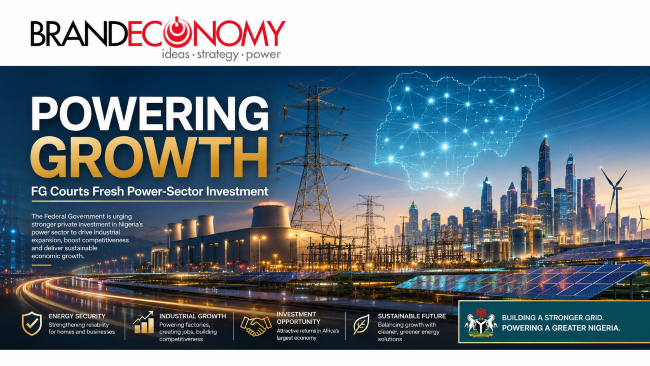
 The Federal Government has urged local and international investors to deepen their participation in Nigeria’s electricity industry and Power-Sector Investment, arguing that reliable power and a commercially sustainable market are indispensable to the country’s industrial transformation and long-term economic growth.
The Minister of Power, Mr Joseph Tegbe, made the call on Tuesday while delivering the keynote address at the Project Hoover Series II Investor Forum in Abuja.




Tegbe said electricity remained one of the most critical foundations of Nigeria’s economic future, noting that manufacturers, small businesses, technology companies, hospitals, schools and other productive sectors could not achieve their full potential without dependable and affordable energy.
According to him, sustainable growth will require an electricity market capable of attracting private capital, rewarding efficient operators and generating sufficient revenue to maintain and expand infrastructure.
He said reforms being implemented by President Bola Tinubu’s administration were designed to reposition the Nigerian Electricity Supply Industry and attracting Power-Sector Investment as a more financially viable, investment-driven and commercially disciplined sector.
“Our destination is clear—a financially sustainable, investment-led electricity market that powers Nigeria’s industrial renaissance,” Tegbe said.
Electricity Act opens new investment frontier
The minister said the Electricity Act 2023 had created an important legal foundation for restructuring the sector and widening participation.
He identified key reform priorities to include stronger competition, state-level electricity markets, expanded transmission infrastructure, faster renewable-energy deployment, greater regulatory certainty and improved governance across the industry’s value chain.
The growing role of states could become particularly significant. Subnational electricity markets offer state governments an opportunity to develop solutions aligned with their industrial clusters, urban centres, agricultural communities and rural populations.
States capable of creating credible regulatory institutions, improving land access and supporting commercially viable projects may become more attractive to independent power producers, mini-grid developers, renewable-energy companies and infrastructure funds.
However, decentralisation will also require strong coordination to prevent overlapping rules, investor confusion and uneven consumer protection.
Historical debts remain an obstacle
Tegbe acknowledged that unresolved financial obligations from previous years had continued to weaken investor confidence.
Nigeria’s power sector has long struggled with liquidity constraints arising from unpaid invoices, weak collections, inadequate metering, tariff shortfalls and operational inefficiencies.
When revenue cannot move efficiently from consumers and distribution companies through the wider electricity value chain, generation companies, gas suppliers and infrastructure providers become financially exposed.
This reduces the ability of operators to maintain existing assets, invest in new capacity or secure long-term financing.
The government’s challenge is therefore not simply to attract capital, but to restore confidence that investments will generate predictable cash flows and that contractual obligations will be honoured.
₦501bn Series I attracts strong demand
Tegbe recalled that the ₦501 billion Series I issuance launched earlier in 2026 was oversubscribed, describing the outcome as evidence of investor confidence in the Federal Government’s power-sector reform programme.
He urged investors to view the latest offering not merely as a fixed-income security, but as an opportunity to participate in rebuilding the country’s electricity market.
The investment framework appears designed to address legacy obligations and strengthen the sector’s commercial foundation, thereby reducing one of the major risks discouraging fresh capital.
The minister said investors should see the transaction as a partnership with government in shaping the next phase of Nigeria’s economic development.
That argument has merit because power-sector financing carries implications far beyond electricity companies. Reliable energy can lower production costs, support industrial expansion, improve business competitiveness and strengthen job creation.
Government highlights inter-agency collaboration
Tegbe commended the collaboration between the Ministry of Power and the Ministry of Finance and Coordinating Ministry of the Economy.
He described power reform as a central component of Nigeria’s broader economic restructuring agenda.
The minister also acknowledged the Office of the Special Adviser to the President on Oil and Gas for coordinating important stakeholders.
Other institutions recognised for their roles included the Nigerian Bulk Electricity Trading Plc, the Debt Management Office, financial advisers and transaction partners involved in developing the investment structure.
The success of the programme will depend significantly on this institutional coordination. Power-sector reforms frequently cross the mandates of regulators, ministries, gas suppliers, debt managers, state governments and private operators.
Fragmented decision-making can delay projects and increase risk. Coordinated implementation can improve confidence and shorten the time between policy announcements and actual investment.
Market implications
Fresh investment could unlock opportunities across generation, transmission, distribution, metering, renewable energy, gas-to-power, storage and embedded electricity systems.
Manufacturers could benefit from more reliable supply and reduced dependence on costly diesel generators. Technology providers may find opportunities in smart meters, grid management, payment systems and energy data.
The reforms could also support the growth of regional electricity markets and industrial clusters.
However, capital will remain cautious unless government addresses payment discipline, tariff predictability, infrastructure vandalism, regulatory consistency and the financial health of market operators.
Investor relevance
The oversubscription of the earlier issuance suggests that investors are willing to support credible power-sector instruments where returns, guarantees and transaction structures are sufficiently clear.
Yet long-term investors will look beyond one successful bond offer.
They will assess whether the government can sustain reforms, resolve legacy liabilities, enforce contracts and support an electricity market that is commercially viable without abandoning consumer protection.
The strongest Power-Sector Investment proposition will combine predictable returns with measurable improvements in electricity supply.
Brand implications
For the Tinubu administration, electricity reform is one of the most consequential tests of its economic brand.
Businesses and households may not experience policy reform through speeches or financial instruments. They experience it through the number of hours electricity is available, the cost of energy and the reliability of service.
For the Ministry of Power, successful mobilisation of private capital could strengthen its positioning as a reform-oriented institution. But credibility will depend on whether investment commitments translate into visible improvements.
BRANDECONOMY Insight
Nigeria’s economic transformation cannot be built on unreliable electricity. Power-Sector Investment is thus very critical to its success.
The government is right to position power investment as a partnership in national development rather than merely another fixed-income opportunity.
But investors need more than attractive instruments. They need a market where contracts are respected, debts are resolved, tariffs are credible and operators are accountable.
The real measure of reform will not be the amount raised at investor forums.
It will be the number of factories operating more efficiently, businesses reducing generator costs and communities gaining dependable access to electricity.
Nigeria’s industrial renaissance begins with power—but only disciplined execution will make that promise real.