

CBN’s 2025 Scorecard: Growth Hits 3.87%, Inflation Falls, Capital Inflows Surge 94%

 Nigeria ended 2025 with a stronger macroeconomic scorecard: faster economic growth, sharply lower reported inflation, improving government revenues, stronger external reserves, a recovering naira and an extraordinary rally in the equities market.
Yet beneath those headline gains lies the question that will define the next phase of Nigeria’s economic reform experiment: can macroeconomic stabilisation translate into stronger purchasing power, cheaper credit, expanding businesses and better living standards?




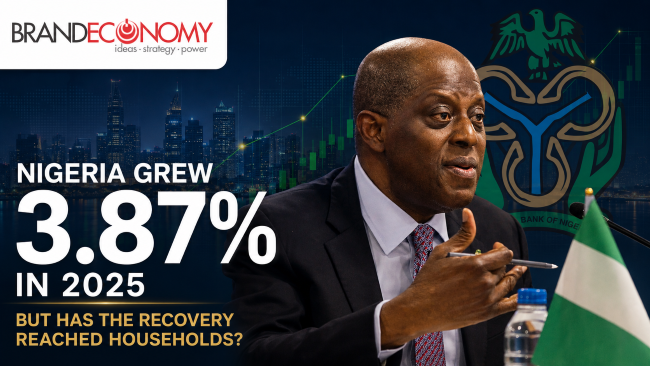
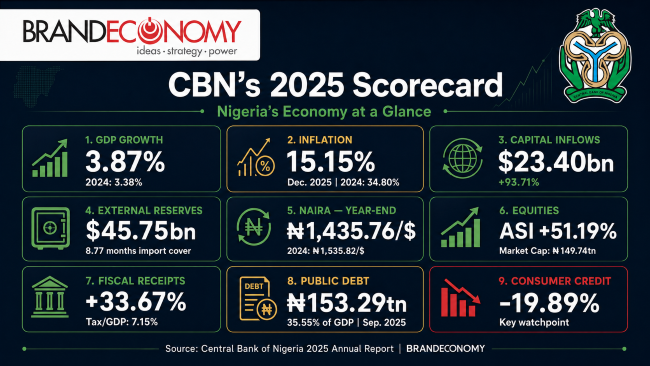
The Central Bank of Nigeria, in its 2025 Annual Report, said the domestic economy expanded by 3.87 per cent, improving from 3.38 per cent in 2024.
The apex bank attributed the stronger performance to continued reforms across key sectors and an economic rebasing exercise that captures emerging areas of activity more effectively.
That distinction matters. Rebasing can improve the accuracy with which the size and structure of an economy are measured, but it does not, by itself, put additional money in households’ pockets. Nigeria’s real economic test therefore goes beyond measuring a larger or more diversified economy to determining whether productive capacity and incomes are expanding meaningfully.
 Inflation retreats—but the consumer question remains
 Inflation retreats—but the consumer question remains
Perhaps the most dramatic number in the report is inflation. Headline inflation declined to 15.15 per cent in December 2025 from 34.80 per cent at the end of 2024.
The CBN attributed the moderation to tight monetary policy, improved exchange-rate stability and the revised methodology for calculating the Consumer Price Index, including updated weights designed to better reflect contemporary household expenditure.
The methodological change means the two inflation readings require careful interpretation. More importantly, falling inflation does not mean prices have returned to earlier levels; it means they are increasing more slowly.
This distinction is critical for businesses. Consumer brands should resist interpreting disinflation as a complete recovery in household purchasing power.
Indeed, one revealing counterpoint is consumer credit. Outstanding consumer lending contracted by 19.89 per cent during the year, partly reflecting reduced personal loans.
That suggests monetary tightening may have succeeded in cooling inflationary pressure while simultaneously constraining the credit needed to stimulate household consumption.
Government collects more—but debt keeps rising
Nigeria’s fiscal numbers also strengthened. Federation receipts increased by 33.67 per cent on stronger oil and non-oil revenues, improving allocations to federal, state and local governments.
Tax revenue as a share of GDP increased from 5.41 per cent in 2024 to 7.15 per cent in 2025, driven by petroleum profit tax, Value Added Tax and corporate income tax.
That improvement is important for a country historically constrained by weak revenue mobilisation.
However, public debt remained a major balance-sheet issue. At the end of September 2025, the debt stock stood at approximately ₦153.29 trillion, equivalent to 35.55 per cent of GDP.
Although that remains below Nigeria’s statutory debt ceiling and the referenced threshold for market-access countries, the debt-to-GDP ratio tells only part of the story. For fiscal sustainability, debt-service costs and government revenue matter at least as much as the nominal debt stock.
Capital markets deliver a spectacular year
Investors had considerably more to celebrate.
The Nigerian equities market recorded one of the report’s most striking performances, with the All-Share Index climbing 51.19 per cent to 155,613 points. Market capitalisation rose 37.01 per cent to ₦149.74 trillion, supported by corporate earnings and improved investor sentiment.
Capital inflows also surged 93.71 per cent to $23.40 billion from $12.08 billion in 2024.
The CBN attributed the increase partly to competitive returns in Nigerian financial assets and reforms to the foreign-exchange market, including the FX Code.
This provides important evidence that greater transparency and improved price discovery can rebuild confidence. But policymakers should distinguish between capital attracted by high financial-market yields and long-duration investment committed to factories, infrastructure and employment.
The financial system, according to the CBN, remained resilient under mild and moderate stress scenarios.
Naira and reserves strengthen
Nigeria’s external buffers also improved.
External reserves rose to $45.75 billion, providing an estimated 8.77 months of cover for goods and services imports. The naira closed 2025 at ₦1,435.76 to the dollar, compared with ₦1,535.82 at the end of 2024.
There is, however, an important nuance: the average exchange rate for 2025 was ₦1,518.38/$, weaker than the ₦1,478.97/$ average recorded in 2024. The year-end recovery therefore signals improving momentum rather than an entirely stronger year for the currency.
Nigeria recorded an overall balance-of-payments surplus of $4.23 billion, although this was below the $6.83 billion achieved in 2024.
Globally, the environment remained complicated. World growth held around 3.30 per cent, while emerging and developing economies expanded by 4.40 per cent. Global inflation eased to 4.20 per cent, prompting several economies to begin reducing interest rates.
Nigeria also faced softer oil prices, with average Bonny Light falling to $70.93 per barrel from $82.56 in 2024.
Brand and market implications
For Nigerian businesses, the emerging opportunity is predictability.
A more stable naira improves budgeting, inventory planning and pricing. Lower inflation can eventually support consumer confidence, while deeper capital markets broaden financing possibilities.
But brands should remain realistic. GDP growth does not automatically equal consumer prosperity. Companies that win this phase will combine disciplined pricing with smaller pack sizes, local sourcing, operational efficiency and products built around value.
For investors, improving reserves, foreign-exchange stability and rising capital inflows make Nigeria more compelling. The risks remain equally visible: elevated debt obligations, constrained consumer credit, dependence on commodity earnings and the need to convert portfolio inflows into productive investment.
BRANDECONOMY Insight
Nigeria’s 2025 numbers suggest that the economy may finally be moving from acute instability towards stabilisation. But stabilisation is the runway, not the destination.
The next scorecard must be tougher: Are real household incomes rising? Is private-sector credit expanding? Are manufacturers investing? Are jobs growing? Is foreign capital building businesses rather than merely chasing yields?
A 3.87 per cent economy is stronger than a 3.38 per cent economy. But the ultimate success of Nigeria’s reforms will not be decided by GDP, reserves or stock-market records alone.
It will be decided when macroeconomic recovery becomes something ordinary Nigerians and Nigerian businesses can actually feel.