Nigeria Customs, Afreximbank Deepen Strategic Alliance to Unlock AfCFTA Trade Opportunities

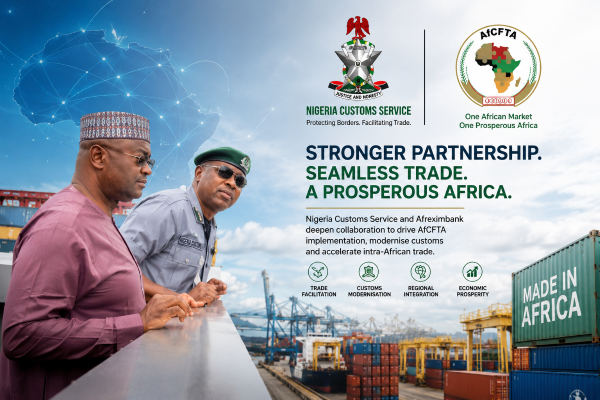 Partnership targets customs modernisation, seamless border trade, regional transit systems and stronger African competitiveness
The Nigeria Customs Service (NCS) and the African Export-Import Bank (Afreximbank) have reaffirmed their commitment to building a more integrated African trading system, strengthening an alliance that is increasingly becoming central to the continent’s ambition of unlocking the full potential of the African Continental Free Trade Area (AfCFTA).




The renewed collaboration emerged following a strategic meeting between the Comptroller-General of Customs, Bashir Adeniyi, and the President and Chairman of the Board of Directors of Afreximbank, Dr George Elombi, at the Nigeria Customs Service Headquarters in Abuja.
Beyond diplomatic engagement, the discussions underscored a shared determination to remove long-standing barriers to cross-border commerce, modernise customs administration and position Africa as a stronger internal trading bloc capable of driving its own economic transformation.
According to the Nigeria Customs Service, the meeting reviewed ongoing collaboration between both institutions while identifying fresh areas of cooperation aimed at simplifying trade procedures, strengthening customs cooperation and accelerating implementation of the AfCFTA.
Building Africa’s Internal Market
For decades, African economies have remained heavily dependent on external markets despite their geographic proximity and expanding consumer base. One of the principal objectives of AfCFTA is to reverse that trend by creating a truly integrated continental market where goods, services and investments move with fewer barriers.
Speaking during the meeting, Adeniyi described the relationship between the Nigeria Customs Service and Afreximbank as one driven by a common belief that Africa’s future prosperity depends largely on expanding trade among African nations themselves.
According to him, initiatives such as the Customs Partnership for African Cooperation in Trade (C-PACT) demonstrate how that shared vision is gradually being translated into practical action through customs reforms and trade facilitation programmes.
The Customs chief noted that cooperation between both organisations has already begun producing measurable progress, particularly in customs modernisation initiatives designed to harmonise procedures and improve the movement of goods across African borders.
He explained that the renewed partnership would further support Afreximbank’s regional transit programmes, encourage the development of one-stop border posts along strategic trade corridors and promote wider adoption of international best practices in customs administration.
Adeniyi also disclosed that Nigeria Customs was already witnessing encouraging outcomes from Afreximbank’s support for regional transit systems, expressing confidence that deeper collaboration would improve Africa’s competitiveness while creating greater opportunities for legitimate trade.
Afreximbank Reaffirms Commitment
Elombi reaffirmed Afreximbank’s readiness to expand support for initiatives capable of facilitating cross-border commerce and accelerating implementation of the AfCFTA.
He commended the Nigeria Customs Service for demonstrating strong institutional commitment to transforming continental trade through modern customs administration and closer regional cooperation.
The discussions also reviewed the successful inaugural edition of the Customs Partnership for African Cooperation in Trade (C-PACT) conference hosted in Abuja in 2025.
The forum brought together customs administrations, development finance institutions, policymakers and private sector stakeholders to promote harmonised customs procedures, strengthen institutional capacity and improve connectivity across Africa’s trading ecosystem.
Why This Partnership Matters
While the announcement may appear administrative on the surface, its economic implications extend far beyond customs operations.
Efficient customs administration remains one of the most critical enablers of competitive trade. Delays at border crossings, inconsistent documentation requirements and fragmented customs systems continue to increase the cost of doing business across Africa.
The partnership between NCS and Afreximbank directly addresses many of these structural bottlenecks.
One-stop border posts, digital customs processes, harmonised documentation and integrated transit systems have the potential to significantly reduce clearance times, lower logistics costs and improve supply chain reliability.
For exporters, manufacturers and logistics companies, these improvements translate into faster market access, lower operating costs and enhanced competitiveness.
Nigeria’s Strategic Position
Nigeria occupies a pivotal position within the AfCFTA framework.
As Africa’s largest economy by GDP and one of its biggest consumer markets, Nigeria’s customs efficiency has significant implications for regional commerce.
Successful customs modernisation could strengthen Nigeria’s position as:
- West Africa’s logistics gateway
- A regional manufacturing hub
- A preferred destination for export-oriented investments
- A continental distribution centre
Conversely, inefficient border processes could limit the country’s ability to fully benefit from AfCFTA’s market-opening opportunities.
Market Implications
The strengthened partnership is expected to benefit several sectors:
Manufacturing
Simplified customs procedures could improve access to regional markets while reducing export bottlenecks.
Logistics and Transport
Improved regional transit systems are likely to create new opportunities for freight operators, haulage companies and supply chain service providers.
Ports and Maritime
More efficient customs operations can increase cargo throughput at Nigerian ports while enhancing the country’s competitiveness against other regional gateways.
Financial Services
Trade finance providers may experience increased demand as cross-border commerce expands.
SMEs
Small and medium-sized exporters stand to benefit from reduced administrative costs and easier market access across Africa.
Investor Relevance
Investors should view this development as an important policy signal.
Countries that streamline customs administration generally attract stronger investment into:
- Manufacturing
- Warehousing
- Industrial parks
- Export processing zones
- Logistics infrastructure
- Trade technology
- Supply chain solutions
As Afreximbank continues supporting regional trade infrastructure and customs reforms, businesses aligned with continental trade corridors may experience accelerated growth opportunities.
Brand Implications
For the Nigeria Customs Service, the collaboration reinforces its ongoing transformation from a traditional revenue collection agency into a strategic trade facilitation institution.
The emphasis on digital customs systems, regional cooperation and international best practices strengthens the Service’s reputation as an increasingly modern public institution supporting national competitiveness.
For Afreximbank, the partnership reinforces its positioning as one of Africa’s foremost development finance institutions driving economic integration through practical trade-enabling interventions rather than financing alone.
BRANDECONOMY Insight
Africa’s next economic frontier will not be determined solely by new trade agreements, but by how efficiently goods move across borders.
The real promise of AfCFTA lies beyond policy declarations—it lies in faster customs clearance, interoperable digital systems, efficient transport corridors and stronger institutional cooperation.
The expanding partnership between the Nigeria Customs Service and Afreximbank signals growing recognition that customs agencies are no longer merely border regulators. They are becoming strategic enablers of competitiveness, investment and continental prosperity.
If successfully implemented, initiatives such as regional transit systems, one-stop border posts and harmonised customs procedures could significantly reduce the cost of intra-African trade, making African businesses more competitive while unlocking new opportunities for exporters, manufacturers, logistics operators and investors.
Ultimately, Africa’s economic integration will be measured not by the number of agreements signed, but by how quickly a product can move from Lagos to Nairobi, Accra, Kigali or Johannesburg. Partnerships such as this bring that vision closer to reality.