Indorama, Nigerian Breweries and Genesis Move to Build One of Africa’s Biggest rPET Plants in Nigeria

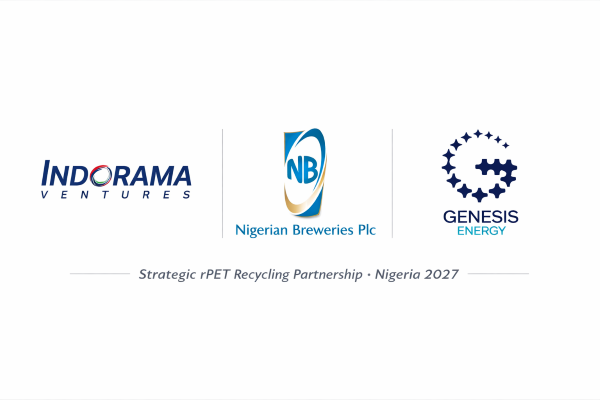 Nigeria’s packaging and manufacturing economy is preparing for a significant circular-economy leap as Indorama Ventures Public Company Ltd., Nigerian Breweries Plc and Genesis Power and Energy Solutions Ltd. partner to establish what is projected to be one of Africa’s largest recycled polyethylene terephthalate (rPET) production facilities.
Planned for Lagos, the rPET Plant facility is expected to produce up to 45,000 tonnes of food-grade rPET resin annually, with start-up targeted for the first half of 2027. More than a factory announcement, the project signals a strategic attempt to connect sustainability, industrial policy, waste recovery and local manufacturing into a more coherent value chain.



At a time when Nigeria is under growing pressure to reduce plastic waste, deepen local industrial capacity and align business practices with global ESG expectations, this investment arrives as both an environmental intervention and an industrial statement.
Why This Matters Now
Nigeria’s consumer economy is expanding, but so is the pressure on its waste management systems. PET bottles remain among the most visible forms of post-consumer plastic waste in urban centres, especially in Lagos, where consumption, logistics and disposal challenges intersect daily.
That makes this project strategically important. A large-scale rPET plant does not simply process waste; it creates an industrial destination for discarded plastic, potentially transforming post-consumer bottles from environmental burden into economic feedstock.
In effect, the venture aims to do three things at once: reduce plastic leakage into the environment, create local industrial value from waste, and help multinational and domestic consumer brands meet rising recycled-content requirements in packaging.
A Circular Economy Bet on Lagos
According to Yash Lohia, Chairman of the ESG Council at Indorama Ventures, Lagos offers the right commercial and logistical base for am rPET Plant project of this scale. As Nigeria’s business capital and largest consumption hub, Lagos generates the density of packaging waste, supply-chain activity and industrial demand needed to support a serious recycling ecosystem.
The recycling facility is expected to convert post-consumer PET bottles into food-grade recycled resin suitable for packaging applications. That matters because food-grade rPET is higher up the recycling value ladder than low-grade plastic recovery. It allows recycled material to re-enter mainstream packaging systems at scale, supporting more sophisticated circular manufacturing.
The project also aligns with Nigeria’s National Policy on Plastic Waste Management, introduced in 2020, which envisions plastic packaging becoming recyclable, reusable, biodegradable or compostable by 2030.
More Than Recycling: Building a Packaging Value Chain
The significance of this investment lies not only in plant size but in the structure of the partnership.
Indorama Ventures brings global recycling expertise and proven technology. The company says it already operates 20 recycling facilities across 11 countries and has recycled more than 160 billion post-consumer PET bottles into high-quality materials. That gives the Nigerian venture technical depth and execution credibility.
Nigerian Breweries brings local market intelligence, packaging demand visibility and strong relevance within the beverage ecosystem. Its role signals that downstream offtake and local commercial alignment are built into the project’s design.
Genesis Power and Energy Solutions adds infrastructure and energy capability, a critical factor in Nigeria where industrial reliability often depends as much on power architecture as on factory equipment.
Together, the partners are not merely building a recycling plant. They are assembling a vertically aware, cross-sector platform that connects waste collection, material recovery, energy support and packaging demand.
The Industrial Logic Behind rPET
Globally, rPET has become a strategic material as beverage and consumer goods companies face pressure from regulators, investors and consumers to increase recycled content and reduce virgin plastic dependence.
Nigeria has often been seen as a large consumer market without enough circular manufacturing infrastructure. This project could begin to change that equation.
If delivered successfully, the plant could help local manufacturers source recycled content domestically rather than depend on imported alternatives or struggle with inconsistent recycling supply. That would reduce supply-chain friction while giving Nigeria a stronger foothold in sustainable packaging manufacturing.
It also raises the possibility that Nigeria could evolve from being a major generator of plastic waste into a serious processing hub for recovered PET in West Africa.
Jobs, Collection and Informal-Economy Linkages
Large recycling investments only work when collection systems work. That means the project’s long-term success will depend not just on machinery inside the plant, but on the efficiency of bottle recovery outside it.
This is where the socio-economic promise becomes especially important.
The partners say the project will support better collection systems, create jobs and deepen community engagement around waste recovery and recycling best practices. That could have real consequences for Nigeria’s informal waste economy, where thousands of collectors, aggregators and small recyclers already operate with limited structure and inconsistent earnings.
A facility of this scale can create stronger demand signals for collected PET, improve pricing consistency, and encourage more organised recovery networks. That, in turn, can widen income opportunities at the lower end of the value chain while reducing landfill pressure and environmental spillover.
Sustainability Meets Industrial Competitiveness
For Nigerian industry, the project also reflects a broader shift: sustainability is no longer just a compliance theme or CSR talking point. It is becoming a competitive manufacturing variable.
Packaging companies increasingly need access to recycled inputs. Consumer-facing brands increasingly need credible sustainability stories. Regulators increasingly want proof of environmental responsibility. Investors increasingly want measurable ESG outcomes.
In that context, rPET capacity is industrial infrastructure.
This explains why the project matters not only to environmental advocates, but also to beverage producers, manufacturers, logistics players, state governments and policymakers focused on industrial transformation.
The Risks and the Execution Questions
The rPET Plant promise is significant, but execution will determine whether the project becomes a model or a missed opportunity.
The partners themselves acknowledge that delivery remains subject to regulatory approvals, technical validation and operational implementation. Those conditions matter. Nigeria’s industrial environment can be slowed by permitting complexity, infrastructure bottlenecks, energy constraints and inconsistent waste segregation at source.
The most important questions now are practical:
Can bottle collection scale fast enough to support 45,000 tonnes of annual output?
Can the plant secure stable power and logistics efficiency?
Can brands commit to sustained demand for recycled-content packaging?
Can Nigeria’s waste and regulatory systems support industrial-grade circularity rather than fragmented recycling activity?
These are not minor details. They are the difference between announcement value and lasting economic value.
A Defining First for Africa
Indorama says the Nigerian project will be its first recycling investment in Africa and its largest recycling plant globally. That is a notable signal.
For Africa, it suggests that global recycling capital is starting to view the continent not only as a waste challenge, but as a growth market for circular manufacturing. For Nigeria, it shows that the country can still attract strategic industrial investment when market demand, policy direction and partnership structure are credible enough.
That makes this project symbolically important. It tells investors that Nigeria’s circular economy may be entering a more bankable phase.
Forward Outlook
If the Lagos rPET Plant launches on schedule in 2027 and collection systems mature around it, Nigeria could gain a powerful new industrial platform that sits at the intersection of manufacturing, climate strategy and urban waste management.
The broader opportunity is clear: build a packaging economy that is less wasteful, more resource-efficient and more locally anchored.
The deeper strategic test is also clear: whether Nigeria can move from policy ambition to industrial execution in the circular economy.
If this venture succeeds, it will not only recycle bottles. It may help recycle the country’s industrial narrative itself—from reactive waste management to proactive materials leadership.
BRANDECONOMY Insight
This rPET Plant project is one of the clearest signs yet that Nigeria’s circular economy is beginning to move from advocacy to infrastructure.
Three deeper shifts are worth watching.
First, waste is being reclassified as industrial feedstock. That changes the economics of recycling and opens the door to larger, more structured value chains.
Second, sustainability is becoming a manufacturing issue, not just an environmental one. Companies that secure local recycled inputs will gain strategic advantage in packaging, exports and ESG positioning.
Third, industrial collaboration is becoming essential. No single player can build circularity alone. Technology, local demand, power reliability and collection systems must work together.
If this rPET Plant is executed well, it could become a template for how Nigeria industrialises around sustainability rather than treating it as an afterthought.