


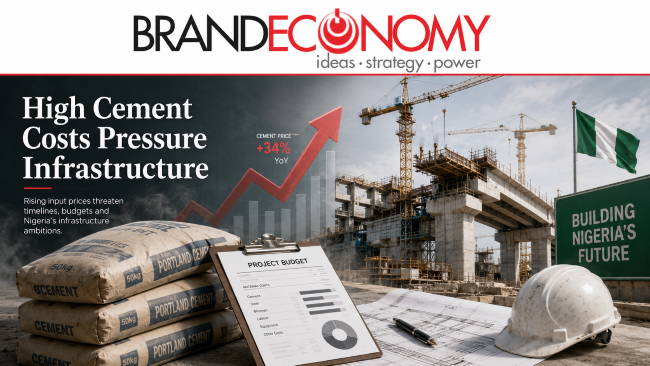
 Nigeria’s ambitious infrastructure drive is colliding with a stubborn domestic constraint: the rising cost of cement. Works Minister Dave Umahi has urged cement producers to cut prices, arguing that expensive building materials are increasing pressure on contractors and threatening to inflate the cost of major public projects. His intervention places a strategic national question before the cement industry: can local manufacturers support Nigeria’s infrastructure ambitions with greater capacity, better cost discipline and more predictable pricing?
Nigeria’s infrastructure programme is expanding at a time when one of its most essential inputs has become increasingly expensive.



The Minister of Works, Senator Dave Umahi, has called on cement manufacturers to reduce prices, warning that the escalating cost of the commodity is putting fresh pressure on contractors handling public infrastructure projects across the country.
Speaking in Lagos at the unveiling of Lafarge Nigeria’s new corporate identity as HBM, now a member of the Huaxin Group, Umahi said high cement prices were becoming a major source of tension within the construction value chain. Contractors, he said, are increasingly seeking upward reviews of existing project contracts as the cost of materials rises.
The minister’s message was direct: government does not want to see infrastructure budgets continually reworked to absorb higher cement prices. Instead, he argued, manufacturers should examine their cost structures and respond to the realities of a country undertaking one of its most ambitious road, bridge and public-works programmes in decades.
According to Umahi, the Federal Government plans to begin formal engagement with cement manufacturers from July 1, with the aim of addressing the cost pressures affecting project delivery.
The intervention is significant because cement is not merely another consumer product. It is a strategic industrial input. Its price shapes the cost of roads, housing, bridges, rail infrastructure, schools, hospitals, drainage systems, industrial estates and urban development.
When cement prices rise sharply, the effect moves quickly through the economy.
Contractors face thinner margins. Project timelines come under pressure. Developers delay construction. Homebuyers confront higher property prices. Governments must either increase capital expenditure or reduce the scope of planned projects. In a country with a major housing deficit and large infrastructure gaps, the consequences are not abstract.
They are visible in stalled sites, revised budgets and more expensive homes.
The Cement Question Behind Nigeria’s Development Agenda
Umahi’s comments come as the Tinubu administration continues to place infrastructure at the heart of its economic-development narrative.
The government has repeatedly identified road construction, logistics upgrades, energy infrastructure, industrial corridors and housing delivery as key routes to job creation, productivity growth and private-sector expansion. The Lagos-Calabar Coastal Highway, one of the administration’s most visible projects, has become a central symbol of that ambition.
But ambitious infrastructure programmes rely on dependable supply chains.
Cement manufacturers are therefore not peripheral players in Nigeria’s development story. They are part of the country’s economic infrastructure. Their pricing decisions influence the viability of public projects and the affordability of private construction.
Umahi’s appeal to HBM and other cement producers to expand capacity reflects this reality. The government wants manufacturers to respond to rising demand not only by adjusting prices, but by increasing output, improving supply reliability and reducing the bottlenecks that make construction materials expensive.
The central concern is that Nigeria’s infrastructure programme may be growing faster than the supply-side reforms required to support it.
Why Cement Costs Matter Beyond Construction
The high cost of cement has implications far beyond government contracts.
For private developers, it can mean a delayed project, reduced margins or a shift toward smaller units and lower-cost designs. For households, it means the dream of building or buying a home moves further away. For small contractors and artisans, it reduces working capital and weakens business confidence.
For the broader economy, expensive cement reinforces inflationary pressure.
Housing costs rise. Commercial property becomes more expensive. Public infrastructure requires larger budgets. Local manufacturing loses competitiveness when the cost of warehouses, factories and industrial facilities climbs.
This is why cement pricing is often treated as a public-policy issue rather than merely a commercial matter.
Nigeria has a large domestic cement industry and significant limestone resources. Yet the market still faces recurring concerns around high prices, energy costs, logistics challenges, exchange-rate pressures, transport bottlenecks and the cost of imported production inputs.
Manufacturers, understandably, point to these operating realities. They must contend with energy expenses, equipment maintenance, haulage costs, foreign-exchange volatility and uneven infrastructure. But government and consumers will continue to ask a difficult question: if Nigeria has local raw materials, large domestic demand and major producers operating at scale, why does cement remain so costly?
That question is unlikely to disappear.
HBM’s Rebranding and the Investment Signal
The rebranding of Lafarge Nigeria as HBM, under the Huaxin Group, adds another layer to the conversation.
Corporate transitions of this nature are more than cosmetic exercises. They can signal changes in investment appetite, production strategy, capital deployment, technology adoption and market positioning.
Umahi welcomed the company’s renewed identity and its continued commitment to the Nigerian market, promising government support and collaboration. But his remarks also carried an expectation: the company and other manufacturers must contribute more meaningfully to the country’s infrastructure expansion by enlarging capacity and supporting more stable prices.
For HBM, the new identity presents a brand opportunity.
It can position itself not simply as a cement supplier, but as a partner in Nigeria’s industrial development, housing expansion and infrastructure modernisation. That will require more than a new logo or corporate name. It will demand a clear market promise around reliability, innovation, scale and long-term local value creation.
The strongest industrial brands are built when commercial ambition aligns with national need.
The Lagos-Calabar Highway as a Test Case
Umahi cited the Lagos-Calabar Coastal Highway as evidence of the Federal Government’s infrastructure ambition and its desire to deliver projects of international quality.
The highway is one of the most politically significant construction programmes under the current administration. Supporters see it as a transformative logistics and tourism corridor capable of improving regional connectivity, unlocking coastal economic activity and creating new development zones. Critics have raised concerns about cost, procurement transparency, environmental impact and fiscal sustainability.
Whatever the debate, the project illustrates a wider truth: Nigeria’s infrastructure ambitions are increasingly large, technically demanding and capital-intensive.
That makes construction-input pricing an issue of national competitiveness.
A country cannot deliver major transport corridors at speed if contractors are repeatedly compelled to seek variation because core materials have become too expensive. Nor can it sustain an affordable-housing drive if cement prices make mass construction financially unworkable.
The Works Minister’s intervention is therefore not merely about a dispute with producers. It is about protecting the economics of public investment.
What Government and Industry Must Do Next
The coming engagement between government and cement manufacturers should move beyond public appeals and produce a practical industrial compact.
First, manufacturers should be encouraged to disclose the biggest drivers of cement costs, including energy, freight, foreign-exchange exposure, equipment, distribution and taxes. This would help separate genuine production pressures from market inefficiencies.
Second, government should address the structural costs that manufacturers cannot control alone. Better roads, rail evacuation, port efficiency, lower logistics friction and improved energy supply would all reduce the cost of producing and distributing cement.
Third, the industry must consider more transparent and competitive distribution models. Cement prices often vary significantly across states and regions because transport costs and supply chains are uneven. A national infrastructure programme requires more predictable access to building materials beyond major urban markets.
Fourth, capacity expansion should be tied to regional demand. As public projects grow across the country, local production and distribution networks must follow.
Finally, government must protect competition. A concentrated market may deliver scale, but it can also create pricing concerns when buyers have limited alternatives. Competition, transparency and efficiency are essential if Nigeria is to balance industrial profitability with public-development needs.
Market Implications
- Higher cement prices could increase the cost of public infrastructure and trigger more contractor requests for contract variations.
- Housing developers may delay projects or pass higher construction costs to buyers and tenants.
- Cement manufacturers with stronger capacity, distribution networks and cost efficiency may gain market share as infrastructure demand rises.
- Public infrastructure budgets may face pressure unless material costs are stabilised or projects are restructured.
Brand Implications
HBM’s entry under the Huaxin Group creates an opportunity to reposition the company as an industrial-development partner, not merely a materials supplier.
Its brand promise should rest on four pillars: dependable quality, nationwide availability, innovation in construction solutions and visible support for Nigeria’s housing and infrastructure priorities.
For the sector as a whole, reputation will increasingly depend on whether manufacturers are seen as helping to build Nigeria or making it harder to build.
Investor Relevance
Investors should monitor:
- Cement demand generated by federal and state infrastructure projects;
- Producers’ capacity-expansion plans and distribution investments;
- Energy and logistics costs affecting margins;
- Potential changes in government engagement, competition policy or industry regulation;
- The impact of material-price inflation on construction, housing and real-estate companies.
BRANDECONOMY Insight
Dave Umahi’s call for lower cement prices goes to the heart of Nigeria’s development equation.
Infrastructure is expensive everywhere. But in Nigeria, the burden becomes heavier when the cost of core construction inputs rises faster than public budgets, household income and project financing can absorb.
The government’s infrastructure ambition is real. Roads, bridges, housing, industrial corridors and logistics systems are needed if Nigeria is to reduce transport costs, attract investment and create jobs at scale.
But the country cannot build a modern economy with construction materials priced beyond the reach of developers, contractors and ordinary citizens.
The cement industry has a legitimate case on energy costs, logistics challenges, equipment expenses and foreign-exchange pressures. Yet its long-term licence to grow will depend on whether it is seen as part of Nigeria’s development solution rather than a source of rising construction costs.
For HBM and its peers, this is a defining brand moment.
The winning cement company will not simply sell more bags. It will demonstrate that it understands the national urgency around affordable housing, resilient infrastructure and industrial growth. It will invest in capacity, supply reliability, product innovation and cost efficiency.
For government, the solution cannot be price directives alone. It must include infrastructure support, transport reform, lower production friction and stronger competition policy.
Nigeria’s development plan requires a cement sector that is profitable, globally competitive and domestically enabling.
That balance is now the real policy challenge.