


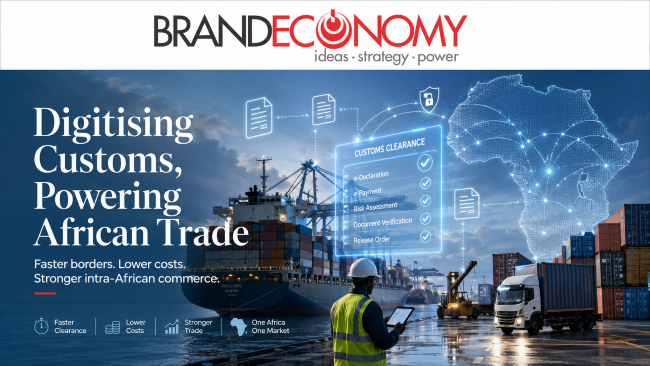
 Experts say customs modernisation is no longer a back-office reform. It is the operating system Africa needs to make AfCFTA commercially real—cutting border delays, lowering logistics costs, improving transparency and helping Nigerian businesses reach wider continental markets.
Africa’s free trade ambition will not be delivered by policy declarations alone.



It will be delivered at the border.
That is the strong message from economic and trade experts who say customs modernisation is critical to the success of the African Continental Free Trade Area, AfCFTA, and the expansion of intra-African commerce.
Speaking in separate interviews with the News Agency of Nigeria in Abuja, the experts said the continent must accelerate the digitisation and harmonisation of customs processes across African countries if AfCFTA is to move from promise to practical trade advantage.
Their argument is simple: goods cannot move freely across Africa if paperwork, manual inspections, duplicated documentation, border delays and weak digital integration continue to define the trade experience.
AfCFTA is designed to create a large African market for goods and services, but implementation has remained uneven, with Reuters reporting that although the agreement has been widely ratified, only a smaller number of countries are actively trading under it. Reuters also cited World Bank projections that AfCFTA could significantly raise intra-African exports if implementation barriers are addressed.
The Border Problem
For Mr Agabaidu Jideani, Director-General of the Abuja Chamber of Commerce and Industry, ACCI, customs modernisation is central to faster, cheaper and more transparent trade.
He said the AfCFTA framework is pushing towards digital and harmonised border systems that allow goods to move across African borders with less bureaucracy and lower cost.
Rather than each country relying on its own complex paperwork and manual verification culture, Jideani said the goal should be a seamless and interconnected customs environment.
According to him, digital customs systems, harmonised documentation and risk-based inspections can reduce delays, cut compliance costs and improve transparency across member states.
This is the real trade-facilitation challenge.
A tariff reduction means little if a truck is trapped at the border for days. A trade agreement is weakened when exporters must repeat documents, face unclear procedures or pay avoidable transaction costs across multiple jurisdictions.
SMEs Stand to Gain
Jideani said customs modernisation would particularly benefit Small and Medium Enterprises, SMEs, by simplifying procedures, reducing paperwork and lowering compliance costs.
This is important because SMEs often lack the scale, finance and compliance departments available to larger companies. A big exporter may survive slow documentation and multiple inspections. A small manufacturer or food processor may not.
The ACCI Director-General urged governments to support SMEs with capacity building, digital literacy, affordable financing and simpler trade procedures.
He said large importers and exporters would also benefit from faster cargo clearance, more predictable supply chains and lower logistics costs.
“Businesses can better plan inventory, minimise delays at ports and border crossings, and expand their regional value chains,” Jideani said.
He added that effective customs reforms would strengthen Africa’s competitiveness and attract more investment into manufacturing, logistics and industrial development.
His conclusion was direct: customs modernisation is not merely a technology upgrade. It is a strategic economic reform.
Nigeria’s Opportunity
For Dr Chinedu Amadi, President of the Organisation of Youth in International Trade and Commerce, OY-ITC, AfCFTA is Africa’s most ambitious economic integration project since independence.
He said its goal is to create a single, liberalised market for goods and services, promote freer movement of trade, deepen investment and expand continental opportunity.
For Nigeria, he said, the agreement provides a platform to diversify the economy, expand non-oil exports, create jobs and strengthen regional economic leadership.
But Amadi warned that the success of AfCFTA depends heavily on faster, transparent and efficient border processes driven by digital technology.
“The success of AfCFTA depends largely on customs modernisation through faster, transparent and efficient border processes driven by digital technology,” he said.
That point should resonate strongly in Nigeria.
As Africa’s largest economy by population and one of its biggest consumer markets, Nigeria has much to gain from continental trade. But its exporters still face familiar constraints: inconsistent customs procedures, multiple inspections, high transaction costs, weak logistics links, port bottlenecks and documentation hurdles.
Nigeria recently moved to launch the first phase of a National Single Window digital trade platform as part of wider port and trade reforms aimed at streamlining import and export processes and reducing bureaucracy. Reuters reported that the platform is expected to improve trade efficiency and help address long-standing port-cost and logistics challenges.
The Digital Customs Toolkit
Amadi said AfCFTA seeks to harmonise customs procedures through tools such as electronic declarations, digital certificates of origin, online payments and risk-based cargo inspections.
These tools matter because they reduce discretion, duplication and opacity.
A digital declaration reduces paper. A digital certificate of origin helps confirm whether a product qualifies for preferential treatment. Online payment reduces cash-based leakage. Risk-based inspection allows customs authorities to focus attention on high-risk cargo rather than subjecting every shipment to slow manual checks.
Amadi said the reforms could reduce corruption, improve revenue collection and promote legitimate trade across Africa.
He commended the Federal Government’s digital customs framework but called for faster implementation of the National Single Window and stronger border infrastructure.
He also stressed that collaboration among border agencies would determine how much Nigeria benefits from AfCFTA.
That is crucial. Customs cannot modernise alone if immigration, port health, standards agencies, quarantine services, security agencies and transport authorities still operate in silos.
Beyond the Ports
For Nigeria’s maritime and logistics economy, customs modernisation is especially important.
Ports are the gateways of trade, but their efficiency depends on the systems around them: documentation, payments, inspection, cargo release, trucking, scanning, warehousing, customs valuation, tariff classification and agency coordination.
If these processes remain manual or fragmented, port reform will remain incomplete.
A modern customs system should help reduce dwell time, improve cargo visibility, protect revenue and support legitimate traders.
For importers, it means predictability. For exporters, it means speed. For government, it means better revenue assurance. For investors, it means a more credible trade environment.
A Continental Network
Mr Williams Osaze, President of the Society for Promotion of People’s Right, said customs modernisation under AfCFTA is creating interconnected digital platforms and single windows to improve trade processes.
He explained that customs systems across African countries previously operated separately, making it difficult to exchange information and process trade documents efficiently.
According to him, digital integration would allow customs declarations submitted in one country to be recognised and processed in another, thereby reducing duplicate paperwork and administrative waste.
That is the architecture Africa needs.
The continent cannot build regional value chains if its customs systems behave like disconnected islands.
A textile producer in Nigeria, a packaging supplier in Ghana, a food processor in Côte d’Ivoire and a retailer in Kenya need trade systems that speak to one another.
The MSME Gateway
Prof. Emmanuel Adeniyi, an economic consultant, said AfCFTA is also simplifying procedures for small-scale traders and MSMEs through the Simplified Trade Regime, STR initiative.
He said the initiative is intended to reduce documentation requirements, simplify clearance procedures and provide specific lists of goods eligible for easier cross-border movement.
For informal and semi-formal traders, this could be transformative.
A simplified regime can reduce harassment, improve compliance, encourage formalisation and help small traders move goods legally and more confidently across borders.
Adeniyi also linked customs modernisation to financial integration through the Pan-African Payment and Settlement System, PAPSS, which enables traders to transact in local currencies.
PAPSS is designed to reduce dependence on third currencies in African cross-border trade. Reuters reported that PAPSS has been expanding as part of efforts to reduce trade costs, improve local-currency settlement and deepen intra-African payments infrastructure.
Payments Matter Too
Customs reform and payment reform must move together.
Even if goods clear borders faster, trade remains constrained if payments are slow, expensive or exposed to dollar shortages.
PAPSS is therefore strategically important because it helps address one of Africa’s biggest trade frictions: the cost and complexity of settling transactions across different currencies.
Reuters reported that African leaders and institutions have increasingly supported local-currency payment systems to reduce reliance on dollar-based routes and support intra-African trade.
For Nigerian exporters, this could eventually mean easier payment settlement with African buyers. For SMEs, it could reduce foreign-exchange barriers. For banks and fintechs, it opens new infrastructure opportunities around trade finance, compliance, documentation and settlement.
Quality Still Counts
Amadi also urged Nigerian business owners to improve product quality, packaging, branding, certification and productivity to compete effectively with firms from other African countries.
This is an important warning.
Customs modernisation can open doors, but it cannot make weak products competitive.
AfCFTA will expose Nigerian companies to larger markets, but also stronger competition. Firms from Egypt, South Africa, Kenya, Ghana, Morocco, Côte d’Ivoire and other markets will also be looking for continental growth.
For Nigeria to win, exporters must combine trade access with quality, standards compliance, packaging, logistics readiness and brand differentiation.
Market Implications
Digitised customs could reshape Africa’s trade economy in several ways.
First, it can reduce border delays and improve supply-chain predictability.
Second, it can lower the cost of moving goods across the continent.
Third, it can widen SME access to export markets by simplifying documentation and compliance.
Fourth, it can improve government revenue collection by reducing leakages and strengthening data visibility.
Fifth, it can support regional value chains in agriculture, food processing, pharmaceuticals, textiles, automotive components, construction materials, technology and consumer goods.
For Nigeria, the market implications are even more strategic. Better customs processes could boost non-oil exports, reduce pressure on petroleum revenue, stimulate production and improve foreign-exchange earnings.
Brand Implications
For national brands, customs performance is part of investment reputation.
A country known for slow ports, unpredictable border procedures and opaque clearance systems becomes difficult to sell as a trade hub.
A country known for transparent, efficient and digitally enabled customs becomes more attractive to manufacturers, exporters, logistics companies and investors.
For Nigerian businesses, AfCFTA also raises the bar for branding. Products must be export-ready in quality and presentation. Packaging, certification, traceability and customer trust will determine whether Nigerian goods become preferred continental choices.
For the Nigeria Customs Service and related agencies, modernisation is also a public-trust opportunity. Transparent digital systems can improve the perception of border agencies as facilitators of trade rather than obstacles to commerce.
Investor Relevance
Investors should watch customs modernisation closely because it affects multiple sectors at once.
A faster border environment improves the business case for:
- logistics and warehousing
- ports and inland dry ports
- industrial parks
- export processing zones
- manufacturing
- agribusiness
- cold-chain infrastructure
- trade finance
- fintech and cross-border payments
- compliance technology
- freight forwarding and customs brokerage
- maritime services
The investment opportunity is not simply in moving more goods. It is in building the systems that make trade easier, cheaper and more predictable.
For private capital, the strongest opportunities will come where digital customs, payment systems, transport infrastructure and export production capacity meet.
What Nigeria Must Do
Nigeria must treat customs modernisation as a national competitiveness project.
That means:
- accelerating National Single Window implementation
- improving border and port infrastructure
- harmonising procedures across agencies
- training SMEs on AfCFTA rules and documentation
- expanding digital literacy for exporters
- strengthening product certification and standards
- improving road, rail and inland logistics links
- deepening trade finance
- supporting export-ready industrial clusters
- enforcing transparency and accountability at borders
AfCFTA provides the platform. Customs modernisation provides the gateway. But Nigerian firms must still deliver products the continent wants.
BRANDECONOMY Insight
Africa’s trade future will not be decided only in boardrooms, summits or policy documents.
It will be decided at ports, border posts, customs desks, payment platforms and logistics corridors.
The promise of AfCFTA is huge: a larger market, stronger value chains, more jobs, deeper industrialisation and less dependence on narrow export baskets.
But the continent cannot trade efficiently with 20th-century paperwork in a 21st-century market.
Customs modernisation is therefore not a technical detail.
It is the bridge between African ambition and African commerce.
For Nigeria, the message is clear: digitise the border, build export capacity, improve product quality and lead the continent not by size alone, but by trade readiness.