

CBN Holds MPR at 27% as Disinflation Gains Strength: Inside Nigeria’s New Stability Strategy

Why Monetary Tightening Remains Central to Nigeria’s Economic Reset
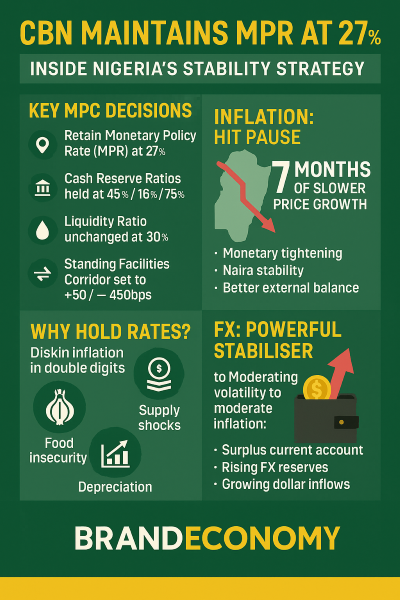
Nigeria’s monetary authorities have signaled a clear message: stay the course. At its 303rd meeting, the Monetary Policy Committee (MPC) of the Central Bank of Nigeria (CBN) voted unanimously to retain the Monetary Policy Rate (MPR) at 27%, reflecting a deliberate decision to protect the country’s fragile—but unmistakably improving—macroeconomic environment.
CBN Governor Olayemi Cardoso, delivering the Committee’s communiqué, framed the decision around one central theme: Nigeria’s disinflation is real, but still too delicate to risk an early policy reversal.




A Consistent Policy Stance for an Unsteady Global Economy
Alongside the benchmark MPR, the MPC also maintained:
- CRR for commercial banks: 45%
- CRR for merchant banks: 16%
- Public sector (Non-TSA) CRR: 75%
- Liquidity Ratio: 30%
- Standing Facilities Corridor: +50 / –450 basis points
The retention of all key parameters signals continuity—a recognition that the effects of earlier tightening are still unfolding, and that the economy needs time to consolidate recent gains.
Nigeria’s Disinflation Story: Slow, Steady, and Hard-Won
Cardoso noted that inflation slowed for the seventh consecutive month in October—an encouraging trend supported by:
- sustained monetary tightening,
- a more stable exchange rate,
- improved FX inflows,
- stronger current account performance,
- better PMS price stability, and
- modest improvement in food supply.
For the first time in over two years, Nigeria appears to be steadily inching away from runaway inflation. Yet inflation remains elevated in double digits, meaning the CBN’s job is far from over.
Why the CBN Won’t Ease Pressure Yet
Despite progress, risks remain—both domestic and global:
- lingering supply chain disruptions,
- geopolitical tensions,
- uneven oil production recovery,
- persistent food insecurity,
- and financial tightening in advanced economies.
Against this backdrop, the MPC argues that loosening policy prematurely could unwind months of progress. Instead, the Committee prefers to let previous rate hikes filter more deeply into the economy, enhancing the credibility of monetary policy and anchoring expectations.
Nigeria’s External Sector: A Quiet but Powerful Stabiliser
One of the most important—but least discussed—developments is the renewed strength of Nigeria’s external sector.
The CBN highlighted:
- a surplus on the current account,
- steady growth in FX reserves,
- improving dollar liquidity, and
- growing investor confidence.
These developments, coupled with better coordination between fiscal and monetary authorities, have helped moderate exchange-rate volatility—one of the biggest inflation triggers of the past three years.
BRANDECONOMY ANALYSIS: What This Means for Nigeria’s Economic Outlook
Nigeria’s economic reset is beginning to take shape. The CBN now appears focused on building a new monetary credibility framework—one where policy signals are consistent, predictable, and data-driven.
If current trends hold:
- inflation could ease below current levels by mid-2026,
- FX markets may stabilise further, and
- the CBN could begin a cautious rate-cut cycle.
But for now, the strategy is clear: hold the line and lock in the gains.
The real test will be whether monetary policy can work hand-in-hand with structural reforms—agricultural expansion, energy reliability, logistics improvements, and fiscal discipline—to push Nigeria toward durable, inclusive growth.