

Bauchi Tomato Glut Pushes Prices Down as Bumper Harvest Exposes Nigeria’s Post-Harvest Challenge

 A sharp fall in tomato and pepper prices across Bauchi is giving households welcome relief, but the seasonal glut also highlights a familiar weakness in Nigeria’s food economy: abundant harvests are still too often followed by weak storage, limited processing and sudden price collapses that can squeeze farmers even as consumers celebrate.
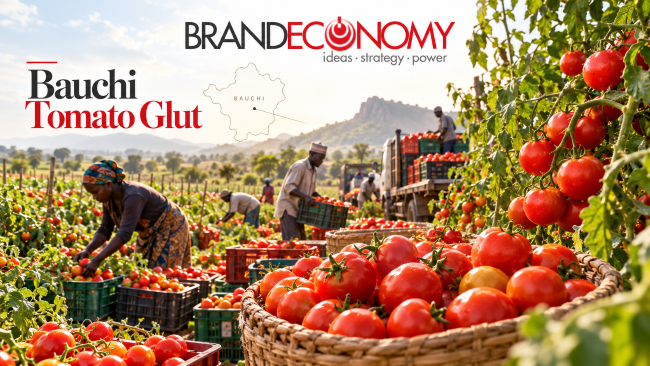 A sharp fall in tomato and pepper prices across Bauchi is giving households welcome relief, but the seasonal glut also highlights a familiar weakness in Nigeria’s food economy: abundant harvests are still too often followed by
 Tomato prices have fallen sharply across major markets in Bauchi following a surge in supply from farms, offering consumers some respite from recent food-price pressures while once again exposing the structural weaknesses in Nigeria’s fresh-produce value chain.
Checks at Muda Lawal and Yelwan Tudu markets showed that prices of tomatoes and other perishables had dropped by about 30 per cent amid a bumper wet-season harvest.




A basket of tomatoes that previously sold for about ₦18,000 was trading at roughly ₦14,000, while the fall in pepper prices was even more dramatic. A bag of pepper, which had sold for as much as ₦120,000 three months earlier, was now available for between ₦30,000 and ₦45,000.
For households already grappling with the high cost of food, transport and other essentials, the decline is immediately significant. Mishel Reuben, a shopper at one of the markets, said she was now spending about ₦1,500 on tomatoes and vegetables compared with roughly ₦3,000 previously.
Her experience captures the consumer side of the story: when fresh-food supply expands rapidly, price relief can arrive quickly.
But the market is not moving uniformly. Some vegetables have become more expensive. A bag of okra rose from about ₦6,000 to ₦7,500, while a bunch of spinach climbed from ₦1,500 to around ₦3,500, underscoring how different crops respond to distinct production cycles, supply conditions and seasonal pressures.
For tomato traders, however, the current trend is being driven overwhelmingly by increased arrivals from farms.
Musa Yakubu, a tomato dealer, attributed the decline to the scale of the bumper harvest and said prices could fall further as fresh supplies continue to reach the markets. In his assessment, the trend may persist until the harvesting season begins to taper off.
Another trader, Bala Audu, described business conditions as favourable, noting stronger patronage as customers take advantage of lower prices to buy tomatoes in larger quantities for household preservation.
That consumer response points to an important behavioural feature of Nigeria’s food market: when prices fall sharply, families often try to lock in savings by buying more than they immediately need.
Yet the deeper economic story lies beyond the bargains at the market stall.
The Paradox of Plenty
Nigeria’s tomato economy repeatedly swings between scarcity and glut.
When supply is tight, consumers face sharp price increases. When harvests are abundant, markets can become overwhelmed, sending prices lower and sometimes reducing returns to farmers.
This volatility reflects more than simple seasonality. It is also the result of insufficient cold storage, limited processing capacity, weak aggregation systems, poor logistics and inadequate market coordination.
In a better-developed value chain, an increase in fresh tomato supply would not automatically translate into a price collapse. Surplus production could be diverted into paste, puree, sauces, dried tomato products or structured industrial off-take.
Instead, much of Nigeria’s tomato crop remains dependent on immediate fresh-market demand.
That creates a dangerous imbalance.
The same bumper harvest that delights consumers can become financially painful for farmers if prices fall below sustainable production and transport costs.
For development planners, therefore, the question is not simply how to make tomatoes cheaper. It is how to stabilise the system so that consumers enjoy affordable food without forcing producers into recurring cycles of boom and distress.
Market and Investor Implications
The current Bauchi Tomato glut illustrates an opportunity for investors across cold-chain logistics, warehousing, processing, aggregation and food manufacturing.
Tomatoes are highly perishable, which means that the difference between a profitable harvest and a loss can be measured in days.
Commercial processing facilities located closer to major production belts could absorb seasonal surpluses and transform them into higher-value products with longer shelf lives. Investments in crates, refrigerated transport, collection centres and digital commodity platforms could also reduce losses and improve price discovery.
For agro-processors, the current environment presents an obvious sourcing opportunity. Lower farmgate and wholesale prices can improve raw-material economics, but only businesses with reliable procurement, processing and storage systems are positioned to capture that advantage.
Brand Implications
There is also a consumer-brand opportunity in the volatility.
Food brands that can offer affordable, locally processed tomato products when fresh produce becomes scarce can build relevance around reliability and value. The strongest brands will be those that connect consumer convenience with domestic sourcing, farmer partnerships and reduced post-harvest waste.
In an era of growing consumer concern about food inflation, brands that can demonstrate that they are helping stabilise supply rather than merely passing price increases to households may earn greater trust.
BRANDECONOMY Insight
The falling price of tomatoes in Bauchi is good news for households, but it should not be mistaken for evidence that Nigeria’s food system has become more efficient.
A genuinely efficient food economy does not swing endlessly between painful scarcity and wasteful abundance.
The larger challenge of the Bauchi Tomato bumper harvest and similar harvests is to turn seasonal harvests into year-round value.
Nigeria must develop a system in which bumper production triggers more processing, storage and industrial demand rather than panic selling and price collapse.
If farmers cannot earn sustainably when harvests are strong, they may reduce production later, setting the stage for another cycle of shortages and high prices.
That is why Nigeria’s food-security challenge is not only about producing more.
It is about preserving more, processing more and coordinating markets better.
The real success will come when consumers can enjoy affordable tomatoes without farmers having to suffer from the very abundance they worked hard to create.