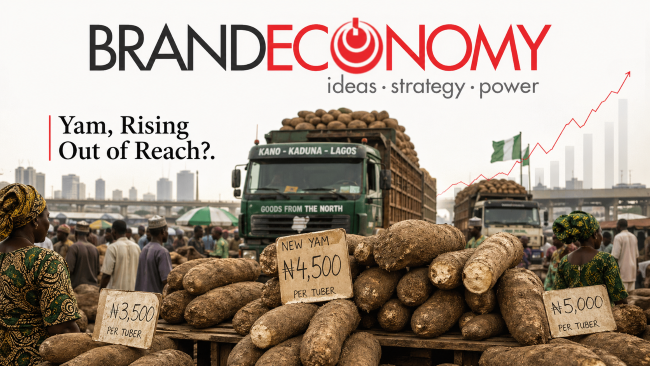
 Yam prices are rising across Lagos markets as transport costs, seasonal supply shortages and sourcing pressures squeeze traders and households. From Oyingbo to Mile 12 and neighbourhood retail stalls, the story is no longer just about the price of a tuber. It is about the fragile economics of food movement, urban purchasing power and the daily calculations of Nigerian families trying to stretch shrinking incomes.
A Staple Under Pressure
In Lagos, the price of yam has become another window into Nigeria’s stubborn food inflation problem.




Across major markets and neighbourhood stalls, yam prices continue to fluctuate, with traders blaming higher transportation costs, seasonal supply patterns and sourcing difficulties. Consumers, meanwhile, are making increasingly careful choices about where to buy, how far to travel and whether the savings from wholesale markets justify the cost of movement.
Yam is not an exotic food item. It is one of Nigeria’s most familiar staples—boiled, fried, roasted, pounded or served in restaurants, canteens and homes across income classes. That is why price movements in yam carry wider meaning. When staples become volatile, household budgeting becomes more difficult, food vendors reprice menus, and lower-income families adjust both quantity and quality.
In Lagos, yam is sold in neighbourhood markets and major wholesale hubs such as Oyingbo Market and Mile 12 Market, where traders attract bulk buyers looking for better prices. But in a city where transport fares can cancel out market savings, the cheapest yam is not always the yam with the lowest sticker price.
From ₦1,200 to ₦3,500: The New Price Reality
Traders and consumers say yam prices have risen significantly compared with the same period last year.
Tubers that sold for between ₦1,200 and ₦2,000 around the same period in 2025 now cost between ₦2,500 and ₦3,500, depending on size, origin and market location. Larger, better-quality tubers command higher prices, while smaller varieties remain the fallback option for lower-income buyers.
At Oyingbo Market, yam trader Mr Ibrahim Hassan said fresh harvests remain limited because the new planting season has only just begun. According to him, market supply is still in a sensitive phase, and prices could rise further before the next major harvest cycle improves availability.
Another trader at Oyingbo, Mrs Jumoke Fakunle, said tuber size remains a major determinant of price. Smaller yams are more affordable, but households seeking larger, better-quality tubers must pay more.
At Mile 12 Market, trader Mrs Abiodun Ariyo also noted that current prices are noticeably higher than the same period in 2025, when tubers now selling for ₦2,500 to ₦3,000 were available for between ₦1,200 and ₦2,000.
The arithmetic is simple but painful. For many Lagos households, yam has moved from an everyday staple to a measured purchase.
Why Wholesale Markets Still Matter
The price gap between major markets and neighbourhood stalls remains important.
At Oyingbo, trader Mrs Kehinde Adebayo explained that bulk purchases and direct supply links help keep prices relatively lower. Wholesale traders receive trailer loads from the North, allowing them to offer better prices than smaller roadside or neighbourhood markets.
The logic is straightforward. Retailers in smaller markets often buy from larger wholesale hubs, then add transport, loading, storage, levies, spoilage risk and profit margins before reselling. By the time a yam reaches a neighbourhood stall in Surulere, Mushin, Yaba, Ajah or Alimosho, the original wholesale price has absorbed the cost of Lagos itself.
This is the hidden inflation Nigerian consumers face: not only farm-gate prices, but every layer of movement from farm to market, market to stall, and stall to kitchen.
The Transport Equation
For consumers, the real question is no longer simply: where is yam cheaper?
It is: where is yam cheaper after transport?
Mrs Amaka Njoku, a consumer, said she prefers buying yam from nearby markets because the quantities suit her household needs and the convenience matters. In her view, when transport fares are added, travelling to major markets may not always be worth it.
Her argument reflects the reality of millions of urban households. A consumer who buys one or two tubers may not save enough by travelling to a wholesale market. But a family buying in bulk—or a food vendor purchasing for commercial use—may still benefit from going to Oyingbo or Mile 12.
By contrast, Mrs Titilope Adekeye said she prefers larger markets where prices are often lower. She recently bought yam for between ₦1,500 and ₦2,500 per tuber and argued that paying more elsewhere makes little sense when cheaper options are available.
For Mrs Funmilayo Ajayi, a Surulere resident, Oyingbo has become a better option because neighbourhood prices have climbed sharply. She said yam can cost up to ₦4,000 in her area, while Oyingbo offers better sizes for less—even after accounting for transport.
This is the new Lagos food economy: consumers are not merely buying food; they are calculating logistics.
Seasonality and the Yam Supply Cycle
Yam prices follow the rhythm of planting, harvesting, storage and supply.
When fresh harvests are limited, traders rely more heavily on stored stock or supplies from regions where availability is stronger. This creates price pressure, especially when combined with high diesel costs, bad roads, insecurity in producing belts, multiple levies and the cost of moving goods from northern and middle-belt farms into southern urban markets.
The new planting season means supply is not yet at full strength. As the harvest cycle improves later in the year, supply may ease. But traders warn that harvest alone may not automatically restore affordability if transport, fuel, security and market charges remain high.
Food prices are therefore not only an agricultural story. They are an infrastructure story, an energy story, a security story and a distribution story.
The Development Economist’s Lens: Food Inflation Is a Logistics Tax
Nigeria’s food inflation crisis is often discussed as though it begins and ends on the farm. That is incomplete.
For Lagos consumers, much of the pain is added after the crop leaves the farm. Transport fares, fuel prices, poor road networks, informal payments, storage losses, market levies and retailer mark-ups all become embedded in the final price.
This is why two consumers in the same city can experience food inflation differently. One who lives close to a wholesale market may pay less. Another buying from a neighbourhood stall may pay significantly more. A food vendor may travel for volume. A salary earner may choose convenience because time and transport are also costs.
The result is a fragmented urban food market where affordability depends not only on income, but on location, mobility and buying power.
Households, Vendors and the Quiet Adjustment
Rising yam prices affect more than household meals.
Restaurants, bukas, food vendors and caterers must either raise menu prices, reduce portion sizes, switch to cheaper alternatives or absorb lower margins. For households, the adjustment may be more subtle: smaller tubers, fewer yam-based meals, more reliance on rice, garri, beans or other substitutes, or collective buying among neighbours.
These adaptations rarely appear in official statistics, but they define how Nigerians survive inflation.
The concern is that when staples become unpredictable, nutrition also suffers. Households under pressure do not only spend more carefully; they sometimes eat less diversely.
BRANDECONOMY Insight
Yam prices in Lagos are telling a bigger story about Nigeria’s food system.
The issue is not merely that a tuber now sells for ₦2,500 to ₦3,500 in many markets. The deeper issue is that Nigeria’s food economy remains too vulnerable to transport shocks, seasonal gaps and inefficient distribution.
For policymakers, the lesson is clear: food security cannot be achieved by farming alone. It requires roads, storage, logistics hubs, cold chains where relevant, market transparency, security in producing regions, lower transport friction and better data on food movement.
For Lagos households, the market has become a place of calculation. Consumers compare Oyingbo with neighbourhood stalls, weigh bus fares against yam prices, and decide whether time, stress and movement are worth the savings. That is not an efficient food economy. It is survival economics.
For investors and agribusiness operators, the opportunity lies in structured food logistics: aggregation, warehousing, standardised wholesale markets, digital produce pricing, transport pooling and direct farm-to-market channels. The market is already showing the demand. The missing link is infrastructure.
Nigeria often treats food inflation as a temporary discomfort. It is not. It is one of the most important development challenges of the decade because it affects wages, productivity, health, poverty, social stability and political trust.
A country cannot build broad prosperity if its citizens are permanently negotiating the price of staple food. Yam prices are only one signal. But in Lagos, that signal is loud enough.
Consumer Takeaway
For now, Lagos consumers will continue to balance price, transport and convenience. Major markets such as Oyingbo and Mile 12 may offer cheaper options, especially for bulk buyers, but neighbourhood markets remain attractive for households purchasing smaller quantities.
Prices may ease when supply improves, but sustained affordability will depend on more than harvest cycles. Transport costs, logistics efficiency and market structure will remain decisive.