Tinubu Takes Nigeria’s Investment Pitch to Africa CEO Forum in Kigali

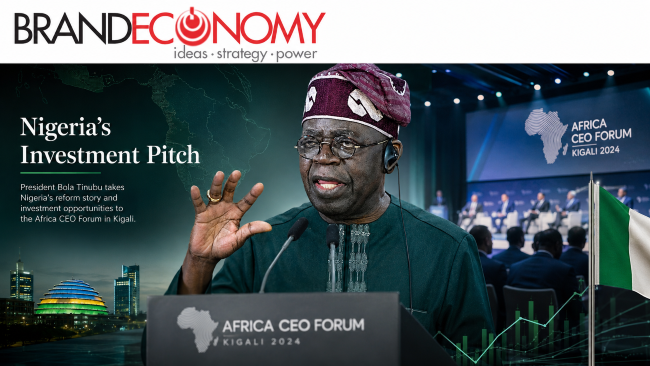 President Bola Tinubu is taking Nigeria’s reform story to the Africa CEO Forum in Kigali, Rwanda, where the Presidency says he will present the country as Africa’s most compelling investment destination. The message is direct: Nigeria’s challenges are visible, but its scale, consumer depth, reform momentum, entrepreneurial energy and continental relevance still make it one of the world’s most attractive markets for patient capital and bold enterprise.
Nigeria is returning to the continental investment stage with a familiar but urgent message: the country remains too large, too strategic and too commercially rewarding to be ignored.

Ahead of President Bola Tinubu’s participation at the Africa CEO Forum 2026 in Kigali, Rwanda, the Presidency has framed the engagement as one of the administration’s most important investor-facing outings since assuming office. According to Mr Sunday Dare, Special Adviser on Media and Public Communications to the President, Tinubu will use the forum to make Nigeria’s business case directly to Africa’s most influential corporate leaders, financiers, sovereign wealth actors and policy decision-makers.
The argument is straightforward. Nigeria may be difficult, but it is also deeply profitable for investors who understand scale, patience and market adaptation.
Dare’s position is that while many conventional global investment models project returns within the range of 20 to 25 per cent, Nigeria has often delivered far beyond such expectations in sectors where investors entered early, scaled properly and stayed the course. The Presidency points to telecommunications and pay television as examples of how Nigeria’s market size can transform bold bets into exceptional corporate outcomes.
The case of MTN Nigeria remains one of the strongest illustrations. When the telecoms giant entered Nigeria in 2001, few could have fully anticipated the speed and depth of mobile adoption that would follow. Today, MTN Nigeria is one of the most valuable companies on the Nigerian Exchange, with a subscriber base and revenue profile that underline the country’s extraordinary consumer-market power.
MultiChoice, promoters of DStv, offers another example. Nigeria became one of its most important commercial markets, powered by urban growth, entertainment appetite, rising middle-class consumption and the country’s unmatched cultural energy.
These examples are not being cited merely for corporate nostalgia. They are part of a broader investment argument: Nigeria rewards investors who can absorb early friction, build local relevance and position for long-term demand.
Kigali as Investment Theatre
The Africa CEO Forum is not just another conference. It is one of the continent’s most important marketplaces for capital, ideas, partnerships and policy signalling. The 2026 edition in Kigali is expected to draw more than 2,000 chief executives, investors, financiers, policymakers, sovereign wealth managers and multinational decision-makers.
For Nigeria, that audience matters.
The country is competing for capital in a continent where several economies are presenting increasingly polished investment stories. Rwanda sells governance efficiency. Kenya sells technology and regional services. Morocco sells industrial platforms and access to Europe. Egypt sells scale and infrastructure. South Africa sells institutional depth. Ghana sells relative stability and gateway positioning.
Nigeria’s proposition is different. It sells scale.
It sells a population of more than 200 million people, one of Africa’s deepest consumer markets, expanding urban centres, a large youth base, a strong entrepreneurial culture, abundant natural resources, growing technology clusters, industrial potential and strategic access to the African Continental Free Trade Area.
But Nigeria must also sell reform credibility. That is where Tinubu’s Kigali pitch becomes critical.
Reforms as Investment Language
The Presidency says Nigeria will present its ongoing reforms as part of a deliberate effort to restore macroeconomic credibility and attract sustainable investment.
The reform list is now familiar: fuel subsidy removal, exchange-rate liberalisation, tax modernisation, infrastructure concessions, power-sector restructuring, gas commercialisation and digital-economy expansion.
These reforms have not been painless. They have triggered inflationary pressure, currency adjustment, higher operating costs and intense public hardship. Businesses have had to reprice. Households have had to adjust. Investors have watched carefully to see whether the administration can sustain direction beyond the first wave of policy shock.
That is why communication has become part of the reform agenda.
The Presidency appears to understand that reforms do not sell themselves. Investors need more than policy announcements. They need clarity, consistency, leadership conviction and evidence that Nigeria will not reverse course at the first sign of political discomfort.
Dare’s message reflects this thinking: reforms must be explained to capital. Investors must understand not only what government has done, but why it has done it, where it is going and what opportunities the transition creates.
In emerging markets, structural adjustment often produces turbulence before opportunity. The smart money watches for the moment when painful reforms begin to create a clearer playing field for long-term investment. Nigeria is trying to convince global and African capital that it is approaching that point.
The Profitability Argument
Nigeria’s strongest investment argument has always been the sheer size of its market.
A business that succeeds in Nigeria does not merely win a country. It wins a platform. It gains access to a market that can support continental expansion, regional production, export growth and brand influence across West Africa and beyond.
This is why consumer-facing businesses, telecoms, fintech, entertainment, logistics, food, retail, energy, construction, healthcare, education and digital services continue to attract attention despite Nigeria’s difficult operating environment.
The paradox is well known: Nigeria is one of Africa’s toughest places to operate, but also one of its most rewarding markets when scale is achieved.
That is the proposition Tinubu is expected to take to Kigali. Nigeria is not asking investors to pretend that its challenges do not exist. It is asking them to price those challenges against the size of the upside.
For development economists, this is the central Nigerian equation: risk is high, but so is latent value.
From Domestic Reform to Continental Diplomacy
The Kigali engagement also fits into a broader pattern of economic diplomacy by the Tinubu administration.
The Presidency referenced earlier engagements in Equatorial Guinea and Tanzania, where Tinubu advanced discussions around energy cooperation, infrastructure financing and regional development. Kigali is being presented as the next stage in that outreach: a platform to move Nigeria’s investment story beyond domestic reform into continental capital mobilisation.
This matters because African economies are increasingly competing and cooperating at the same time.
The African Continental Free Trade Area has created a stronger case for regional production, cross-border logistics, harmonised standards and market integration. Nigeria, by population and market size, should naturally be central to that future. But size alone is no longer enough. Capital will flow where policy is credible, infrastructure is improving and returns can be protected.
Tinubu’s pitch must therefore do more than celebrate Nigeria’s potential. It must convince investors that Nigeria is becoming more investable.
BRANDECONOMY Insight
Tinubu’s appearance at the Africa CEO Forum is more than a diplomatic engagement. It is a test of Nigeria’s ability to convert reform pain into investment confidence.
Nigeria has always had the raw ingredients of a major investment destination: population, energy, land, talent, consumption, culture, minerals, ports, technology ambition and entrepreneurial drive. What it has often lacked is policy predictability, infrastructure reliability, institutional trust and disciplined execution.
That is why the Kigali pitch matters.
The Presidency is correct that investors who entered Nigeria early in sectors such as telecoms and pay television achieved exceptional scale. MTN and MultiChoice are powerful examples of the Nigerian upside. But investors will also ask harder questions today: Can they repatriate capital? Can they plan around exchange rates? Will taxes be predictable? Will power-sector reforms work? Will ports and logistics improve? Will policy remain stable after political cycles?
Nigeria’s investment story is strongest when it is honest. The country should not pretend that its difficulties are exaggerated out of existence. It should acknowledge them, show what is being done to solve them, and present bankable opportunities with clarity.
The real opportunity in the Africa CEO Forum Kigali is not applause. It is conversion.
How many investors leave with serious interest? How many projects move to due diligence? How many partnerships materialise? How many capital commitments can be tracked after the forum?
For Nigeria, the future will not be built by slogans about potential. It will be built by turning reform into confidence, confidence into capital, and capital into jobs, exports, infrastructure and industrial growth.
Tinubu’s message in Kigali is that Nigeria is open, reforming and ready for scale. The market will listen. But the market will also verify.