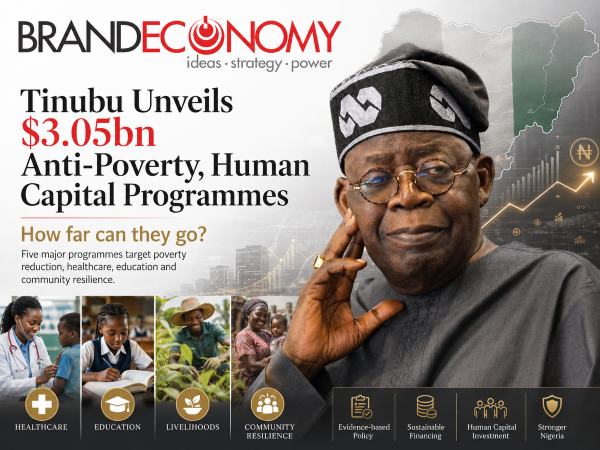
 President Bola Tinubu has unveiled five social and development programmes valued at about $3.05 billion, presenting them as a coordinated national response to poverty, weak public services, displacement and Nigeria’s deep human-capital deficit.
The scale of the Anti-Poverty programme is ambitious. The targets are sweeping. The financing is substantial.



But the harder question is whether the programmes can move beyond federal announcements, donor-backed frameworks and implementation committees to deliver visible improvements in the lives of poor and vulnerable Nigerians.
Tinubu, represented by the Minister of Finance and Coordinating Minister of the Economy, Mr Taiwo Oyedele, inaugurated the initiatives at the Presidential Villa in Abuja.
The programmes comprise the Nigeria Community Action for Resilience and Economic Stimulus Additional Financing, known as NG-CARES AF; the Solutions for Internally Displaced and Host Communities programme, SOLID; and three Human Capital Opportunities for Prosperity and Equity initiatives covering governance, primary healthcare and education—HOPE-GOV, HOPE-PHC and HOPE-EDU.
The President described the initiatives as practical fulfilment of his administration’s commitment to protect vulnerable citizens, strengthen communities and invest in the capabilities that Nigeria requires for future growth.
“This is not just a set of programmes; these are promises kept,” Tinubu said. “Today, we act on our pledge by protecting the vulnerable, empowering communities and building the human capital that will carry Nigeria forward.”
According to him, the five programmes are designed as one national strategy linking poverty reduction with healthcare, education, livelihoods, social protection and support for displaced communities.
That integrated approach is important. Poverty in Nigeria is not simply a shortage of income. It is reinforced by poor health, weak schools, insecurity, unemployment, limited access to credit and inadequate public infrastructure.
The success of the programmes will therefore depend on whether government agencies can coordinate delivery across these interconnected areas.
$1.25bn for livelihoods, farmers and small businesses
NG-CARES will receive about $1.25 billion in additional World Bank financing to support smallholder farmers, small businesses and vulnerable households.
The programme is expected to strengthen livelihoods, improve agricultural productivity and help households and enterprises withstand economic shocks.
For small businesses, the intervention could provide badly needed liquidity, tools, training and access to markets. For farmers, it could support inputs, production infrastructure and community-level economic activity.
The potential impact is substantial because micro, small and informal enterprises remain central to employment and household survival in Nigeria.
Yet financing alone will not guarantee durable businesses.
Previous public-intervention schemes have often suffered from weak beneficiary selection, political influence, inadequate monitoring and limited follow-up support. Many beneficiaries receive one-off assistance without the finance, skills or market connections needed to build sustainable enterprises.
NG-CARES will go farther if it is tied to credible data, transparent selection, measurable productivity gains and access to markets—not merely the number of people enrolled.
SOLID targets displaced people and host communities
A further $300 million will be deployed through the SOLID programme to support internally displaced persons and the communities hosting them.
The programme seeks to move vulnerable populations from emergency relief towards resilience and productive livelihoods.
This is a critical shift.
Displacement in Nigeria has often been treated mainly as a humanitarian problem, with emphasis on temporary shelter, food and relief materials. But prolonged displacement requires a development response involving jobs, schools, healthcare, housing, security and local infrastructure.
Host communities also need support. They frequently absorb large displaced populations without matching increases in public services, creating pressure on classrooms, clinics, water systems, housing and local employment.
SOLID can make a meaningful difference if it addresses both displaced people and the communities carrying the burden of displacement.
Its limits, however, will remain severe unless the insecurity that creates displacement is addressed. Development financing can rebuild livelihoods, but it cannot substitute for peace, security and functioning local institutions.
$1.5bn for health, education and governance
The $1.5 billion HOPE package is aimed at strengthening primary healthcare, foundational education, teacher support and governance reforms.
The Coordinating Minister of Health and Social Welfare, Prof. Ali Pate, said the $570 million HOPE-PHC component would improve primary healthcare services for about 40 million Nigerians, especially women, children and adolescents.
The programme is expected to strengthen health facilities, improve service delivery and reduce maternal and under-five mortality through performance-based financing.
The ambition is significant. Primary healthcare is the level of the system most Nigerians encounter first, yet many facilities lack reliable personnel, medicines, power, water and basic equipment.
Performance-based financing could improve accountability by linking funding to measurable service outcomes. But the approach must avoid rewarding paperwork instead of genuine improvements in patient care.
Health centres must be functional, staffed and accessible. Citizens should not merely be counted as beneficiaries; they should receive better treatment, shorter waiting times, essential medicines and safer maternal care.
Education programme targets 30 million pupils
The Minister of Education, Dr Tunji Alausa, said the $562 million HOPE-EDU programme would benefit nearly 30 million pupils, support about 500,000 teachers and strengthen 65,000 public schools.
The programme is expected to improve foundational learning, teacher effectiveness, school governance and educational outcomes.
Its potential reach is enormous. But reach and impact are not the same.
Nigeria’s education crisis is not simply a shortage of school buildings. It includes weak learning outcomes, teacher absenteeism, overcrowded classrooms, poor supervision and large numbers of children outside the formal school system.
The programme should therefore be judged by whether pupils can read, write and solve basic problems at the appropriate age—not simply by the number of teachers trained or schools listed as beneficiaries.
Teacher support must also extend beyond workshops. It should include effective supervision, modern teaching materials, motivation and clear performance standards.
Can the programmes meaningfully reduce poverty?
The answer is yes—but only to a point.
A $3.05 billion package can improve services, support livelihoods and strengthen community resilience. It can create jobs, expand healthcare access and improve education delivery.
But it cannot, by itself, eliminate the structural drivers of poverty in an economy of Nigeria’s size.
Poverty reduction will still depend on inflation, food prices, employment, power supply, security, agricultural productivity and the capacity of businesses to grow.
If economic reforms continue to weaken purchasing power faster than social programmes provide relief, the interventions may cushion hardship without fundamentally reversing it.
Tinubu said rising foreign reserves, declining inflation and improved economic performance had created the foundation for the next phase of development. He also said expanded cash transfers had reached 15 million vulnerable households.
The government must now demonstrate how macroeconomic gains translate into real household recovery.
The implementation challenge
Tinubu urged federal, state and local governments, development partners and implementing agencies to ensure effective execution, stressing that accountability would determine success.
That may be the most important point made at the launch.
Nigeria does not lack development programmes. It often lacks disciplined implementation.
The five initiatives will cut across ministries, states, local governments and donor institutions. That creates opportunities for collaboration—but also risks duplication, bureaucratic delay and weak accountability.
Clear responsibilities, open procurement, beneficiary verification and public reporting will be essential.
Citizens should be able to see where funds are going, which communities are benefiting and what outcomes are being achieved.
Market and investor implications
The programmes could stimulate activity in agriculture, construction, healthcare, education, logistics, technology and financial services.
Private companies may find opportunities in medical supplies, school infrastructure, educational technology, digital payments, data management and agricultural services.
Development finance could also strengthen local demand and support small-business growth.
However, investors will monitor how contracts are awarded, how payments are made and whether implementation remains consistent across states.
The stronger the governance around the programmes, the more likely they are to attract credible private-sector partners.
Brand implications
For the Tinubu administration, the programmes represent an attempt to give the economic reform agenda a stronger human face.
That is strategically important.
Many Nigerians have experienced reform primarily through higher prices, reduced subsidies and pressure on household incomes. Social investment offers the government an opportunity to demonstrate that reform is also capable of producing protection, opportunity and better services.
But the brand risk is equally high.
Large funding announcements raise expectations. If citizens see little improvement, the initiatives could reinforce distrust rather than strengthen confidence.
The government’s credibility will depend on visible outcomes—not programme names, launch ceremonies or funding totals.
BRANDECONOMY Insight
The $3.05 billion package can go far, but not everywhere.
It can strengthen clinics, improve schools, support farmers and help displaced families rebuild. It can create a bridge between macroeconomic reform and household welfare.
But it cannot carry the full weight of Nigeria’s poverty challenge.
Its success will depend on targeting, transparency, security and the quality of state and local implementation.
The programmes will have their greatest impact if they are treated as investments in productive citizens rather than temporary welfare schemes.
Nigeria does not merely need more beneficiaries. It needs healthier children, better-trained teachers, more productive farmers, sustainable small businesses and communities capable of recovering from shocks.
That is how far these programmes should be expected to go.
The greater danger is not that the funding is too small. It is that the ambition may be weakened by execution.