
How Ademola Adeleke Danced Past the Long Knives, Intimidation and ‘Federal Might’ to Win Osun Again

 Ridiculed as a “dancing governor,” pushed out of the PDP, resisted by powerful political interests and confronted by a formidable APC national machine, Ademola Adeleke did more than retain the Osun governorship. He enlarged his mandate. But behind the music was a disciplined fusion of incumbency, welfare politics, infrastructure, family capital, grassroots organisation, celebrity influence and voter resistance—and a warning that power imposed from above can still be defeated by legitimacy built below.
Osun 2026: The Result at a Glance
| Indicator | Official collation figure | Strategic meaning |
| Registered voters | 2,339,544 | Osun entered the poll with a substantially expanded register |
| Accredited voters | 1,010,684 | Accreditation reached about 43.2% of registered voters |
| Total votes cast | 1,005,800 | Election turnout was approximately 43.0% |
| Valid votes | 985,079 | 97.9% of ballots cast were valid |
| Rejected votes | 20,721 | About 2.1% of ballots cast |
| Ademola Adeleke, Accord | 511,067 | 51.88% of valid votes; won 19 LGAs |
| Bola Oyebamiji, APC | 444,815 | 45.15% of valid votes; won 11 LGAs |
| Najeem Salaam, ADC | 17,180 | 1.74% of valid votes; won no LGA |
| Winning margin | 66,252 | More than double Adeleke’s 2022 margin |


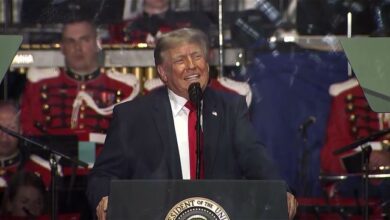
Ademola Adeleke danced again in the early hours of August 16, 2026. This time, the dance was not a campaign meme, a social-media diversion or an eccentric flourish for which his opponents could mock him. It was the physical punctuation to a victory that had looked improbable months earlier.
The Independent National Electoral Commission declared the Accord candidate winner with 511,067 votes. Bola Oyebamiji of the All Progressives Congress polled 444,815. Najeem Salaam of the African Democratic Congress finished a distant third with 17,180.
Adeleke won 19 of Osun’s 30 local government areas. He carried Osogbo, the state capital, by 36,480 votes to 30,474. His Ede fortress delivered overwhelming margins, but the victory was not confined to home soil. He also won in Ife Central, Ife East, Ife North, Ilesa West, Iwo, Oriade, Ifelodun and other politically consequential councils.
This matters because Adeleke was not re-elected on the platform that first carried him to Bola Ige House. He left a crisis-ridden PDP and entered the election on Accord’s ballot. The logo changed; the electoral relationship survived.
That is the first great lesson of Osun 2026: when a politician’s personal brand, field structure and emotional compact with voters become stronger than the party vessel, the electorate can migrate with the candidate.
He Did Not Merely Survive—He Enlarged the Mandate
| Measure | 2022 election | 2026 election | Change |
| Adeleke’s votes | 403,371 | 511,067 | +107,696, or 26.7% |
| Main APC challenger’s votes | 375,027 | 444,815 | +69,788, or 18.6% |
| Adeleke’s valid-vote share | 50.14% | 51.88% | +1.74 percentage points |
| APC valid-vote share | 46.62% | 45.15% | -1.47 percentage points |
| Winning margin | 28,344 | 66,252 | +37,908, or 133.7% |
| LGAs won by Adeleke | 17 | 19 | +2 |
| Total valid votes | 804,450 | 985,079 | +180,629, or 22.5% |
The comparison punctures two easy narratives.
First, this was not simply an APC collapse. Oyebamiji polled almost 70,000 more votes than Oyetola did in 2022. The opposition was competitive, well funded, nationally supported and capable of enlarging its own vote.
Second, Adeleke’s victory was not a narrow escape secured by his home base alone. He increased his tally by almost 108,000 votes, expanded his share of valid votes and more than doubled his margin. Of the additional 180,629 valid votes cast compared with 2022, Adeleke captured roughly 60 per cent of the increase.
The contest therefore turned on superior conversion in an expanded market. In business language, both principal brands grew volume; Adeleke grew faster, defended his core territory and captured more incremental demand.
The Dance Was a Language—But the Organisation Won the Election
For years, opponents used “dancing governor” as a diminishing label. The intention was to imply unseriousness: a man of entertainment in an office demanding executive rigour.
Yet political branding obeys a difficult rule: an attack works only when the audience accepts the attacker’s interpretation.
Many Osun voters did not read Adeleke’s dancing as evidence of emptiness. They read it as familiarity, gratitude, cultural fluency and refusal to perform the cold grandeur of high office. He appeared emotionally available. He could enter a crowd without making the crowd feel like an audience before power.
That distinction became decisive when Edo Governor Monday Okpebholo attacked Adeleke repeatedly over his dancing, claimed he neglected governors’ meetings and asked whether Osun was not tired of him. The ridicule entertained APC supporters, but it also helped Adeleke. It repeated his most recognisable brand code, centred the election on personality and gave his base an insult to resist.
Babafemi Ojudu, an APC figure and experienced journalist-politician, later identified Okpebholo’s derision as one of the forces that provoked resentment and strengthened Adeleke. He was making a deeper point about political communication: mockery can consolidate the very identity it seeks to destroy.
But romance must not replace analysis. Adeleke did not win because he can dance. He won because the dance sat on top of organisation.
His campaign traversed communities, commissioned visible projects, pulled traditional rulers and local influencers into public view, prepared him more effectively for debate and deployed a strong media operation. The choreography was political as much as physical: ground mobilisation, message repetition, coalition maintenance, election-day monitoring and rapid digital counterattack.
The dance was the interface. The machine ran underneath.
From PDP Dislocation to Accord Reinvention
Adeleke’s departure from the PDP could have been fatal. The party had given him the Senate platform and the governorship ticket. It carried longstanding opposition recognition across Osun and possessed structures that voters already understood.
By late 2025, however, the PDP’s national crisis had turned the party into an unreliable vehicle. Adeleke resigned, joined Accord and said the smaller party’s welfare philosophy matched his governing priorities. He emerged through Accord’s primary with 145 votes.
The transition revealed political pragmatism bordering on platform agnosticism. The state PDP structure subsequently backed him, effectively transferring much of its field organisation into Accord. Adeleke therefore did not build a new movement from zero; he placed an existing Imole network, the Adeleke family structure and sympathetic PDP operatives beneath a new logo.
Accord supplied ballot access and institutional shelter. Adeleke supplied most of the market demand.
Even that shelter came under attack. At the APC’s final rally, Christopher Imumolen—presented there as Accord’s national chairman—announced that the party had withdrawn support for Adeleke and endorsed Oyebamiji. Accord’s recognised leadership and Osun chapter rejected the claim, describing Imumolen as unauthorised to speak for the party, while fact-checkers found the claim that Accord had officially abandoned Adeleke misleading.
The manoeuvre arrived too late to break the coalition. Instead, it reinforced the campaign’s siege narrative: even the platform beneath Adeleke appeared to be contested in public.
Accord’s reward is historic. A minor party captured the Osun governorship for the first time. Its danger is equally clear: unless it converts Adeleke’s borrowed machinery into a durable institution, it may remain a ballot vehicle around one dominant personality rather than a governing party with independent life.
When the Long Knives Came Out
The election did not emerge from a normal contest over manifestoes. It followed a prolonged institutional struggle over councils, allocations, transport unions, labour legitimacy, security and political violence.
The local-government crisis began with the October 2022 elections conducted near the end of Oyetola’s administration, which returned APC candidates across the councils. Adeleke dissolved those councils after assuming office. Fresh elections held in February 2025 returned PDP candidates. Competing court interpretations and rival claims to legitimacy then produced a governance deadlock.
Federal allocations to Osun’s 30 local governments were withheld from March 2025 amid the dispute. The Adeleke administration described the action as unconstitutional and said it impaired payments and services involving council workers, teachers, primary healthcare facilities, retirees and traditional institutions. The federal side disputed the state’s standing and its handling of local-government autonomy. The Supreme Court later criticised the withholding but dismissed the state’s action on jurisdictional grounds, leaving political actors to weaponise different parts of the outcome.
By the 2026 campaign, there were rival local-government leadership claims and competing ALGON structures. The council battle spilled into the transport economy. Control of motor parks—important nodes of mobility, informal taxation, patronage and street-level political power—became contested. Gunfire and clashes around parks in Osogbo intensified anxiety; Accord and APC accused each other of sponsorship and manipulation.
Labour, too, became a contested constituency. Established labour leaders supportive of Adeleke pointed to salary, promotion and pension payments. A factional workers’ group held a separate May Day rally and backed Oyebamiji. What looked like ordinary institutional pluralism carried an unmistakable electoral subtext: if a governor’s strongest welfare constituency could be divided, his protection against the opposition machine would weaken.
Security was another theatre of allegation. Adeleke and Accord repeatedly accused elements of the police of selective arrests, partisan enforcement and failure to act against attacks on their supporters. APC countered that Adeleke’s camp sponsored violence and harboured political thugs. Independent reporting documented a disturbing pre-election pattern of violent incidents and fatalities, although responsibility was disputed and claims from both sides require judicial testing.
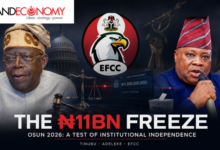
Then came the EFCC’s restriction and court-backed freeze involving a state-government account days before the election. The commission linked its action to an investigation into alleged suspicious transactions. Adeleke’s government called it political. President Tinubu intervened, describing the timing as capable of creating an impression of federal interference, and directed the agency to return to court to vacate the order.
That intervention did not erase the sense of siege. It confirmed that the timing was serious enough to trouble the President himself.
Veteran journalist, Babafemi Ojudu’s viral post-election online commentary, listed 15 forces behind APC’s defeat, including national hardship, Okpebholo’s insulting rhetoric, the freezing of the state account, threats attributed to political actors, Oyetola’s choice of candidate, visiting governors who appeared to arrive as conquerors, Adeleke’s dancing, Davido’s crowd appeal, project commissioning, courageous voters, creative campaign songs, debate preparation and an effective media team.
“Federal Might” Was Real—but It Was Not Monolithic
APC presented Osun with the classic mainstream-politics proposition: elect the party that controls Abuja and gain easier access to federal opportunity.
At the grand finale in Osogbo, Senate President Godswill Akpabio represented the President. Governors and senior leaders—including Hope Uzodimma, Uba Sani, Monday Okpebholo, Usman Ododo, Lucky Aiyedatiwa, Biodun Oyebanji, Babajide Sanwo-Olu and AbdulRahman AbdulRazaq—projected national solidarity. Speakers urged voters to bring Osun onto the “national grid.”
In one reading, this was normal party mobilisation. In another, it sounded less like an economic offer and more like a warning that opposition government carries a penalty.
Osun voters rejected that equation at the governorship level.
But intellectual honesty requires a distinction between APC’s display of national power and President Tinubu’s personal conduct. Tinubu had endorsed his party’s candidate, as a party leader would. Yet he also publicly reversed the effect of the EFCC’s badly timed intervention, called for a peaceful and transparent election, congratulated Adeleke and said the outcome reflected the people’s will.
The election was therefore not a clean story of Adeleke versus Tinubu. It was a contest against APC’s local and national restoration project inside a more ambiguous relationship with the President. Adeleke had already endorsed Tinubu for 2027 and reaffirmed that support after winning.
This makes Osun a poor template for simplistic national extrapolation. It proves that a strong local incumbent can defeat the President’s party. It does not prove that Adeleke is building a presidential opposition front against Tinubu.
Davido: When Celebrity Becomes Political Infrastructure
Davido’s role was substantial, but it should neither be inflated into sole causation nor dismissed as show business.
The Afrobeats star served as chairman of the campaign’s youth-mobilisation council, suspended parts of his entertainment schedule, appeared at rallies, mobilised artistes and influencers, activated his enormous digital audience and urged supporters to remain vigilant during counting. His family connection made the intervention credible in a way that a paid endorsement could never be.
Celebrity influence becomes politically valuable when it performs four jobs: attention, translation, mobilisation and protection.
Davido attracted attention to a state election far beyond Osun. He translated political messages into the language and platforms of younger voters. He helped turn rallies into cultural events. During collation, his updates encouraged supporters to keep watching the process.
He also responded combatively when opponents attacked his uncle. That energy carried risks—celebrity trolling can degrade civic debate—but it made the campaign feel defended in real time.
The brand lesson is important. Davido did not parachute into the campaign as a stranger. He was family, a long-term participant and an emotionally invested stakeholder. His influence amplified an existing political product. Had the government’s record been universally rejected, even his reach would probably not have rescued it.
Celebrity can accelerate trust. It cannot manufacture durable trust from nothing.
Osun Voters Were the Decisive Character
The most important actors were not on the rally stages. They were the citizens who entered polling units despite weeks of apprehension.
Yiaga Africa’s statistical verification found that INEC’s announced shares for Accord, APC and ADC fell within its independently estimated ranges. That indicates that the official totals reflected ballots counted at sampled polling units and were not significantly altered during collation.
Yiaga also reported turnout of about 43 per cent. BVAS functioned properly in 80 per cent of sampled polling units; reported problems in the remainder were subsequently resolved. Observers commended voters who remained to watch sorting, counting and result announcement.
This is where the “people power” claim earns evidential support. Voter presence and observation made manipulation more difficult.
Yet the halo must not become blinding. Yiaga, the Situation Room, CDD-West Africa and other observers reported widespread vote buying or inducement. Situation Room recorded food and drink distribution at one location and harassment or disruption at others. Other reporting carried allegations of cash offers involving both leading camps.
It would therefore be dishonest to narrate vote buying solely as an APC weapon deployed against an innocent Accord campaign. The credible conclusion is narrower and more troubling: the tabulation appears to have reflected the polling-unit count, but the freedom surrounding some voters’ choices was contaminated by inducement.
Osun delivered a verifiable result. It did not deliver a vote-buying-free election.
Why APC’s Technocratic Offer Could Not Close the Emotional Gap
Bola Oyebamiji was not a frivolous candidate. A banker, former Osun finance commissioner, former head of the state investment company and immediate past chief executive of the National Inland Waterways Authority, he offered administrative experience and economic competence.
APC framed the election as seriousness versus spectacle, technical governance versus dance and federal alignment versus opposition isolation.
The proposition failed for four reasons.
First, competence was asserted more convincingly than it was emotionally translated. Voters do not purchase résumés; they vote for expected lived outcomes.
Second, Oyebamiji carried the weight of Oyetola’s restoration project. Ojudu later criticised Oyetola for imposing a candidate he regarded as insufficiently popular. Whether or not “imposition” is a fair description of the primary, the perception reduced Oyebamiji’s ability to appear fully self-authored.
Third, the campaign overused Adeleke’s dancing as a negative frame. Every repetition increased recall for the incumbent’s most distinctive identity asset.
Fourth, the visiting-governor spectacle risked activating local resistance. A formidable show of elite solidarity can communicate strength; it can also tell voters that outsiders expect compliance.
APC still won 11 councils and 444,815 votes. It remains a major Osun force. The lesson is not that its machinery disappeared, but that machinery without sufficient local affection could not defeat a better integrated incumbent brand.
Performance Gave the Personality Something to Stand On
Adeleke’s record was neither the miracle claimed by supporters nor the emptiness alleged by opponents.
Visible infrastructure was his strongest evidence. His administration pursued road rehabilitation, dualisation and flyover projects, and said it had worked on more than 350 kilometres of roads. It also renovated schools and primary healthcare centres and promoted the University of Ilesa.
Workers’ welfare mattered politically. The government paid portions of inherited salary, promotion and pension obligations, implemented the new minimum wage and cultivated organised labour. In a civil-service-heavy state, salary predictability is not merely administration; it is household liquidity, retail demand and electoral goodwill.
There were measurable fiscal improvements. Reported domestic debt fell from N148.37 billion in December 2022 to N83.32 billion by March 2025, while external debt also declined. IGR reportedly rose from N27.72 billion in 2023 to N54.7 billion in 2024.
But there were unresolved weaknesses. Some flagship projects remained incomplete. Questions arose about project quality, including controversy around cracks associated with a newly built flyover. Education spending remained below the national policy benchmark. Workers’ legacy obligations were not fully cleared. Osun stayed heavily dependent on federal transfers. The council crisis degraded grassroots service delivery regardless of which political camp carried greater legal blame.
The electorate appears to have delivered a comparative verdict, not a certificate of perfection. Enough voters concluded that continuity under Adeleke offered more value—or less risk—than restoration under APC.
The Business and Investor Meaning of the Result
For businesses, continuity lowers immediate policy-reset risk. Contractors, suppliers, civil servants, cooperatives and investors already dealing with the administration can expect ongoing programmes to survive the electoral transition.
The enlarged mandate may also improve executive confidence. That can accelerate decisions, but it can equally weaken restraint. Investors should therefore watch procurement transparency, project quality, budget execution, debt management and the treatment of political opponents—not merely new project announcements.
The local-government dispute remains the most damaging institutional risk. Councils are essential to primary healthcare, basic education support, rural roads, markets, sanitation and local permits. When allocations, leadership and accounts are trapped in partisan warfare, the cost is paid by households and small businesses.
Adeleke’s second term must convert the political demand for released funds into a transparent service compact. Osun should publish council-by-council receipts, payrolls, procurement, projects and outcomes. A victory built partly on resisting alleged diversion must now make radical disclosure its answer.
The state’s rising IGR also requires care. Revenue growth should come from economic expansion, digitisation, widened compliance and reduced leakage—not aggressive extraction from a fragile private sector.
The real second-term economic scorecard should include jobs, private investment, farm productivity, power reliability, school outcomes, health access, road durability and household income—not kilometres, ceremonies and headline allocations alone.
Brand Lessons from the Adeleke Playbook
Authenticity can outperform polish. Adeleke’s public style is imperfect, but recognisable and culturally congruent. Voters often trust a coherent personality more than a heavily engineered candidate image.
Never let an opponent define your attack as your identity. APC tried to make dance evidence of incompetence. Adeleke’s campaign recoded it as joy, resilience and connection.
A celebrity works best as an operator, not an ornament. Davido contributed platforms, networks, youth translation and vigilance—not merely a rally performance.
Distribution still wins. Accord’s logo was weak, but the Imole organisation, PDP field network, Adeleke family capital, labour relationships, community influencers and media operation supplied distribution.
Visible delivery is powerful, but verification makes it durable. Project commissioning helped create momentum. Long-term trust will depend on quality, value for money and measurable impact.
Threat-based selling can provoke rejection. Telling voters that prosperity depends on joining the federal “grid” may sound efficient to party strategists. To proud voters, it can sound like punishment for political independence.
What Osun 2026 Says—and Does Not Say—About 2027
Osun says federal incumbency is not omnipotent when voters are mobilised, polling-unit results are watched and a local candidate possesses a stronger emotional and organisational franchise.
It tells APC that national dominance cannot replace local candidate legitimacy. It tells opposition parties that social-media outrage is not a ground game. It tells INEC that transparent administration can withstand a fiercely contested election when properly resourced and watched.
But Osun does not automatically predict an APC defeat in 2027. Adeleke has reaffirmed support for Tinubu’s second-term bid. The President’s intervention against the EFCC account freeze and his acceptance of the result complicate any attempt to present the election as a direct rebellion against him.
The broader lesson is institutional: democracy gains credibility when federal power does not overturn local choice—even when that choice defeats the ruling party.
BRANDECONOMY Insight: The Mandate Is a Dance Floor, Not a Throne
Ademola Adeleke’s victory is richer than the caricature on either side.
He did not win merely because he danced. He won because he turned dance into a language of accessibility, placed that language on visible projects and worker relationships, surrounded it with family and celebrity capital, moved an existing political structure into a new party, endured a siege narrative and persuaded more voters to defend continuity.
His opponents brought formidable resources. Their vote grew. Their governors arrived. Their federal-alignment case was loudly made. Yet they could not overcome the incumbent’s superior local conversion.
The long knives did not cut deeply enough because the target kept moving—with humour, rhythm, organisation and an electorate unwilling to be instructed from above.
Still, victory cannot legalise every allegation made by Adeleke’s camp, absolve Accord of inducement claims or convert contested projects into monuments of excellence. Nor should the people’s resistance become an excuse for personality rule.
The new mandate is larger, and so is the burden.
Adeleke must now stop governing as a man permanently on the campaign stage. He must resolve the council paralysis, institutionalise security neutrality, publish the books, audit project quality, deepen education and health outcomes, protect business confidence and ensure that Osun’s rising revenue creates rising household opportunity.
He has danced past the long knives. His second-term test is whether Osun can dance past poverty, institutional conflict and underdevelopment.
That performance will not be judged by the music. It will be judged by the morning after.