The tenants’ union says rent pressure in Port Harcourt and Obio/Akpor has become a social and economic emergency, with many workers paying more for accommodation than their annual earnings can reasonably sustain.
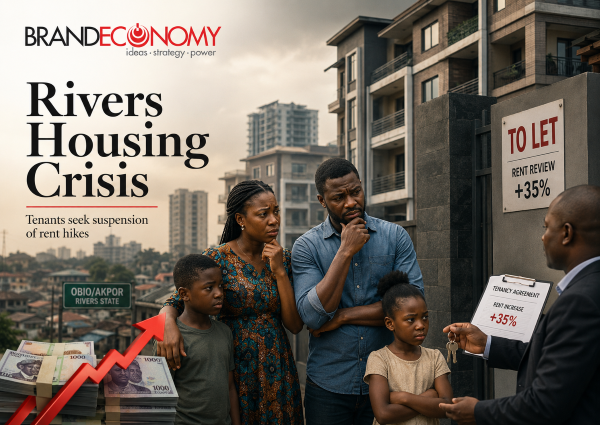 The tenants’ union says rent pressure in Port Harcourt and Obio/Akpor has become a social and economic emergency, with many workers paying more for accommodation than their
 The National Union of Tenants of Nigeria has called on Governor Siminalayi Fubara of Rivers State to urgently intervene in what it describes as a worsening housing crisis in Port Harcourt and Obio/Akpor, two of the state’s most commercially active and densely populated areas.
In a letter addressed to the governor and signed by the union’s Executive Secretary, Ceaser Enwefah, the group said rent inflation in the two local government areas had escalated into a serious affordability crisis affecting more than 1.5 million residents.




According to the union, many residents, including civil servants, private-sector employees, self-employed persons and retirees, are now spending a disproportionate share of their income on rent, leaving families exposed to deeper economic hardship.
Enwefah said about 80 per cent of residents in the affected areas are under severe rent pressure. He cited the case of civil servants earning the national minimum wage of ₦70,000 monthly, or ₦840,000 annually, who are being asked to pay as much as ₦900,000 per year for self-contained apartments.
That, he argued, is no longer a normal market adjustment. It is a housing affordability breakdown.
The union said rents for double-room apartments had reportedly risen from about ₦120,000 to ₦520,000 annually, while one-bedroom flats had jumped from about ₦300,000 to as much as ₦1.5 million in some areas.
Residential Housing Under Commercial Pressure
Enwefah attributed the crisis partly to the conversion of residential properties into commercial spaces, as well as indiscriminate approval of building-plan amendments that reduce the stock of affordable housing available to ordinary residents.
He alleged that some landlords and unregistered property agents were exploiting the housing shortage through excessive rent increases.
As a short-term intervention, the union urged the Rivers State Government to suspend further conversion of residential buildings to non-residential uses in the affected areas.
“We urge Governor Fubara to suspend rent increases pending the introduction of new policy directives,” Enwefah said.
The union also called for the appointment or deployment of a substantive or supervisory commissioner to the Rivers State Ministry of Housing to coordinate urgent policy action.
According to Enwefah, previous attempts to draw attention to the crisis through the ministry did not produce the expected response.
Housing as a Constitutional and Social Question
The union said affordable housing should not be treated merely as a private-market issue, arguing that it falls within the broader responsibility of government to promote welfare and social stability.
“There must be urgent redress of the situation because affordable housing is a key component of the Fundamental Objectives and Directive Principles of State Policy contained in the nation’s Constitution,” Enwefah said.
He also referenced international housing standards, which emphasise that rent and housing costs should remain affordable and proportionate to residents’ income.
The union warned that failure to address the situation could deepen poverty, displace low-income households and trigger social unrest.
“Nigerians are sacrificing virtually all their earnings to pay rent, leaving many families in severe economic hardship,” Enwefah said.
He appealed to the governor to adopt the union’s recommendations as part of a roadmap for addressing the housing pressure facing residents in the state.
BRANDECONOMY Insight
Rivers’ Rent Crisis Is a Warning on Urban Affordability
The housing crisis in Port Harcourt and Obio/Akpor reflects a wider urban problem across Nigeria: wages are not keeping pace with rent.
When workers earning ₦840,000 annually are expected to pay ₦900,000 for modest accommodation, the rental market has crossed from pressure into impossibility. Rent should not consume a household’s entire income. When it does, families cut back on food, education, healthcare, transport and savings.
The tenants’ union is right to frame this as more than a landlord-tenant dispute. Housing affordability is now an economic productivity issue. Workers who spend most of their income on rent have little left to support local commerce. Businesses suffer. Families become financially fragile. Social tension rises.
However, rent-control measures must be handled carefully. A blanket suspension of rent increases may offer short-term relief, but if poorly designed, it could discourage new housing investment or push transactions into informal arrangements. In the end, tenants may end up paying even more. The better approach is a balanced housing-affordability framework.
Rivers State needs a clear housing response: protect residential zones from reckless commercial conversion, regulate agents, improve tenancy-data collection, fast-track affordable housing projects, incentivise private developers to build rental housing, and strengthen dispute-resolution systems.
The deeper lesson is clear: cities cannot remain productive if workers cannot afford to live in them. Meanwhile, governments at all levels need to execute massive affordable housing projects for the masses and improve on rapid mass transit so that city centres are not over-crowded, and ultimately become too expensive for tenants.
Port Harcourt is one of Nigeria’s most important oil, gas, logistics and commercial cities. Its housing market must serve workers, not price them out of survival.