Workers Reject Proposed ₦100,000 Wage, Demand Cost of Living Allowance

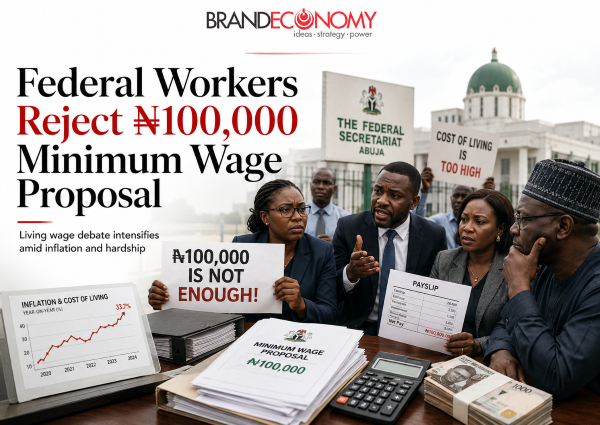
 The Federal Workers Forum says the proposed wage falls far short of current economic realities, warning that inflation, insecurity, unpaid arrears and falling purchasing power have pushed many public servants into a daily struggle for survival.
 The Federal Workers Forum says the proposed wage falls far short of current economic realities, warning that inflation, insecurity, unpaid arrears and
 The Federal Workers Forum has rejected the proposed ₦100,000 national minimum wage, describing it as inadequate, unrealistic and incapable of addressing the harsh economic conditions confronting Nigerian workers.
The forum made its position known in a communiqué issued after a meeting and opinion poll convened to deliberate on the worsening cost of living, insecurity and unresolved welfare concerns affecting federal workers across the country. The communiqué was signed by Andrew Emelieze, National Coordinator of the forum; Ayo Ogundele, National Secretary; and Aminu Yerima, National Mobilisation Officer.




According to the group, federal workers are facing deepening hardship caused by inflation, rising living costs, fuel subsidy removal, the declining value of the naira, unpaid entitlements and worsening insecurity.
The workers said the implementation of the ₦70,000 national minimum wage had failed to meaningfully improve purchasing power. They alleged that only ₦40,000 was added uniformly to salaries across grade levels, while deductions further reduced the actual take-home benefit.
The forum also expressed concern over the non-implementation of the 40 per cent peculiar allowance, as well as outstanding wage awards, promotion arrears, Duty Tour Allowances and other accumulated entitlements.
“Federal workers nationwide are living daily in fear and uncertainty. We are constantly confronted with the challenges of survival and safety,” the forum said.
It added that many public servants had continued to bear the burden of inflation, transport costs, high food prices and weakening real wages, despite repeated government assurances on workers’ welfare.
₦100,000 Not a Living Wage, Workers Say
The forum said the proposed ₦100,000 minimum wage, reportedly canvassed by some governors, does not meet the basic definition of a living wage in today’s economy.
It described the offer as a “Greek gift,” arguing that many of the same governors who previously complained about their ability to pay ₦70,000 were now floating ₦100,000 without a transparent and credible negotiation process.
“The ₦100,000 proposal is not a living wage. We condemn and reject this proposal in all its forms and entirety,” the group stated.
For the workers, the issue is no longer the headline number alone, but the actual value of wages after inflation, deductions, transport costs, food expenses, rent, school fees and healthcare bills.
In practical terms, the forum is arguing that wage reform must be based on purchasing power, not political convenience. A nominal wage increase that fails to restore workers’ ability to afford basic needs will not solve the labour crisis.
Unpaid Arrears Deepen Frustration
Beyond the proposed minimum wage, the forum said accumulated arrears remain a major source of resentment among federal workers.
It listed promotion arrears, wage awards, Duty Tour Allowances and other entitlements owed over several years as evidence that government has yet to fully meet its obligations to workers.
This is significant because wage credibility depends not only on new salary announcements, but also on whether previously approved benefits are paid promptly. When arrears accumulate, trust weakens. Workers begin to see official promises as temporary political language rather than enforceable commitments.
For a public service already under pressure from low morale, talent flight and declining productivity, unpaid entitlements can further erode institutional efficiency.
Insecurity Adds to Workers’ Anxiety
The forum also linked workers’ welfare to the worsening security situation in the country.
It said federal workers and ordinary Nigerians were increasingly exposed to kidnappings, killings and other violent crimes, while schools had become targets of criminal attacks in some parts of the country.
The forum called on government to urgently address insecurity, secure the release of kidnapped persons and halt the killings recorded across the country.
“The fear is real, as many federal workers and indeed many more Nigerians are daily falling victims of the system’s failure to guarantee safety,” it said.
The group gave President Bola Tinubu a 30-day ultimatum to tackle insecurity, kidnappings, killings and economic hardship, warning that continued inaction could deepen public dissatisfaction.
Call for Labour Action
The forum urged the Nigeria Labour Congress and the Trade Union Congress to declare an indefinite nationwide strike over hardship and insecurity.
It said its poll mandated organised labour to call workers out on strike if urgent steps were not taken to address worsening living conditions.
The forum also expressed support for proposed nationwide protests and rallies, pending improvement in security and welfare conditions.
In addition, it called on the Federal Government to settle all outstanding arrears owed workers and introduce a Cost of Living Allowance to cushion the impact of inflation.
The group further advocated the convocation of a sovereign national conference to address constitutional and governance issues it identified as contributing to the country’s economic and security challenges.
BRANDECONOMY Insight
Nigeria’s Wage Debate Is Really a Purchasing-Power Crisis
The rejection of a ₦100,000 minimum wage by federal workers exposes a deeper problem in Nigeria’s labour economy: wages are being overtaken by inflation faster than government can revise them.
The old wage-negotiation model is no longer enough. A salary figure that appears large politically may still be weak economically if food, transport, rent, energy and healthcare costs have risen faster. For workers, the real question is simple: what can the wage actually buy?
That is why the concept of a living wage matters. A minimum wage should not merely exist on paper. It should provide a realistic floor for survival, dignity and productivity. When workers cannot meet basic needs, morale collapses, absenteeism rises, informal coping mechanisms expand and public-sector efficiency declines.
Government must also recognise that unpaid arrears worsen the credibility problem. Promotion arrears, wage awards and allowances are not favours. They are obligations. Failure to settle them undermines trust and weakens labour relations.
The insecurity dimension makes the situation even more delicate. Workers are not only worried about hunger; they are worried about safety. Economic hardship and physical insecurity together create a more volatile social environment.
The way forward requires a more honest wage framework: credible data on cost of living, transparent negotiation, indexed allowances where necessary, arrears settlement, productivity-linked reforms and stronger fiscal discipline.
Nigeria cannot build a functional public service on wages that workers consider incapable of sustaining life.