How Poor Electricity Supply is Pushing Small Businesses to the Brink

 For many micro and small enterprises in Abuja’s satellite towns, unstable, poor electricity supply is no longer a mere inconvenience. It has become a direct threat to productivity, customer trust, operating margins and business survival.
 For many micro and small enterprises in Abuja’s satellite towns, unstable, poor electricity supply is no longer a mere inconvenience. It has become a direct threat to productivity, customer trust, operating margins and
 Small business owners in the Federal Capital Territory are calling for urgent Federal Government intervention as persistent power outages continue to disrupt operations, raise production costs and push many enterprises toward distress.
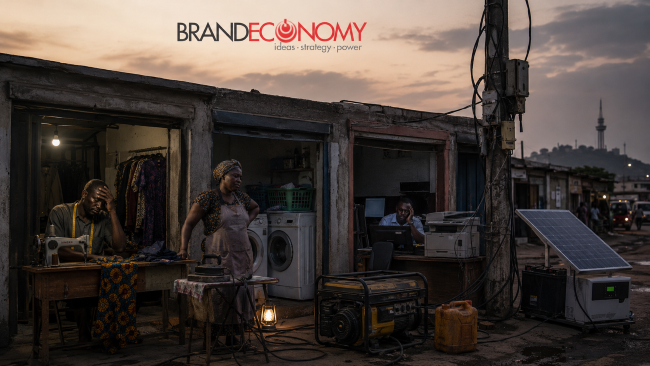
Across several parts of the FCT, particularly in satellite towns, business owners say electricity supply has become increasingly unreliable. Some areas reportedly receive only a few hours of power daily, while others experience prolonged blackouts that force entrepreneurs to depend almost entirely on generators, charcoal alternatives or expensive solar systems.




For small enterprises already contending with inflation, weak consumer spending, rising rent, fuel costs and higher input prices, poor electricity has become a silent business killer.
A laundry operator, Muhammadu Isah, said his business depends heavily on electricity because washing machines and pressing irons are central to daily operations. However, irregular power supply has forced him to rely on generators, draining a large share of his earnings through petrol purchases.
“We are facing serious challenges due to poor electricity supply because our business depends heavily on electricity,” he said.
Isah explained that ironing has become especially difficult because small generators cannot always power electric pressing irons efficiently. As a result, some laundries have returned to charcoal irons, a method that comes with operational and safety risks.
According to him, charcoal ironing can cause burns and sometimes damage customers’ clothes, leading to complaints and loss of trust.
For a small laundry business, that is more than a technical inconvenience. It is a reputational risk. Customers who lose confidence in service quality may never return.
Tailors Lose Production Time, Customers Lose Patience
For Mrs Amina Yusuf, a tailor, power instability has slowed production and made delivery timelines harder to meet.
She said modern tailoring now depends on electricity-driven sewing machines, weaving machines and steaming equipment used for finishing and applying decorative stones to garments. When power fails, production stalls.
“When there is electricity, I can sew about four to five clothes in a day, but because of poor power supply, I can no longer meet my targets,” she said.
The business consequence is immediate. Delayed delivery damages customer relationships. Missed deadlines reduce daily income. Generator use raises operating costs. Over time, the business becomes less profitable, less reliable and less competitive.
Another tailor, Chioma Micheal, described the situation as a daily struggle affecting productivity, customer trust and even mental well-being.
“When there is no electricity, everything becomes difficult. You cannot iron, you cannot sew fast, yet customers still expect their clothes to be ready on time,” she said.
She noted that generators have become almost as important as sewing machines in many tailoring shops. But fuelling them daily is expensive, often forcing small operators to divert money meant for transport, feeding or materials into petrol purchases.
Business Centres Shift to Solar as Survival Strategy
A business centre operator, David Okafor, said poor electricity supply has disrupted daily operations and increased the cost of running his enterprise.
His business depends on computers, photocopiers, printers, laptops and internet devices. Power outages delay customer service, reduce productivity and sometimes cause customer dissatisfaction.
Okafor said generators had become necessary for continuity, but fuel and maintenance costs had eaten into profit margins. Rising paper costs and rent have further worsened the pressure.
To stay afloat, he adopted solar energy.
“Although the installation of solar energy is expensive, it has helped improve business operations and reduced dependence on generators,” he said.
His experience reflects a wider shift among Nigerian small businesses. Solar power is increasingly becoming a survival tool, but the upfront cost remains prohibitive for many micro-enterprises. Those who can afford it gain stability. Those who cannot remain trapped in the generator economy.
Electricity as the Foundation of Small-Business Productivity
The complaints from laundries, tailoring shops and business centres illustrate a larger economic truth: reliable electricity is not simply infrastructure. It is working capital.
When power is unavailable, businesses spend more to produce less. They burn fuel, lose time, delay orders, damage equipment, disappoint customers and reduce daily output. The cost is not limited to petrol. It includes lower productivity, lower margins, weaker customer confidence and, in many cases, business fatigue.
For small enterprises, these losses can be decisive. A large company may absorb power instability through industrial generators, inverters, dedicated feeders or captive power systems. A micro-business cannot. For the smallest operators, every litre of petrol, every hour of blackout and every delayed order matters.
This is why the electricity crisis is also an employment issue. Small businesses are major employers in Nigeria’s informal and semi-formal economy. When they struggle, jobs weaken. When they close, household incomes fall.
BRANDECONOMY Insight
Nigeria’s MSME Crisis Is Also an Electricity Crisis
The frustration of small business owners in the FCT reflects one of Nigeria’s oldest development failures: businesses are expected to compete in a modern economy while powering themselves like survivalists.
Poor electricity supply is effectively a tax on enterprise. It raises costs, reduces output, damages equipment, weakens customer trust and lowers productivity. For small businesses, it can determine whether they survive or shut down.
The deeper issue is that Nigeria’s MSME ecosystem cannot scale on generators. A tailoring shop, laundry outlet, barbing salon, business centre, cold-room operator or small manufacturer needs affordable and predictable power to grow. Without it, entrepreneurs spend capital on survival rather than expansion.
Solar adoption offers hope, but it is not yet affordable enough for many micro-businesses. Government and development-finance institutions should therefore consider targeted energy-financing schemes for MSMEs, including low-interest solar loans, mini-grid expansion, productive-use energy grants and electricity clusters for small business corridors.
The power sector reform agenda must also pay greater attention to satellite towns and informal business districts. These are places where jobs are created daily, but where infrastructure is often weakest.
Electricity is not just about lighting homes. It is about powering livelihoods. Until Nigeria solves that problem, small businesses will continue to subsidise national inefficiency with petrol, stress and shrinking profits.