
Otti’s Azumini-Obeaku Seaport Vision: Can Abia Build a Corridor to the Atlantic?
Approve immediate commencement of feasibility study

 Abia State Governor, Dr Alex Otti, has taken a significant first step toward what could become one of the most ambitious infrastructure ideas in the South-East: the proposed Azumini-Obeaku Seaport and Inland Waterways Corridor project.
At a meeting in Nvosi, Isialangwa South Local Government Area, with officials of China Harbour Engineering Company Limited, Otti approved the immediate commencement of a feasibility study for the project. The approval does not mean the port will be built tomorrow. It means Abia is now formally asking the most important question: is this dream technically, commercially, financially and environmentally viable?



That distinction matters. In infrastructure, the distance between political ambition and bankable project execution is often wider than the physical distance between river channels and the open sea.
Otti appeared to understand that point. He gave the green light for the study, but also asked the company to shorten its proposed six-to-seven-month timeline. For a government eager to move quickly, half a year can feel too slow. But for a project of this complexity, speed must not defeat rigour. A seaport corridor is not a road contract. It involves hydrology, dredging, navigation, environmental impact, cargo demand, intermodal connectivity, port economics, security, community relations, federal approvals and long-term financing.
The governor also directed relevant state agencies to begin the process of securing Federal Government approvals. That is critical because port development and inland waterways infrastructure are not purely state matters. They sit within a web of federal regulatory interests, including maritime administration, waterways control, environmental approvals, port concessioning and national transport planning.
In other words, Abia can dream. But Abuja must approve key parts of the journey.
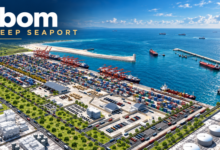
The proposed location, according to Otti, is about 19 nautical miles from the high sea. That makes the technical study especially important. If dredging is required—and it almost certainly will be—the feasibility report must determine the depth, channel alignment, sediment behaviour, maintenance dredging cost, navigability, tidal patterns and long-term operational sustainability.
Many port ideas fail not because they cannot be launched, but because they cannot be maintained economically. Initial dredging is one cost. Keeping a channel open year after year is another. That is where serious feasibility work separates development planning from political theatre.
Still, the attraction of the Azumini-Obeaku corridor is easy to understand.
Abia is a commercial state with industrial energy. Aba, long regarded as one of Nigeria’s great enterprise cities, remains famous for manufacturing, leatherworks, garments, fabrication, trade and resilient small-business culture. Yet the South-East has historically suffered from weak logistics access to seaports. Manufacturers and traders depend heavily on long, costly movement of goods through Lagos ports or other coastal gateways, with congestion, delays and high transport costs eating into competitiveness.
A viable seaport or inland waterways corridor linked to Abia could change that equation. It could reduce logistics costs for regional businesses, support export activity, stimulate industrial clusters, attract warehousing and logistics firms, and provide a stronger trade route for Aba, Umuahia, parts of Akwa Ibom, Imo, Ebonyi, Cross River and the wider South-East/South-South corridor.
This is why the project should not be viewed merely as a maritime dream. It is a regional economic strategy.
China Harbour Engineering Company’s presence also gives the proposal a certain seriousness. The company’s representative, Nicholas Liu, said it was interested in partnering with the Abia Government to actualise the project and pointed to its experience in Nigeria’s infrastructure space, including involvement in the Lekki Deep Sea Port project. Liu also identified some of the issues that will determine success: government commitment, funding model, public-private partnership structure and phased development.
Those points go to the heart of the matter.
A project like this cannot be built on enthusiasm alone. It needs a bankable structure. Who will finance it? Who will own it? Who will operate it? Will it be a state-led project, a concession, a public-private partnership, a federal-state collaboration, or a special-purpose vehicle? What cargo volumes will justify the investment? Which industries will use it? What competing ports or corridors will it face? What road, rail or inland transport links will connect it to markets?
The answers will determine whether investors see opportunity or risk.
The phased-development model for the Azumini-Obeaku Seaport may be the most sensible route. Rather than attempt a full-scale seaport all at once, Abia may need to begin with a realistic corridor strategy: navigation assessment, small cargo facilities, inland jetty development, logistics parks, access roads, industrial zones and export-support infrastructure. If demand grows and the technical conditions are favourable, the project can then scale toward deeper port functionality.
This approach would reduce the danger of building an oversized asset before the market is ready.
The governor’s caution that the feasibility study could return a negative verdict is also important. It shows a measure of realism. Not every attractive infrastructure idea is viable. Some projects are technically possible but commercially weak. Others are commercially attractive but environmentally risky. Some are politically exciting but financially unsustainable.
A mature government must be willing to hear the truth from a feasibility study—even if the truth is inconvenient.
For Abia, the bigger opportunity lies in using this process to build an integrated economic development plan. The seaport corridor should not stand alone. It should connect with Aba’s industrial regeneration, export promotion, power supply, road rehabilitation, urban renewal, investment promotion and skills development. A port without productive hinterland activity is underutilised. A manufacturing base without logistics access is constrained. The power lies in joining both.
Otti has built part of his governance brand around reform, competence and infrastructure renewal. The Azumini-Obeaku proposal fits that brand. It signals ambition beyond routine administration. It says Abia wants to compete for investment, trade and logistics relevance.
But the Azumini-Obeaku Seaport ambition will now meet due diligence.
The feasibility study must be transparent, independent, technically sound and commercially honest. It must not become a document written to justify a predetermined political decision. It must test the real economics: dredging cost, traffic forecasts, capital expenditure, environmental impact, regulatory pathway, community issues, revenue projections and investor appetite.
If the study is positive, Abia may have the foundation for a transformational project. If it is negative, the state should still gain valuable intelligence for future waterways, logistics and industrial planning.
Either way, the process is useful if conducted seriously.
Nigeria urgently needs subnational governments that think beyond salaries, roads and ceremonies. States must begin to build economic platforms. Ports, logistics corridors, industrial parks, digital infrastructure, agro-processing zones and export routes are the new tools of competitiveness.
Otti has put one bold idea on the table.
The next question is whether the Azumini-Obeaku Seaport corridor is a dream with engineering beneath it—or merely another attractive headline in Nigeria’s long archive of proposed infrastructure projects.
For Abia’s economy, Aba’s manufacturers and the South-East’s trade future, the answer could be consequential.
BRANDECONOMY Insight
The proposed Azumini-Obeaku Seaport and Inland Waterways Corridor is one of the boldest economic ideas to emerge from Abia’s current development agenda. But its real importance is not the announcement. It is the feasibility test.
For decades, the South-East has carried one of Nigeria’s most productive commercial cultures without matching logistics infrastructure. Aba manufactures. Onitsha trades. Nnewi produces. The region moves goods with energy and resilience, but often through costly, congested and distant port routes. That logistics disadvantage has quietly taxed enterprise, weakened export competitiveness and slowed industrial scale.
A viable Abia-linked seaport corridor could change the equation. It could reduce cargo movement costs, strengthen Aba’s manufacturing base, attract warehousing and logistics investments, open new export channels, and reposition Abia as a strategic gateway between the South-East and the Atlantic economy.
But ports are not built on optimism. They are built on depth, dredging, cargo volumes, environmental approvals, federal cooperation, capital structure and long-term maintenance economics. The fact that the proposed location is about 19 nautical miles from the high sea makes the feasibility study even more critical. Initial dredging may be expensive; maintenance dredging may be even more decisive.
Governor Alex Otti is right to move quickly, but speed must not compromise rigour. The study must answer the hard questions: Is the channel navigable? What cargo will justify the investment? Who will fund and operate the project? How will the corridor connect to roads, industrial zones and markets? What environmental risks exist? What federal approvals are required?
The smartest route may be phased development: begin with inland waterways, jetties, logistics parks and export-support infrastructure, then scale if the economics prove strong.
If the study is positive, Abia may have the foundation for a transformational trade corridor. If it is negative, the state will still gain valuable intelligence for smarter infrastructure planning.
Either way, this is how serious states should think: not only about roads and salaries, but about economic platforms. Abia’s seaport ambition is therefore a test of vision, execution and discipline.