Nigeria’s Telecoms Pulse: Active Voice Subscribers Hit 179.6m as Internet Users Rise to 148.2m
Voice Still Matters...

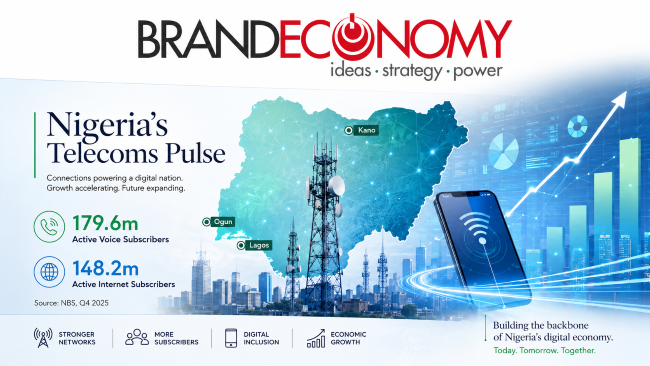 Nigeria’s telecoms market remained on an expansion path in the fourth quarter of 2025, with active voice subscriptions rising to 179.6 million and active internet subscriptions climbing to 148.2 million, according to the National Bureau of Statistics. The figures show renewed momentum in subscriber activity after earlier industry adjustments, but they also expose familiar gaps: Lagos, Kano and Ogun continue to dominate connectivity, while Bayelsa, Ebonyi and Ekiti remain at the lower end of the digital-access table.
Telecoms Growth Returns to the Front Burner
Nigeria’s telecommunications industry ended 2025 with stronger subscriber activity, reinforcing the sector’s role as one of the country’s most important economic infrastructure platforms.




According to the National Bureau of Statistics, active voice subscribers stood at 179,642,333 in the fourth quarter of 2025. This represents an 8.92 per cent year-on-year increase from 164,926,599 recorded in the corresponding quarter of 2024.
On a quarter-on-quarter basis, active voice subscriptions grew by 3.52 per cent, rising from 173,541,983 in the third quarter of 2025.
The internet segment also recorded expansion. Active internet subscribers rose to 148,166,926 in Q4 2025, compared with 139,282,108 in Q4 2024. This translates to a 6.38 per cent year-on-year increase. Quarter-on-quarter, active internet users grew by 5.12 per cent from 140,949,570 in Q3 2025.
These numbers matter because telecoms is no longer merely about calls and data bundles. It is the backbone of Nigeria’s digital economy: banking, e-commerce, streaming, identity systems, logistics, education, remote work, health-tech, taxation, security platforms, government services and small-business growth.
When telecoms subscriptions rise, the signal is bigger than network usage. It suggests deeper participation in the digital economy.
Voice Still Matters in a Data-Driven Age
The continued rise of active voice subscribers shows that voice communication remains resilient despite the growth of messaging apps and internet-based communication platforms.
In Nigeria, voice is still essential for informal trade, family communication, transport coordination, customer service, market transactions and small-business operations. Many Nigerians may use internet-enabled platforms, but voice calls remain a trusted, direct and familiar form of communication.
For mobile network operators, this means the market is not simply shifting from voice to data. Rather, it is becoming more layered. Consumers use voice, data, mobile money, messaging, social media and digital services simultaneously.
The business challenge for operators is to monetise that complexity without overburdening consumers already facing inflation, rising energy costs and pressure on disposable income.
Internet Subscribers: The Real Growth Story
While voice numbers remain strong, the deeper strategic story is internet usage.
With active internet subscriptions now at 148.2 million, Nigeria’s digital market continues to expand. This supports fintech adoption, mobile advertising, online learning, digital entertainment, gig work, e-commerce, social media commerce and cloud-based business services.
For a country with a young population and strong entrepreneurial culture, internet access is an economic lever. The more Nigerians are connected, the larger the addressable market for digital products and services.
However, subscriber growth does not automatically equal quality connectivity. Many users still struggle with unstable service, high data costs, patchy broadband coverage, device affordability and power-supply challenges.
The next phase of telecoms growth must therefore move beyond subscriber count to connection quality. Speed, reliability, affordability and coverage depth will define the real strength of Nigeria’s digital economy.
Lagos Leads, Kano and Ogun Follow
The state-by-state data confirms the familiar dominance of Lagos.
Lagos recorded the highest number of active voice subscribers in Q4 2025, with 21,575,253 subscriptions. Kano followed with 11,261,625, while Ogun recorded 10,254,588.
The same pattern appeared in internet subscriptions. Lagos led with 18,597,444 active internet subscribers, followed by Kano with 9,166,953 and Ogun with 8,881,234.
Lagos’ leadership is not surprising. It is Nigeria’s largest commercial hub, home to banks, fintechs, media companies, tech startups, ports, retail networks, corporate headquarters, universities, dense residential clusters and a large informal economy. Connectivity in Lagos is both a consumer product and a business necessity.
Kano’s position reflects its commercial importance in the North, while Ogun’s strong numbers point to its growing role as a residential, industrial and logistics extension of Lagos.
Together, these states show that telecoms growth follows economic density. Where trade, population, industry and urbanisation are concentrated, subscriptions rise.
Bayelsa, Ebonyi and Ekiti Lag Behind
At the lower end, Bayelsa recorded the least active voice subscriptions with 1,187,597, followed by Ebonyi with 1,678,094 and Ekiti with 1,687,029.
For internet subscriptions, Bayelsa also had the lowest figure at 1,010,052, followed by Ebonyi with 1,350,111 and Ekiti with 1,439,813.
These numbers raise an important development question. Nigeria’s digital future cannot be built only around Lagos and a few high-density markets. States with lower connectivity levels risk falling further behind in digital commerce, e-learning, telemedicine, financial inclusion and government service delivery.
The policy response should not be to lament the gap. It should be to close it through broadband investment, right-of-way reform, rural connectivity incentives, device-financing schemes, public Wi-Fi zones, digital-literacy programmes and stronger state-level digital economy plans.
South-West Dominates the Connectivity Map
The zonal data further confirms the South-West’s dominance.
The region recorded the highest active voice subscriptions with 49,238,117, while the South-East had the lowest with 18,332,074.
For internet subscriptions, the South-West again led with 48,347,050, while the South-East recorded the lowest figure with 17,776,098.
This dominance reflects population, commerce, urban concentration and the presence of Lagos as Nigeria’s digital and financial command centre. But it also reflects disparities in infrastructure, investment concentration and market scale.
For the South-East, the low subscription figure is particularly notable because the region has a strong trading and entrepreneurial culture. The gap suggests an opportunity for deeper broadband investment, digital enterprise platforms, SME connectivity solutions and stronger state-level telecoms infrastructure policy.
MTN Maintains Market Lead
The NBS report also showed that MTN remained the telecommunications provider with the highest subscription share in Q4 2025.
This reinforces MTN’s long-standing market leadership in Nigeria, driven by network reach, brand strength, distribution depth, enterprise services, data growth and broad consumer adoption.
For competitors, the challenge remains how to win higher-value customers, expand data usage, improve service quality and compete more aggressively in underserved markets.
For regulators, the priority is to ensure healthy competition, fair pricing, better service quality and continued investment in infrastructure.
BRANDECONOMY Insight
Nigeria’s Q4 2025 telecoms numbers confirm that connectivity remains one of the country’s strongest growth platforms.
With 179.6 million active voice subscribers and 148.2 million active internet subscriptions, telecoms continues to power the country’s digital transformation. But the deeper lesson is that Nigeria is not simply adding subscribers. It is building the infrastructure layer on which future banking, commerce, education, identity, entertainment, logistics and public services will depend.
The challenge is that growth remains uneven.
Lagos, Kano and Ogun are pulling strongly ahead, while states such as Bayelsa, Ebonyi and Ekiti remain behind. The South-West dominates both voice and internet subscriptions, while the South-East records the lowest zonal figures. This is not just a telecoms statistic. It is a development signal.
Digital inequality can become economic inequality. States with weaker connectivity will struggle to attract digital businesses, deepen financial inclusion, support online learning and compete in the emerging knowledge economy.
The next telecoms agenda must therefore move from subscriber expansion to digital inclusion and quality of service. Nigeria needs more fibre, more rural broadband, better spectrum utilisation, cheaper smartphones, lower infrastructure barriers, and stronger cooperation between federal and state governments.
Telecoms operators also need a more stable investment climate. Power costs, vandalism, taxation pressure, right-of-way fees and foreign-exchange exposure all affect network expansion. Without solving these issues, subscriber growth may continue, but service quality may lag.
The prize is enormous. A better-connected Nigeria will be more bankable, more productive, more innovative and more inclusive.
Telecoms is no longer a sector. It is the nervous system of the modern economy.