Okomu Oil Posts Strong 2025 Earnings as Palm Revenue Hits ₦172.6bn

 The palm oil major’s 2025 performance reinforces a bigger market reality: Nigeria’s agro-industrial champions are beginning to show the earnings power of scale, disciplined plantation management, commodity pricing strength and export-ready value chains.
 The palm oil major’s 2025 performance reinforces a bigger market reality: Nigeria’s agro-industrial champions are beginning to show the
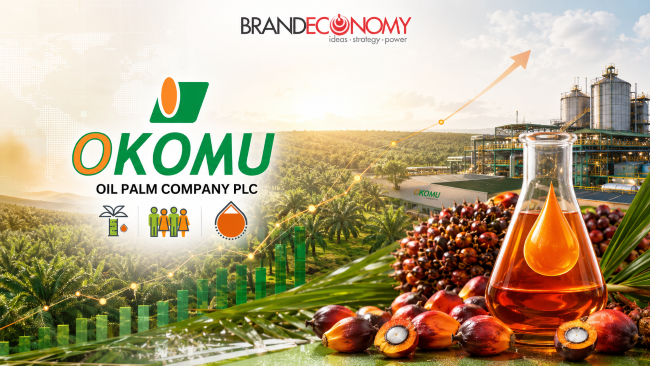
 Okomu Oil Palm Company Plc has reported a strong 2025 performance, with revenue from palm products rising to ₦172.6 billion, a 60.5 percent increase over the previous year.
The company disclosed the figures at its 46th Annual General Meeting and 50th anniversary celebration in Abuja, where its Chairman, Gbenga Oyebode, said Okomu had delivered significant growth in both revenue and profitability despite a demanding macroeconomic environment.



According to him, the company’s palm products segment remained the major earnings engine, supported by strong pricing, disciplined execution and improved operational efficiency. Cost of sales for the palm segment rose sharply to ₦112.339 billion, representing a 175.3 per cent increase over the previous year, reflecting the pressure of inflation, input costs, logistics, wages and wider operating expenses.
Even with the cost surge, Okomu reported a gross profit of ₦123.346 billion, up 93 per cent from 2024. Profit from continuing operations rose to ₦88.798 billion, representing a 103 per cent increase over the corresponding period.
“We surpassed our previous year’s performance, achieving significant growth in both revenue and profitability,” Oyebode said.
He attributed the result to a clear strategy, disciplined execution and the commitment of the board, management and staff to long-term value creation for shareholders.
Rubber Segment Adds Strength to Group Performance
Okomu also recorded strong performance in its rubber business, despite lower output and uneven macroeconomic conditions.
The company reported total turnover of ₦198.2 billion, a 52 per cent year-on-year increase. Consolidated cost of sales rose by about 27.6 per cent, while consolidated gross profit increased by 79.5 per cent, rising from ₦78.5 billion in 2024 to ₦141 billion in 2025.
Net profit from continuing operations climbed to ₦57.9 billion, compared with ₦39.9 billion in 2024, representing a 45 per cent increase.
The numbers underline Okomu’s position as one of Nigeria’s most important listed agro-industrial companies. In an economy still seeking to diversify beyond oil, the company’s performance shows how structured plantation agriculture can deliver scale, exports, jobs, shareholder value and industrial raw materials.
Shareholders to Receive ₦55 Per Share Dividend
The board paid an interim dividend of ₦40 per share during the 2025 financial year and has proposed a final dividend of ₦15 per share, bringing total dividend payout to ₦55 per share.
That payout will interest income-focused investors, especially at a time when equities investors are increasingly watching companies with strong cash generation, resilient margins and credible dividend histories.
For shareholders, Okomu’s performance presents a compelling combination: commodity exposure, plantation assets, export potential, inflation-hedging characteristics and consistent dividend returns.
Security Stability Supports Production
Oyebode said the company maintained a stable and well-controlled security environment across its operations during the review period, enabling uninterrupted production activities.
He noted that the palm and rubber divisions, processing facilities, residential quarters and administrative units recorded no significant security disruptions.
That point is important in Nigeria’s agricultural economy, where insecurity, land disputes, logistics risks and community tensions can severely affect production. For a plantation business, stability is not merely operational comfort; it is a core investment variable.
Fifty Years of Agro-Industrial Evolution
The AGM also marked Okomu Oil’s golden jubilee, a milestone Oyebode described as evidence of resilience, discipline and strategic vision.
The company was established in 1976 as a Federal Government initiative to support the revival of Nigeria’s oil palm industry, beginning with a plantation covering 15,580 hectares in the Okomu Forest Reserve.
Its privatisation in 1990 and subsequent listing on the Nigerian Stock Exchange marked a turning point, transforming the business into a commercially driven, shareholder-focused enterprise.
“Since then, strong corporate governance, transparency and accountability have remained central to our operations,” Oyebode said.
Over five decades, Okomu has expanded its cultivated plantation to more than 34,000 hectares and built a stronger export-facing profile, positioning itself as a globally competitive agro-industrial firm.
Community Investment and Sustainability
Oyebode also highlighted the company’s commitment to sustainability and community development, noting that Okomu currently works with 29 host communities through investments in infrastructure and social initiatives.
This is central to the long-term economics of plantation agriculture. Large-scale agro-industrial companies operate within communities, ecosystems and land-use systems that require careful management. Their licence to operate depends not only on output and profitability, but also on environmental stewardship, host-community relations, labour practices and social investment.
The Managing Director, Dr Graham Hefer, said Okomu had grown from less than 15,000 hectares to more than 34,000 hectares of cultivated plantation over five decades. He said the company remained committed to further expansion of its oil palm plantations and continued job creation, especially for young Nigerians.
BRANDECONOMY Insight
Okomu Oil Shows the Investment Case for Serious Agribusiness
Okomu Oil’s 2025 results are not just a corporate success story. They are a statement about the investment potential of Nigeria’s agro-industrial economy.
The company’s revenue growth, profit expansion and dividend payout show what becomes possible when agriculture is treated not as subsistence activity, but as a structured industrial business. Plantation scale, processing capacity, governance discipline, export orientation and long-term capital planning are what separate commodity potential from real shareholder value.
Nigeria has talked for decades about reviving oil palm, once one of the country’s strongest agricultural export assets. Okomu’s performance proves that the sector can still deliver strong earnings when properly managed.
But the numbers also reveal the pressure points. The sharp rise in cost of sales shows that inflation, energy costs, logistics, labour and input expenses remain major threats to margins. Agro-industrial firms may benefit from commodity pricing, but they are not insulated from Nigeria’s difficult operating environment.
For investors, Okomu Oil remains a compelling case study in defensive growth. Palm oil and rubber are real-economy commodities. Demand is broad. Pricing can hedge inflation. Exports offer foreign-exchange relevance. Dividends strengthen the equity story.
For policymakers, the lesson is even bigger: Nigeria needs more Okomus. That means better land administration, rural infrastructure, security, agricultural finance, research, processing capacity and export logistics.
If Nigeria wants to diversify meaningfully, it must build more agro-industrial champions that can move from farm to factory to market — and do so profitably.