More Wins for Seplat as Shares Hit ₦10,450 and Brand Value Soars
The Making of a Nigerian Energy Champion

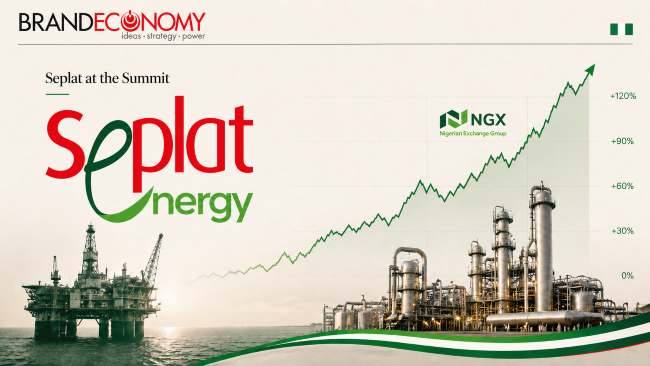
Seplat Energy’s climb to ₦10,450 per share is more than a stock-market record. It is the story of an indigenous energy company that has moved from disciplined Nigerian operator to scaled African energy champion—combining oil, gas, offshore expansion, corporate governance, brand equity, dividends and hard cash flow into one of the most closely watched investment stories on the Nigerian Exchange.




There are share-price movements that merely excite traders. Then there are market milestones that say something deeper about the architecture of an economy. Seplat Energy Plc’s recent surge past the ₦10,000-per-share threshold belongs firmly in the second category.
As at the close of trading on April 24, 2026, Seplat was quoted at ₦10,450 per share, with market data putting its market capitalisation around ₦5.97 trillion. The company’s crossing of the ₦10,000 level earlier in April made it the first NGX-listed company to break that psychological barrier, after rising from ₦5,610 at the start of the year to ₦10,450—an 86.27% year-to-date climb by April 14.
For a Nigerian market long dominated by banks, cement giants, telecoms and consumer names, Seplat’s ascent represents a striking re-rating of the energy sector. Investors are not simply buying an oil company. They are buying scale, reserves, gas optionality, offshore consolidation, dividend visibility and a rare governance story in a sector often burdened by opacity.

The Making of a Nigerian Energy Champion
Seplat’s investment case has been transformed by the completion and consolidation of its acquisition of Mobil Producing Nigeria Unlimited, now integrated into the Seplat group. The transaction gave Seplat a 40% operated interest in OMLs 67, 68, 70 and 104, a 40% operated interest in the Qua Iboe export terminal and Yoho FSO, a 51% operated interest in the Bonny River Terminal NGL recovery plant, and a 9.6% participating interest in the Aneman-Kpono field.
This is the quiet revolution behind the headline share price. For years, the Nigerian oil industry has been defined by the retreat of international oil companies from onshore and shallow-water assets and the gradual rise of indigenous operators willing to invest where global majors were reducing exposure. Seplat has positioned itself as the most investable face of that transition: Nigerian in roots, international in listing discipline, and increasingly continental in ambition.
The company is listed on the Premium Board of the Nigerian Exchange and on the Main Market of the London Stock Exchange, a dual-market identity that gives it both Nigerian relevance and international visibility. Its portfolio now covers eleven oil and gas blocks across onshore and shallow-water locations in the Niger Delta, with interests in export terminals, offshore NGL recovery plants, and three gas processing plants including Oben, Sapele and the 300 MMscfd ANOH Gas Processing Plant.
From Asset Base to Earnings Power
The numbers explain why investors are paying attention. In its audited 2025 results, Seplat reported average group production of 131,506 boepd, up 148% from 52,947 boepd in 2024. Revenue rose 144.2% to $2.726 billion, adjusted EBITDA increased 137% to $1.275 billion, and cash generated from operations jumped 276% to $1.166 billion.
This is the kind of operating leverage capital markets understand instantly. A larger asset base is only meaningful if it produces cash. Seplat’s 2025 performance suggests that the enlarged group is no longer a promise on a deal slide; it is now a functioning enterprise with rising volumes, better cash conversion and a strengthened balance sheet.
Even more important is the quality of the cash. Net debt at year-end 2025 stood at $673.3 million, down 25% year-on-year, while net debt-to-EBITDA was reported at 0.53x. That balance-sheet discipline matters in Nigeria, where capital is expensive, foreign exchange can be volatile and debt-funded expansion can quickly become dangerous if operations disappoint.
The Dividend Signal
Markets love growth, but they respect cash returns. Seplat has understood this delicate balance. The company declared a total 2025 dividend of 25 US cents per share, equivalent to $150 million, representing a 52% increase on 2024. It also reiterated its ambition to return at least $1 billion to shareholders over the 2026–2030 period.
That matters for three reasons. First, it tells investors that the enlarged asset base is producing distributable cash. Second, it creates a bridge between growth investors and income investors. Third, in a market where many companies struggle to convert accounting profits into shareholder value, Seplat is signalling that scale will not be built at the expense of owners.
The investment market’s message is clear: Seplat is being valued not merely as an upstream producer, but as a cash-yielding energy infrastructure platform.
Gas: The Development Economist’s Lens
Seplat’s real strategic beauty lies in the gas story. Oil may be the headline, but gas is the development narrative.
Nigeria’s industrialisation crisis is partly an energy crisis. Power generation, manufacturing competitiveness, fertiliser production, petrochemicals, household energy access and export diversification all require reliable gas supply. Seplat sits at the intersection of these needs.
The ANOH Gas Project achieved first gas in January 2026, with Seplat noting stable production of 50–70 MMscfd and about 60,000 barrels of condensate in storage in its 2025 results. Separately, Seplat says the ANOH gas plant unlocks an estimated 4.6 Tcf condensate-rich gas resource base across the unitised OML 53 and OML 21 field, with Seplat deriving value from wet gas sales and dividends from its 50% equity ownership in AGPC.
This is where Seplat’s story becomes bigger than the stock market. It is a corporate expression of Nigeria’s gas-led transition: not a romantic leap from hydrocarbons to renewables, but a pragmatic bridge from crude dependence to cleaner, domestically useful energy.
Brand Value: When Operations Become Reputation
In April 2026, Brand Finance named Seplat Energy the fastest-growing brand in its Nigeria 25 ranking. Seplat’s brand value rose 97% to ₦194.5 billion, placing it ninth and moving it into Nigeria’s top 10 most valuable brands for the first time. Brand Finance attributed the leap to strong financial and operational performance, higher production volumes, improved cash generation and the consolidation of newly acquired offshore assets.
This is significant. In most extractive industries, brand is often treated as a decorative afterthought. Seplat is demonstrating the opposite: that in a capital-intensive, trust-sensitive industry, brand equity is a function of operational discipline, investor communication, governance credibility and social licence.
A strong energy brand is not built by advertising alone. It is built by wells that produce, plants that work, communities that are engaged, reports that can be trusted, dividends that arrive, and management teams that keep promises.
Governance as an Investment Asset
Seplat’s recent Platinum Award at the ICAN–NGX Regulation Corporate Reporting Awards adds another layer to the story. The award recognised listed companies for excellence in financial reporting, corporate governance and sustainability disclosures, with Seplat emerging as the overall Platinum winner.
For investors, this is not cosmetic. Governance is a valuation tool. In emerging markets, the discount applied to companies often reflects not only macroeconomic risk but also reporting risk, related-party risk, regulatory risk and disclosure risk. A company that reduces uncertainty through superior reporting can command a stronger investor following, deeper institutional confidence and, over time, a lower cost of capital.
That is why Seplat’s awards matter. They reinforce the perception that the company is not only growing but growing in a manner the market can scrutinise.
Why Investors Are Excited
The market appears to be rewarding Seplat for five linked reasons.
First, scale. The MPNU acquisition has changed the company’s production profile and asset depth.
Second, cash flow. The 2025 results show strong EBITDA and operating cash generation.
Third, gas optionality. ANOH, Sapele and offshore gas projects give Seplat a development-economy role beyond crude exports.
Fourth, shareholder returns. The dividend increase and $1 billion return ambition give investors a visible capital-return framework.
Fifth, governance and brand trust. Awards from Brand Finance and ICAN–NGX RegCo strengthen the intangible side of the investment case.
The result is a rare Nigerian listed company that speaks simultaneously to domestic pension funds, retail investors, frontier-market specialists, energy investors and long-term Africa allocators.
The Risks Behind the Rally
A keepsake report must not become a praise song. Seplat is attractive, but it is not risk-free.
The first risk is valuation risk. A stock that rises sharply can become vulnerable to profit-taking, especially if expectations run ahead of execution.
The second is operational risk. Seplat’s 2025 results noted that fourth-quarter production was affected by the Yoho shutdown and planned maintenance, with restart expected in the second quarter of 2026.
The third is commodity-price risk. Oil and gas producers remain exposed to global energy prices, even when domestic fundamentals are strong.
The fourth is Nigeria risk: security, regulation, infrastructure, foreign exchange, community relations and policy consistency.
The fifth is execution risk. Seplat’s 2026 guidance targets production of 135–155 kboepd, with capex of $360–440 million and a plan that includes 17 new wells. Delivering that programme efficiently will determine whether the market’s current optimism is justified by future earnings.
This is why Seplat should be admired with discipline. It is an investment-grade story in narrative terms, but every investment case must still be tested against price, timing, risk tolerance and portfolio strategy.
BRANDECONOMY Insight
Seplat’s rise is not merely a corporate success. It is a signal of where Nigeria’s next generation of corporate value may emerge.
For decades, Nigeria’s capital market rewarded companies that controlled distribution, banking balance sheets, cement capacity, telecom networks or consumer brands. Seplat introduces another model: a technically competent indigenous energy company converting asset ownership, gas infrastructure and institutional credibility into market value.
Its most important achievement may not be that its shares crossed ₦10,000. The deeper achievement is that investors are beginning to price a Nigerian energy company as a platform of strategic national relevance.
Seplat sits at the centre of four powerful transitions: the transfer of hydrocarbon assets from international majors to capable local operators; the rise of gas as Nigeria’s transition fuel; the growing demand for stronger corporate governance in the NGX; and the search for listed companies that can deliver both growth and dividends.
For policymakers, Seplat is proof that indigenous participation can create value when regulation, capital, management and execution align. For investors, it is a reminder that Nigerian risk is not always a reason to stay away; sometimes it is the entry point to exceptional returns—provided the company has the governance, assets and cash flow to justify the risk. For the wider economy, Seplat is a case study in how local champions can move from national relevance to continental ambition.
The next test is execution. If Seplat converts its expanded reserves, gas projects, offshore programme and dividend ambition into consistent results, it may not simply remain an investor’s delight. It may become one of the defining African energy companies of this decade.
Investment Takeaway
Seplat’s investment appeal rests on a powerful combination: enlarged production, strong cash generation, gas-led growth, visible dividends, improved brand equity and credible reporting. The stock’s rapid rise means new investors must be valuation-conscious, but the underlying corporate story remains one of the strongest in Nigeria’s listed market.